
Beltrami County outlines opioid-settlement budget, local grant program and ‘Funding Hope’ rapid awards
Get AI-powered insights, summaries, and transcripts
Subscribe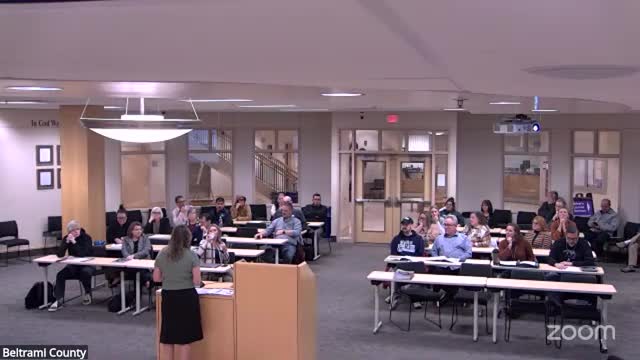
Summary
Beltrami County Public Health updated the community on how opioid-settlement money is being allocated locally: about $2.8 million expected over 18 years (roughly $140,000 annually), eight RFP-backed contracts, a rapid-response small-grant stream called Funding Hope, and a public website and newsletter that publish details and applications.
Beltrami County Public Health leaders told a community session in Bemidji that the county has structured opioid-settlement dollars into an annual spending rhythm and a mix of competitive and rapid-response grants to support local prevention, treatment and harm-reduction work.
"It's a lawsuit settlement, so we're not guaranteed these dollars," said Amy Bowles, public health director for Beltrami County and chief strategist for the opioid steering committee. "But if everybody pays into the settlement ... then we are supposed to get about $2,800,000 over the course of 18 years. That's $140,000 approximately ... every year."
The steering committee has issued eight requests for proposals (RFPs) to fund local providers and maintains a public web page with agendas, documents and spending summaries. Bowles described a second funding track, called Funding Hope, that allows the county to disburse small, noncompetitive awards quickly when an organization demonstrates it meets the state memorandum-of-understanding (MOU) rules. "If Reid comes to me ... and he says, 'I really could use 10 pair of boots, 5 jackets, and 100 hats' ... you meet the rules of the MOU that the state set forth for us. Make that purchase. Send me the receipt, and I'll cut him a check for that money," Bowles said.
State officials who attended the session said they are watching county expenditures because a share of the national settlement goes to the state. "Twenty-five percent of those funds go to the state, 75% go to counties and local government," said Jeremy Drucker, director of the Office of Addiction and Recovery for the State of Minnesota, adding that local control helps tailor responses to community needs.
County staff said the committee also budgets a portion of funds for administration and outreach (advertising, application management) and that details on awardees and expenditures are published on the county website and in the quarterly county newsletter. Bowles said the steering committee has also reviewed applications to refill member seats and that the group intentionally seeks diverse membership representing lived experience, service providers and other community perspectives.
The county emphasized transparency and local decision-making while noting limits: settlement dollars depend on ongoing payments from the national settlement and are not guaranteed in perpetuity. The steering committee reported state recognition for its timely expenditure of settlement dollars and encouraged residents to sign up for the county newsletter or visit the public-health webpage for full documents and award details.
Bowles and other staff asked residents to raise website usability issues with county staff so materials can be easier to find and said recipients' expenditure details and most recent updates will appear both online and in county communications.