
Madison Point Phase 1 proposed for Highway 111: Starbucks drive‑through, car wash and EV charging hub included
Get AI-powered insights, summaries, and transcripts
Sign Up Free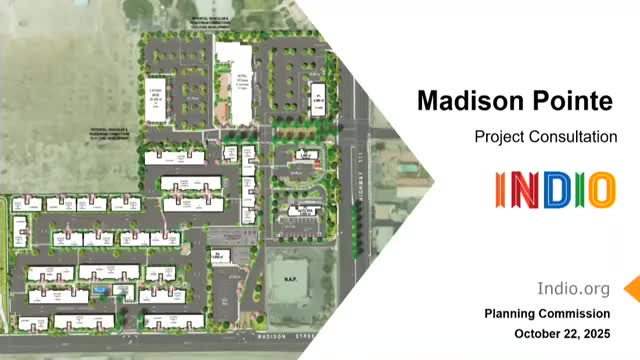
Summary
The Indio Planning Commission on Oct. 22 received a study‑session presentation on the Madison Point Phase 1 mixed‑use project, a 20.27‑acre proposal by Schmidt Desert Investments at the southwest corner of Highway 111 and Madison Street.
The Indio Planning Commission on Oct. 22 received a study‑session presentation on the Madison Point Phase 1 mixed‑use project, a 20.27‑acre proposal by Schmidt Desert Investments located at the southwest corner of Highway 111 and Madison Street in Indio. Staff said the Phase 1 proposal includes four retail pads — a 2,400‑square‑foot Starbucks with a drive‑through, a 3,600‑square‑foot Quick Quack car wash, a 5,500‑square‑foot multi‑tenant retail building and an L3 Energy EV fast‑charging station paired with a 3,000‑square‑foot marketplace — and a tentative tract map to subdivide the site into eight lots.
The presentation, delivered by Gustavo Gomez, Principal Planner with the Community Development Department, placed the project within the Highway 111 Corridor Specific Plan and described Phase 1 as a near‑term, automobile‑oriented set of uses allowed to proceed through a conditional use permit mechanism in subarea 8 of the Specific Plan. Gomez said the commission’s review at this meeting is a consultation and that the planning commission will forward a recommendation to the City Council for any limited land uses that require council approval.
Why it matters: The project is presented as the first major development to come forward under the Highway 111 Specific Plan’s goal of transforming the corridor from a highway commercial strip into a pedestrian‑oriented, mixed‑use gateway. The applicant is also proposing an energy‑focused component — an L3 Energy “Rove” fast‑charging hub with a marketplace and on‑site batteries/microgrid components — that the applicant said could reduce reliance on the utility grid and aggregate charging demand in one location.
Project scope and phasing: Jim Fitzpatrick, the applicant’s representative, said Phase 1 is focused on the commercial pads and site layout while Phase 2 (not part of tonight’s application) is expected to include a hotel, medical office, apartments and a 1.6‑acre retention basin with solar. Gomez and the applicant noted that a previously approved master plan envisioned a 130‑key hotel, 400 senior apartments and 30,000 square feet of medical office; the current proposal describes Phase 1 as roughly 14,500 square feet of commercial and indicates the applicant intends to change the previously‑envisioned senior housing to approximately 300 market‑rate apartments in a later phase.
Approvals and limits: Staff emphasized that the Highway 111 Specific Plan allows a maximum of two “limited land uses” in subarea 8 and that the applicant is proposing to use both of those allowances for a drive‑through restaurant and for a drive‑through car wash. Because those are designated limited uses under the Specific Plan, the planning commission’s role for those pads is advisory; the final approval for limited uses will be made by the City Council.
Energy and EV charging component: Fitzpatrick described discussions with L3 Energy and said the proposed EV hub would use multiple charging cabinets, on‑site batteries and a marketplace designed for the charging customer. He said the applicant is exploring a site‑specific energy plan or microgrid to store and dispatch energy, and noted the proposal must still receive approvals from multiple authorities having jurisdiction, including the fire department, public works, the South Coast Air Quality Management District and Imperial Irrigation District (IID) if the project is to interconnect to or sell energy back to the grid. Fitzpatrick said the applicant is pursuing battery encapsulation and large‑scale safety testing with technical consultants; he noted that any equipment would need appropriate UL listings and local agency sign‑offs before installation.
Commission questions and issues raised: Commissioners asked about parking ratios (staff said the project would be required to meet standard code parking requirements unless a deviation is requested), whether the apartment portion would be rental or for‑sale (the applicant said Mesa intends to be a long‑term owner and operate the apartments as rentals), gated access, and amenities for future residents. Commissioners stressed the importance of a consistent architectural approach between Phase 1 and Phase 2, and asked the applicant to clarify how vehicle queuing at gates and drive‑throughs would be managed to avoid conflicts with Highway 111.
Political and policy context: Commissioners and the applicant noted a history of City Council opposition to certain auto‑oriented uses on Highway 111; staff and the applicant cautioned that the Quick Quack car wash and a drive‑through restaurant could be subject to close scrutiny by council because similar proposals had been denied previously. Fitzpatrick said the commercial pads are a small percentage of the overall land area but serve as anchor tenants that make larger projects financeable.
Next steps: No formal action was taken. Staff and the applicant said the project will return with formal applications (planning review, conditional use permit for limited uses and a tentative tract map) after departmental review and permit completeness. The applicant said it hopes to return in early 2026 for formal hearings; the planning commission will forward recommendations to the City Council on any limited land uses.
Ending: The commission’s feedback centered on ensuring the project meets Highway 111 design goals, clarifying public‑safety and fire mitigation for EV charging and batteries, and explaining parking and amenity plans for the apartment phase; the project remains at the consultation stage and requires further technical reviews and council action for limited land uses.