
Council debates traffic calming and enforcement options, including speed cameras and lower speed limits
Get AI-powered insights, summaries, and transcripts
Subscribe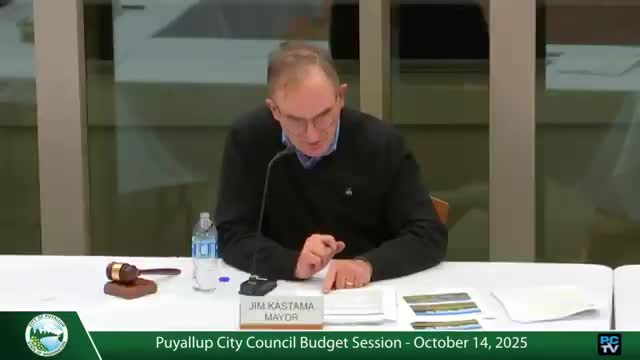
Summary
Councilmembers raised safety concerns about vehicle speeds during commuter peaks and discussed tools from lower posted limits and lane narrowing to speed cameras; staff said neighborhood traffic calming has about $300,000 in fund balance and that state law requires a vendor study before automated speed enforcement can be added.
Several councilmembers used the Oct. 8 budget study session to press for more aggressive traffic calming and enforcement in Puyallup. Members described high vehicle speeds on residential connectors during morning and afternoon commutes and sought options beyond capital measures, including targeted speed reductions, lane narrowing, more frequent traffic calming installations and automated enforcement.
Staff briefed the council on current resources and constraints. Public Works reported a neighborhood traffic‑calming fund balance of roughly $300,000. The police chief and city manager discussed automated enforcement options; the chief noted the city currently operates signal enforcement equipment and that revenues from red‑light enforcement are substantial. City staff noted that state law requires a vendor study before installing automated speed enforcement cameras and that procurement should follow statutory processes.
Why it matters: Councilmembers argued that some corridors and school‑zone approaches create acute safety risks for pedestrians and children and urged staff to assemble an action plan. Councilmember Johnson suggested dedicating fines from automated enforcement to a traffic‑calming fund so the enforcement program could be at least partly self‑funding for additional roundabouts, speed tables or signage.
Next steps: Councilmembers asked staff to prepare a study session focused on traffic and pedestrian safety that includes examples from peer cities (for example, Tacoma’s recent speed‑limit adjustments), estimated costs for different mitigation measures, and a vendor‑study estimate for automated enforcement if council wishes to pursue it. No formal policy changes were approved at the study session.
Ending: Staff will return with a traffic safety study session and options for funding and implementation of traffic calming and automated enforcement.