Get Full Government Meeting Transcripts, Videos, & Alerts Forever!
Get email alerts on the Assessment Mcas Access topic
No spam. Unsubscribe anytime.
Salem Public Schools reports drop in chronic absenteeism, mixed MCAS results; district sets writing and early-literacy priorities
Summary
District leaders told the School Committee that chronic absenteeism declined from about 34% to 19.2% over five years, grade 10 MCAS growth rates were strong though proficiency varied by subject and subgroup, and the district will prioritize writing and early literacy work.
Salem School Committee members heard a two-part presentation on district assessment results on Oct. 20, 2025, in which leaders reported a sizeable decline in chronic absenteeism and mixed results on statewide tests that shaped near-term instructional priorities.
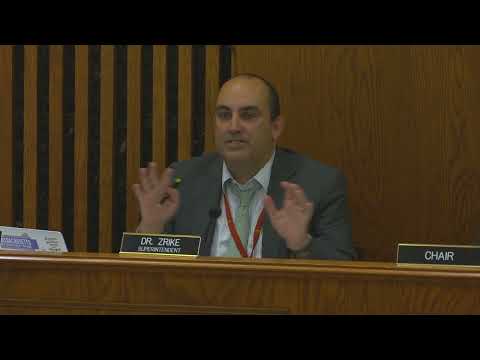
Superintendent (identified in the meeting as Dr. Drake) told the committee the district's chronic absenteeism rate fell from about 34% in the year after the pandemic to 19.2% in the most recent year, a decrease of roughly 15 percentage points. District leaders said the absenteeism metric is defined as students missing 10% or more of enrolled school days (about 18 days in a traditional year) and linked attendance gains to efforts to increase student engagement.
Sonia Lowe, Executive Director of Academics, presented grade-10 MCAS (ELA, math, science) results and growth metrics. She said Salem's grade-10 students outperformed most other "gateway" cities in English language arts and math, noting the district outperformed 23 of 25 comparators in ELA and all but one (Quincy) in math and science. Lowe also provided writing-data detail: about 22% of grade-10 students scored 0 to 1 on the MCAS idea-development rubric while nearly a quarter received top points for that essay metric. She emphasized that strong student growth percentiles (SGPs) accompany the proficiency profile, and that growth does not always translate immediately into movement across proficiency categories.
Andre Fonseca, Director of Multilingual Learning, summarized ACCESS-for-ELLs (English-language proficiency) results and district-level ACCESS performance. Fonseca reported Salem outperformed the state on ACCESS by about four percentage points overall and placed in the top five among gateway districts; he highlighted Horace Mann School and Collins as schools showing notable gains for multilingual learners. Fonseca said the district is evaluating adoption of a new ELD curriculum (LIFT, part of the National Geographic suite) for grades 9—2 to strengthen instruction.
Committee members pressed for disaggregated views. Member Mary Campbell asked for breakdowns that distinguish current English learners from former English learners (students who have exited EL status), and committee leaders said staff will return with slides showing outcomes for former English learners and other subgroup detail.
District leaders described how assessment data drives instructional priorities for 2025—26. They named three main strands: (1) data-informed instruction and real-time monitoring of student work; (2) a systemwide emphasis on writing across grades and content areas, including school-specific writing plans with coaching and feedback cycles; and (3) early-literacy supports aligned to the state Partnership for Reading Success in Massachusetts (PRISM), including a state grant-supported high-dosage tutoring pilot and training modules developed with the New Teacher Project (TNTP).
The superintendent also reminded the committee that the district will host a series of community meetings about elementary reconfiguration and will record and post presentations for families who cannot attend in person.
Why it matters: Attendance and English-language supports are among the district's highest levers for improving MCAS outcomes; the committee directed staff to return with more disaggregated subgroup data so members can evaluate whether gains in growth are translating into higher proficiency across groups.
Looking ahead, staff said they will present the requested subgroup and former-EL performance slides at a future meeting and continue work on the district's writing and early-literacy initiatives.