Get Full Government Meeting Transcripts, Videos, & Alerts Forever!
Get email alerts on the City Salaries Payroll topic
No spam. Unsubscribe anytime.
Lawrence council debates 3% raise versus one‑time bonus as officials review 2026 salary ordinance
Summary
At its Oct. 23 Committee of the Whole meeting, the Lawrence Common Council discussed Proposal 10 (2026 salary ordinance) and whether to fund a 3% pay increase for civilian employees or a one‑time 2025 bonus, weighing pension (PERF) effects and reserve impacts amid limits from Senate Enrolled Act 1.
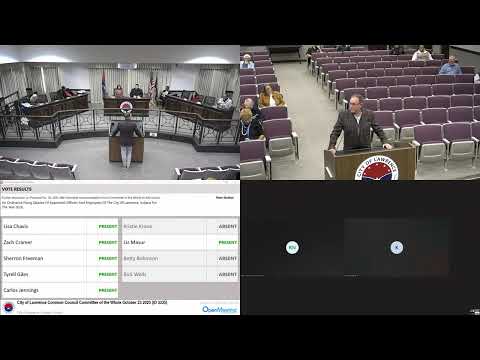
The Lawrence Common Council’s Committee of the Whole on Oct. 23 discussed Proposal No. 10, an ordinance fixing salaries of appointed officers and employees of the city for 2026, focusing on whether to approve a 3% pay increase for civilian employees or instead give a one‑time bonus in 2025.
Councilor Chavis asked members to “double check that with a fine tooth comb,” noting employees and councilors had questions about the dollar impact of a 3% increase. The controller told the council a spreadsheet showing a 3% increase for civilian employees was sent shortly before the meeting and that the total was “in the ballpark of a 142,000 and some change.”
Tim Berry, municipal adviser for Crow, told the council that Public Employees’ Retirement Fund (PERF) contributions for civil employees are calculated on all earnings for a pay period, and that a base pay increase builds future costs into the salary base while a bonus does not. “A pay raise is base building; a bonus would be a one‑time thing in 2025,” Berry said.
The controller said a 3% increase had been budgeted in the 2025 budget but was not paid to employees. The controller also described differences between raises and bonuses in tax and pension treatment, saying the bonus “would not affect PERF but would affect taxes.” Councilors pressed for clarification, and council members asked staff to confirm whether the budgeted funds for 2025 remain available.
Council discussion emphasized sustainability across budget years. Several council members noted that while a bonus could use funds already budgeted in 2025, an ongoing raise would affect 2026 and later budgets, especially given revenue constraints created by Senate Enrolled Act 1. One councilor said the city must consider maintainable spending for 2027 and 2028, when local tax options and state limits may alter revenue.
Members also asked staff to identify vacant positions that remain budgeted for 2026. Councilors said vacant positions can represent substantial unspent appropriations and suggested reducing or reassigning those amounts to free funds for salary actions; one councilor noted a single department’s vacant positions total roughly $700,000. The council set goals of finding roughly $1.5 million to balance the budget and $140,000–$150,000 to cover a 3% increase if possible.
No formal vote on Proposal No. 10 was recorded during the meeting; councilors asked for follow‑up information, including confirmation of the 2025 funds disposition, whether part‑time positions are included in the calculation, and a breakdown of which vacant positions remain budgeted. Councilors asked that the Crow contract and invoices from outside consultants be provided to the council for budget visibility.
Why it matters: The choice between a one‑time bonus and a base pay increase affects employees’ take‑home pay, pension contributions and the city’s recurring personnel costs. Councilors framed the issue as weighing short‑term relief for employees against long‑term budget sustainability.
What’s next: Councilors directed staff to confirm the 2025 budget line‑item status, clarify whether part‑time positions are included in the raise calculation, and provide contract documentation for outside financial consultants. They planned follow‑up meetings the week before Nov. 3 to finalize budget strategies.