Get Full Government Meeting Transcripts, Videos, & Alerts Forever!
Get email alerts on the Traffic Calming Bowling Ave topic
No spam. Unsubscribe anytime.
NDOT proposes single speed cushion, radar signs and flashing school zone on Bowling Avenue; neighbors divided ahead of mailed ballot
Summary
The Nashville Department of Transportation on Tuesday presented a revised traffic-calming plan for Bowling Avenue that would add a radar-feedback speed sign and a flashing school-zone sign near West End Middle School and install a single set of speed cushions between Central Avenue and Murphy Road.
The Nashville Department of Transportation on Tuesday presented a revised traffic-calming plan for Bowling Avenue that would add a radar-feedback speed sign and a flashing school-zone sign near West End Middle School and install a single set of speed cushions on the stretch between Central Avenue and Murphy Road.
NDOT consultant Jeff Hammond said the revised plan responds to feedback from an earlier neighborhood meeting and aims to slow motorists in the corridor while avoiding some placements that would interfere with driveways or existing intersections. "We will put that section 32 feet south of the driveway at 118," Hammond said, describing the planned location for the speed cushion.
The plan matters to residents because Bowling Avenue runs from the West End signal north to Murphy Road and passes a school zone; neighbors said speeding and drivers ignoring stop signs have created safety concerns for children and people walking in the area. Hammond said NDOT uses a data-driven prioritization process and reported an 80th-percentile speed of about 32 mph on the street and roughly 4,000 vehicles per day — below the department's 5,000-vehicles-per-day threshold for installing speed cushions.
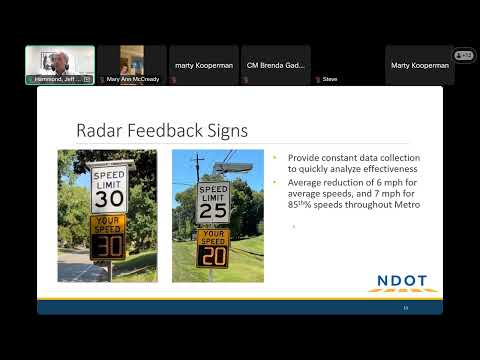
Hammond described the department's tools and why the team proposed the mix of devices. "What we are proposing to do is to make that a flashing sign," Hammond said of the existing static school speed-limit plate at West End; the flashing sign would include a continuous radar-feedback display so motorists see their speed whether the school flashers are active or not. He said NDOT would also repaint and widen worn crosswalk markings to a standard 4-to-6-foot width at the key intersections.
Residents were sharply divided. Mary Hansen, who identified herself as a neighbor at the Richland and Bowling corner, said enforcement was needed for drivers who "just blow in through" stop signs and that engineering fixes alone may not solve the problem. Nancy Willis, who said she lives at 107 Bowling, described a near-miss involving a toddler: "I had a toddler run into the street and almost get hit by a car," Willis said.
Other neighbors warned about adverse consequences of speed cushions. Brady, who gave his address as 109 Bowling, said he feared vehicle damage and slower emergency response times; he told the meeting he had discussed the issue with a firefighter friend who objected to cushions. "He said, we hate it. It slows our response time. It damages our equipment," Brady said. Hammond replied that cushions are designed from high-density recycled rubber and that, "if you're going the right speed, it does not damage your car," while acknowledging NDOT receives occasional complaints and has no comprehensive evidence of systematic vehicle damage.
Several speakers pressed NDOT on alternatives and data collection. One neighbor asked how long speed and volume counts were gathered; Hammond said counts are taken over roughly a 24-hour period and that NDOT typically collects data while school is in session. Neighbors also pushed for lower-cost or less intrusive measures such as rumble strips, pavement markings or additional signage; Hammond said the department favors traffic-calming tools that have consistent, proven effects but described a Plan B if a mailed ballot fails: "We may go back to something lesser. We may do paint on the street. I would expect the radar sign would still be part of that."
NDOT said it will move the proposed plan to an online and mail ballot of property owners who abut Bowling Avenue. Hammond said the ballot card will be mailed to each eligible property owner and churches that abut the project receive one card; ballots remain open for six weeks and require a two-thirds majority in favor to advance the project to construction. "If we vote it down this plan, we don't just say, sorry, we're not doing anything and walk away from it," Hammond said, describing the fallback option.
Hammond also said NDOT enforces a 15-foot minimum distance from driveways for speed-cushion placement and that the spacing goal for cushions in the department's guidance is generally 400 to 600 feet between deployed sets. He said the Bowling project as proposed would leave roughly a little over 500 feet of spacing between cushions where installed.
Other next steps discussed at the meeting included NDOT posting materials on its Engage Nashville page, mailing the ballot cards with a QR code and phone option for voting, and repainting crosswalks before heavy pedestrian events (staff said they would seek to repaint prior to Halloween). NDOT staff and Council offices also noted that changes to posted speed limits and truck restrictions are handled through the Traffic and Parking Commission and related enforcement channels.
The meeting was the second neighborhood outreach session on the Bowling Avenue traffic-calming application; Hammond said the department has more than 600 applications in its queue and uses volume and speed data to prioritize projects. Residents who want additional detail were directed to NDOT's trafficcalming@nashville.gov address and the project's Engage Nashville page.
Ballot materials, the final plan and installation schedule will depend on the mailed ballot outcome and any permitting or coordination required with enforcement partners and the Traffic and Parking Commission.