Get Full Government Meeting Transcripts, Videos, & Alerts Forever!
Get email alerts on the Traffic Calming topic
No spam. Unsubscribe anytime.
NDOT proposes speed cushions for Rawlings Road after residents report speeding and cut-through traffic
Summary
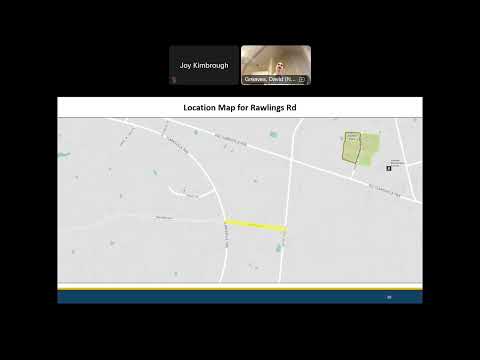
David Greaves, a civil engineer with the Nashville Department of Transportation (NDOT), told residents at a neighborhood meeting that NDOT plans a speed‑cushion design for Rawlings Road to reduce vehicle speeds and improve safety.
David Greaves, a civil engineer with the Nashville Department of Transportation (NDOT), told residents at a neighborhood meeting that NDOT plans a speed-cushion design for Rawlings Road to reduce vehicle speeds and improve safety.
NDOT selected Rawlings Road as one of 25 streets from more than 600 applications and presented data showing the street’s 80th-percentile speed was 38 miles per hour and that 616 vehicles were recorded during a 24‑hour count. “This is a program that focuses on residential streets,” Greaves said, explaining the agency’s emphasis on engineering solutions that produce permanent, physical speed reduction.
The program’s goal is to reduce speeds over significant street lengths rather than single‑intersection treatments. Greaves said the traffic‑calming toolbox emphasizes engineering measures that work at all times, rather than relying solely on education or enforcement. He cited NDOT’s earlier evaluation of six traffic‑calming projects that showed average speeds dropping from 31 mph to 22 mph and 80th‑percentile speeds falling from 37 mph to 25 mph after installation.
Residents told NDOT staff the street functions as a morning cut‑through to avoid higher‑speed arterials, that drivers sometimes behave recklessly, and that mailboxes have been struck repeatedly. “I think the biggest thing that I’ve noticed is it’s a cut through in the mornings,” said a resident during the meeting. Speakers also reported semitrailers and delivery trucks using the street and concerns about the narrow pavement (19–20 feet) limiting some traffic‑calming options.
NDOT’s draft concept calls for speed cushions spaced roughly 300–500 feet apart. On a street the length of Rawlings Road, staff said they would likely place three or four cushions; Greaves said either three (with wider spacing) or four (tighter spacing) would be appropriate. He explained cushions differ from speed tables and are designed with 6‑foot gaps so emergency vehicles can traverse them with less disruption.
Because Rawlings Road is relatively narrow and is used by emergency vehicles, NDOT said it would avoid continuous speed tables and would place cushions deliberately to reduce drivers’ ability to go around them. Staff also described other toolbox options (radar feedback signs, painted edge lines to narrow perceived lane width, bulb-outs and small traffic circles) and said some of those are not suitable for Rawlings given its width.
Next steps described to residents include a field visit to measure roadway geometry, development of construction plans, and a ballot mailed to property owners. The ballot process requires a two‑thirds majority of returned votes in favor for the project to advance to construction scheduling; the voting period is expected to be about six weeks. NDOT said ballots are mailed to property owners (one vote per property) and that vacant parcels and typical commercial properties are generally excluded from the mailing list. Greaves said each mailed ballot includes a unique code to prevent duplicate voting and that NDOT can reissue a code if a resident believes they did not receive a mailer.
NDOT provided the project webpage and an online survey (engage.nashville.gov/trafficcalming) and offered an email contact (trafficcalming@nashville.gov) for follow‑up questions. Greaves said, if the ballot is successful, the project would be entered into the construction queue and built several months later.
The presentation and design concept reflect NDOT’s standard traffic‑calming process: application, data collection and prioritization, initial neighborhood meeting (this meeting), field visits, plan drafting, optional second neighborhood meeting or online plan posting, balloting, and, if approved, scheduling for construction.
NDOT staff noted considerations they will carry forward: the 80th‑percentile speed data, peak use patterns indicating cut‑through traffic in the morning and evening, the narrow pavement width that limits some treatments, and the presence of occasional large trucks. Residents raised concerns about potential impacts on emergency response and about equipment or behaviors that could allow drivers to bypass cushions; Greaves said NDOT designs sites with those concerns in mind and has strategies to discourage bypassing.
No formal decision was recorded at the meeting; NDOT staff will complete field measurements and plan development, then proceed to the ballot stage unless further neighborhood feedback requests a second meeting.
For more information, NDOT provided the project tracker and the online survey at engage.nashville.gov/trafficcalming and encouraged residents to contact trafficcalming@nashville.gov.