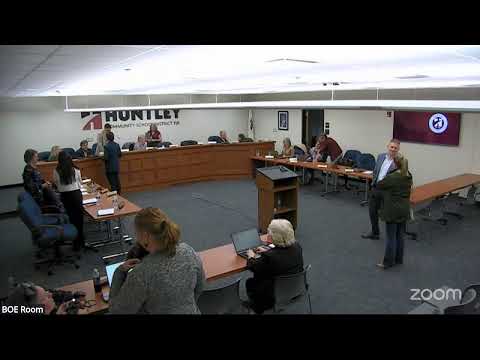
Huntley 158 board presses staff on social-emotional screener pilot, data use and state law
Loading...
Summary
Board members asked staff detailed questions about the district's two-year pilot of the social-emotional learning (SEL) screener (Satchel Pulse), how results are stored and shared, how flags trigger follow-up, and whether the tool will meet a forthcoming Illinois mental-health screening mandate.
The Huntley Community School District 158 Board of Education on Oct. 16 questioned district staff about the district's pilot of an SEL screening tool, how results are integrated into PowerSchool, and whether the product will satisfy pending state requirements.
Board members pressed Assistant Superintendent for Learning and Innovation Dr. McBurnell for specifics about the pilot: how long the district has been in the pilot, where results are stored, who can see them, how history is retained and what happens when a student's responses trigger a flag. "We are waiting for our state accountability ratings, which will come live on October 30," McBurnell told the board while answering broader accountability questions; she later explained technical details of the screener.
Why it matters: The district is using the screener as part of its multi-tiered system of supports (MTSS) and is considering whether to continue paying for the vendor at the end of the pilot. Board members said they want clarity on whether the district has alternatives and whether the contract provides value given other systems already in use.
Most important facts - The district has been running the pilot for an internal multi-year period (staff said they believe it is year two). The vendor platform used for the assessment is Satchel Pulse; results are then stored in PowerSchool to make them easier for parents and teachers to view. - Access rules: teachers can see a student's results in PowerSchool only if the student is rostered to them; parents who log in will see a score report for their own child. Teachers can view historical results across years when that student is rostered to them. - Flags and follow-up: the screener produces red/yellow/green indicators. Staff said the assessment is an SEL competency screener (self-regulation, self-awareness, self-management) and does not include suicide or self-harm triage questions. If responses indicate implausible or random answers ("clicked through"), the system flags that behavior for MTSS facilitators and administrators; students who score red or yellow are routed into the district's MTSS processes and families are notified. - Contract and cost: board members referenced an initial procurement cost in the packet and a multi-year pilot; staff said the district will evaluate impact, teacher usefulness and whether the tool provides value before any renewal. A figure of about $150,000 was discussed in questions as the earlier procurement amount for the pilot, which staff said they would review as part of contract evaluation (staff did not present a final contract renewal recommendation at the meeting). - State law and timing: staff said the district is monitoring an Illinois mental-health screening law. The district expects a list or guidance from the state; staff said implementation and funding timing remain unclear and that the law's effective provisions are currently expected in 2026 but may change.
Discussion highlights and staff responses Board members repeatedly asked whether the district could replicate the screener with internal tools or AI, given that results are stored in PowerSchool. Dr. McBurnell explained that the assessment itself remains housed in the vendor's platform (Satchel Pulse) and that PowerSchool stores the score reports to simplify parent access. She said the vendor also provides norms and benchmarking (national norms) that the district currently relies on.
On eligibility and data protections, staff explained that PowerSchool presents results only to users who already have access to a student's record; the district does not make results broadly available to staff who do not have a legitimate educational interest. Staff confirmed teachers can see historical results for rostered students so patterns can be observed over time.
On escalation, staff clarified that the SEL screener does not contain immediate crisis items (for example, direct questions about self-harm). Instead, it measures SEL competencies; students scoring in the red or yellow ranges are handled through the MTSS process, which includes family notification and offers for intervention.
Next steps and evaluation Staff said the district will evaluate the pilot before any renewal and will include feedback from MTSS facilitators, classroom teachers, students and families. Staff also said the district will wait for state guidance on any required assessment tools before finalizing long-term procurement decisions.