Elkhart superintendent warns of long-term funding shortfall, seeks feasibility study on school consolidation
Loading...
Summary
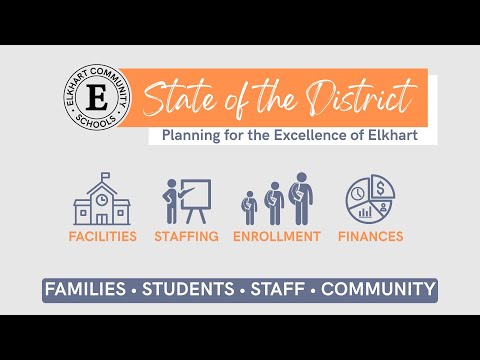
Dr. Larry Huff, superintendent of Elkhart Community Schools, told a standing-room audience at a State of the District event that the district faces a structural funding shortfall driven by declining enrollment, changes in state funding tied to SEA 1, and rising operating costs.
Dr. Larry Huff, superintendent of Elkhart Community Schools, told a standing-room audience at a State of the District event that the district faces a structural funding shortfall driven by declining enrollment, changes in state funding tied to SEA 1, and rising operating costs.
"If we did nothing over the next few years, we would be in a negative cash balance by next year," Huff said, spelling out why he has asked the school board to authorize a consolidation feasibility study. He told residents the administration will seek community input before making formal recommendations.
The superintendent said the district counted 10,100 students on its October 1 enrollment (ADM) and operates 23 school buildings across roughly 80 square miles. Huff said the district manages about $1.1 billion in assets and more than 3 million square feet of facility space, and that routine upkeep requires roughly $20 million annually. He said elementary classroom occupancy averages 58 percent districtwide, with 371 elementary rooms and only 214 used for traditional whole-class instruction.
Huff put the enrollment trend in a longer context: Elkhart peaked at about 13,952 students in 2016 and has dropped to about 10,100, a decline he said amounts to roughly 3,500 students since 2016. He attributed part of the recent declines to growing school choice options — universal vouchers, charter and micro-school options and homeschooling — and said the district lost roughly 496 students year over year. "That’s a difference between, on the low end, $3,400,000 and on the high end over $5,000,000," Huff said, referring to funding tied to student counts and complexity dollars for special needs.
Huff also described a change in the state funding trajectory tied to SEA 1. Using a chart he showed the audience, he said the district's traditional operating-fund revenue path (a steady 4 percent increase) has been replaced by a projected down‑sloping line and that, beginning in 2028, the district will share operating funds with entities that enroll 100 or more resident students. He warned the combination of that change and inflation will reduce available operating revenue for Elkhart schools for years.
On outcomes and programs, Huff emphasized points of strength: the district ranked No. 1 in statewide growth on iREAD/iLEARN growth metrics for districts its size, reported a 94.5 percent graduation rate last year with an anticipated 95.5 percent this year, and said students earned more than 10,000 college credits through dual-credit programs, saving families an estimated $2 million. He also highlighted the Career Center, which Huff described as the top program in the state and noted it serves students from 16 partner schools.
Huff laid out a compressed timeline for the consolidation work. He said he asked the board on the previous Tuesday to authorize a feasibility study; his team plans to present proposed criteria to the board by the first board meeting in November, identify schools that could be considered for pairing at the board's second November meeting, gather community feedback, and deliver a final recommendation to the board at the first April board meeting. "Every kid in this district is worthy of an outstanding education," Huff said. "I do not take this responsibility lightly."
The superintendent listed operational steps the administration is taking immediately: tightening contract review and scrutinizing budgets, building a public-facing financial page and a transparency dashboard, and holding monthly community meetings and direct weekly communications on the consolidation process. He urged community participation via feedback forms and public meetings and said administration will include staff and community leaders throughout the process.
Wendy Wood, director of communication for Elkhart Community Schools, opened and closed the event and directed attendees to the district website and forms for submitting questions and feedback. At the close she said the district will post answers and materials online and share updates at upcoming board meetings.
No formal board vote or approval was recorded during the presentation; Huff said he had requested board authorization earlier in the week and that the board will consider policy criteria and eventual recommendations in November and April. Additional technical details Huff provided — staff counts, classroom occupancy, and budget overages in recent years — will form the factual basis for the feasibility work the superintendent proposed.
Next steps and community response: Huff asked residents to complete feedback forms and attend forthcoming community sessions. He said the district will present the feasibility-study criteria publicly and seek broad engagement before the board votes on any consolidation recommendation.