Get Full Government Meeting Transcripts, Videos, & Alerts Forever!
Get email alerts on the Historic Preservation topic
No spam. Unsubscribe anytime.
Planning Commission recommends updates to historic preservation ordinance, context statement
Summary
The Planning Commission voted unanimously to recommend that City Council adopt updates to the historic preservation ordinance and the historic context statement, a two‑phase project that will reclassify inventory categories and start a comprehensive inventory update in early 2026.
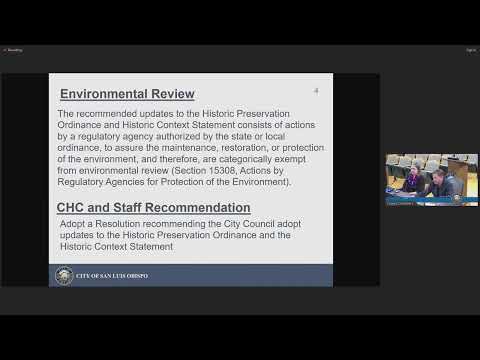
The San Luis Obispo Planning Commission voted unanimously to recommend that the City Council adopt updates to the city’s historic preservation ordinance and the historic context statement, Principal Planner Brian Lavelle told the commission during a staff presentation.
The recommendation matters because the changes reorganize how the city classifies historic resources and set the framework for a Phase 2 comprehensive update of the historic resources inventory planned to begin in early 2026.
Brian Lavelle, principal planner with the Community Development Department, told the commission the work is a two‑phase project. ‘‘I’m also joined this evening by Stacy Kosakovich, our consultant with Page and Turnbull,’’ Lavelle said during the presentation. Phase 1, the ordinance and context statement updates, establishes regulatory guidance and revised categories to align local practice with certified‑local‑government standards. Phase 2, which would begin after Council adoption, will be a property‑by‑property inventory update and potential reclassification of resources.
The staff presentation noted that the city’s existing inventory dates largely from surveys done in the 1980s and 1990s and contains about 760 identified historic resources, including roughly 560 contributing resources, about 200 master‑list properties and five historic districts. The record also shows 65 properties under Mills Act contracts. Lavelle said the inventory ‘‘has never been comprehensively reviewed’’ against the city’s current ordinance and context statement, creating uncertainty about which properties meet today’s adopted criteria.
Consultant Stacy Kosakovich (Page & Turnbull) summarized the ordinance changes the commission reviewed: revised definitions, a simplified four‑criterion designation system (association with events; association with persons/groups; architecture; and information potential), and revised resource categories. The ordinance would rename what the city has called the “master list” to ‘‘landmarks’’ (the highest threshold) and create a new ‘‘local register’’ category for individually significant properties that do not meet landmark thresholds. Kosakovich told commissioners the draft also clarifies the separate concept of district contributors—properties that contribute to a district’s significance but are not necessarily individually significant.
Kosakovich and staff explained that landmarks would require City Council approval and carry the most stringent project review while local register resources could be designated by the director upon CHC recommendation. The Mills Act eligibility policy was discussed: staff said the city’s current program requires the highest‑tier designation (currently master list, proposed to be landmarks) for Mills Act contract eligibility and that changing Mills Act eligibility was beyond the scope of the ordinance update. The commission discussed whether the council might consider Mills Act eligibility for additional categories in the future.
Commissioners asked about the role of the Cultural Heritage Committee (CHC), integrity standards, and outreach. Staff said the ordinance changes do not alter substantive CHC duties and that the revisions were primarily cleanup, alignment with best practices, and improved clarity about designation pathways. Lavelle said the CHC recommended the draft to the Planning Commission on Sept. 29 and that the City Council will consider adoption on Dec. 2.
After the staff presentation and a period of commissioner questions, a motion to approve staff’s recommendation was made and seconded; the Planning Commission called the roll and voted yes: Commissioner Cooley, Commissioner Khan, Commissioner Flores and Chair David Houghton. The commission’s action was a recommendation to City Council; any final adoption will be decided by the City Council at a later meeting (staff noted Dec. 2 as the Council hearing date).
The ordinance and context statement update will, if adopted by Council, set the policy and procedural framework for the Phase 2 inventory work, which staff and the consultant anticipate beginning in early 2026 and prioritize toward re‑evaluating existing inventory entries and surveying new candidate properties.