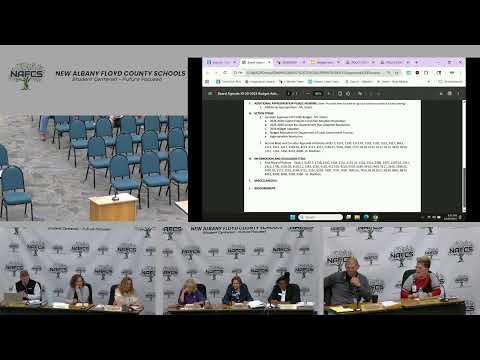
New Albany-Floyd County board adopts 2026 budget, approves $3 million appropriation and policy updates
Loading...
Summary
The New Albany-Floyd County Consolidated School Corporation board approved the 2026 budget package, a $3 million additional appropriation to the Education Fund, and a set of policy revisions, and adopted capital and bus replacement plans during its regular meeting.
The New Albany-Floyd County Consolidated School Corporation board adopted its 2026 budget package and related resolutions and approved a $3,000,000 additional appropriation to the Education Fund at its regular meeting. The board also approved revisions to multiple policies and adopted a capital projects plan and a multi-year bus replacement plan.
The fiscal actions give district staff authority to finalize levy targets with the state’s Department of Local Government Finance and to make within-fund appropriation transfers during the year. “So this meeting, regular meeting is closed, district appropriation open. Looking at $3,000,000 additional appropriation to the education fund,” said Mr. Street during the public hearing portion on the appropriation.
Why it matters: the actions finalize spending and levy-setting steps that affect the district’s debt service levy, operations levy and the rate taxpayers see on property tax statements. Board discussion noted the district advertised a higher debt service levy earlier in the process and then refined it after bond sale and state calculations; the presentation said the district’s debt service levy will be about $23,000,000 after adjustments and the projected adopted property-tax rate for the corporation is likely to fall slightly from recent years (the presentation estimated a likely rate around $1.03–$1.04 per $100 of assessed value compared with roughly $1.05 in prior years).
Board financial staff described capital spending as modest compared with prior years, identifying roughly $4–5 million in project work (general repairs, equipment and smaller capital items) and noting most capital work will be financed through bonds and leases. The bus replacement plan is on a regular 12‑year cycle and will replace several buses at a cost described in the presentation as “less than a couple of million dollars,” with some additional smaller activity buses for middle schools.
The board placed the measures on the record with roll-call votes. Trustees also approved a slate of policy updates recommended through the district’s policy vendor and legal review; the second reading covered a long list of policy codes and technical corrections.
Votes at a glance
- Consent agenda (all items except staffing report): motion to approve passed 7–0 on a roll call (Weishardt, Carruthers, Ball, Galligan, Nafis, Northup, Gardner — all recorded as aye).
- Staffing report (separate vote): motion to approve passed with six ayes and one abstention (Weishardt abstained).
- Additional appropriation — $3,000,000 to the Education Fund to reimburse the fund for summer device purchases and related cash-flow timing: passed 7–0.
- 2026 budget adoption package: included adoption of the Capital Projects Fund plan, the 2026–2030 school bus replacement plan, the budget adoption resolution, the budget resolution to allow staff to work with DLGF on final targeting, and an appropriation resolution allowing staff to move appropriations within funds; the package passed 7–0.
- Second reading and approval of multiple policy revisions (including updates to public meeting procedures, conflict-of-interest, background checks, weapons, assessments, procurement, and federal grants/cash-management policies): passed 7–0.
Board members and staff emphasized the routine nature of the actions: staff said the district advertised conservatively, sold bonds recently, and is refining levy numbers now that certain state posted values and bond results are known. The presentation noted the district’s assessed valuation rose roughly 10 percent, which affects individual taxpayers differently depending on timing and exemptions.
The board directed staff to work with the Department of Local Government Finance to finalize levy targets and carry out appropriation transfers allowed under the adopted resolutions. No further public hearings or immediate additional votes on the budget items were scheduled at the meeting.
Ending: Board members completed the listed business and moved into information and first‑read policy items later in the agenda.