Mesa planning board recommends battery‑storage code with reduced separation, asks staff to review accessory threshold
Loading...
Summary
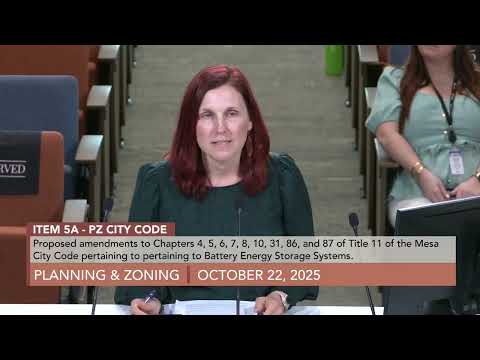
After an extensive public hearing the board voted to forward an ordinance regulating battery energy storage systems (BESS) to City Council, asking staff to change the residential separation from 1,000 feet to 400 feet and to review raising the cumulative accessory threshold from 1 megawatt to 5 megawatts.
The Mesa Planning and Zoning Board on Oct. 22 voted to recommend that City Council adopt a text amendment to Title 11 establishing definitions, zoning table entries and development standards for battery energy storage systems (BESS). The board approved staff’s overall recommendation but directed two specific changes: reduce the residential separation requirement from 1,000 feet to 400 feet, and ask staff to re‑examine the accessory‑use threshold by evaluating whether a 5‑megawatt cumulative cap (rather than the 1‑megawatt threshold in the draft) would be more appropriate.
The ordinance package would add BESS definitions (including “battery energy storage system,” “nameplate capacity” and “augmentation”), create a new use classification for utility‑scale facilities, and set development, screening, and noise standards citywide. Staff told the board that two pre‑submittal projects and other SRP‑driven needs informed the draft language. The board’s motion forwarded the ordinance to City Council with the two amendments and a staff review request; board members then voted to approve that recommendation.
Public commenters included technology and energy industry representatives, municipal and utility officials, emergency‑services personnel and local residents. Several industry speakers urged narrower separation standards and lower size thresholds so that commercial and industrial developments and smaller grid‑support projects are not treated the same as utility‑scale storage. Victor Atlasman, who identified himself as an EV‑charging engineer, said the proposed 1,000‑kilowatt (1‑megawatt) threshold for treating systems as principal utility uses “would actually put against that and actually restrict a lot of the community and the residents.”
Autumn Johnson of the Arizona Solar Energy Industries Association (ARISEA) suggested removing the 1‑megawatt threshold for accessory uses and said, “1,000 feet is extremely large.” She recommended a 150‑foot separation based on NFPA guidance and other jurisdictions’ standards. Industry and business groups including the Arizona Technology Council and developers representing utility‑scale projects asked for smaller separations and waiver provisions so technically beneficial projects would not be blocked.
Representatives of the Salt River Project (SRP) and a legal representative for energy developers warned that the 1,000‑foot residential separation as drafted would effectively preclude many sites and could endanger two projects that SRP had planned. Linda Brady of SRP told the board that, “If this ordinance passes as written, these projects are gone,” and said the projects represented hundreds of megawatts of planned clean energy capacity and were critical to Mesa’s near‑term grid needs.
Mesa’s fire marshal, Division Chief Sean Alexander, told the board that industry standards have improved and that the city is updating fire and building practices. He said the tactical approach to battery fires has evolved: “Allowing that container to burn actually makes the hazard go away,” and that fire crews now focus on protecting adjacent containers to prevent spread. Alexander said the fire and building departments are moving to adopt NFPA 855 and other modern standards and will require plan review, battery‑management systems and hazard analyses during permitting.
Staff said the draft separation distances were developed after reviewing ordinances from other jurisdictions (which vary widely, from about 100–1,500 feet and higher in some places) and model language such as the American Clean Power Association’s utility‑scale guidance. Staff also said accessory uses below the 1‑megawatt threshold were intended to remain exempt from the full facility standards in the draft; they noted that the 1‑megawatt number is commonly used in model ordinances as the utility‑scale threshold.
Board discussion focused on the balance between public‑safety caution and the practical need to site facilities near electric substations and SRP interconnection points. Several members said they wanted a clearer technical basis for the 1,000‑foot number and expressed concern about creating a de facto moratorium by making the separation too large. One board member asked staff to return with comparative data and analysis for a 400‑foot separation and to evaluate a higher accessory‑use threshold (the maker of the motion suggested 5 megawatts as a starting point for staff review).
The board voted to recommend adoption of the ordinance package to City Council with the changes described above and with a request that staff provide additional analysis on the separation distances and the accessory threshold. City Council will receive the board’s recommendation and the staff report before taking final action.
Meeting context: the BESS text amendment was discussed in a prior study session with council and drew extensive public comment at this hearing. Staff noted two active pre‑submittals in Mesa and said the Fire and Building divisions are updating code standards in parallel to address technical safety and permitting requirements.