
Moline council enacts new rules for private security firms and tightens tobacco ID requirements
Get AI-powered insights, summaries, and transcripts
Subscribe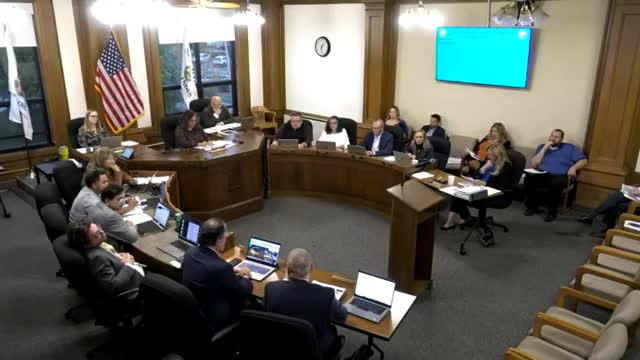
Summary
Council adopted an ordinance creating local regulation and enforcement for private security guards and amended the city’s tobacco ordinance to require ID checks unless the buyer appears at least 40 years old; staff said licensees will be notified before compliance checks begin.
The Moline City Council on Wednesday enacted two ordinances aimed at reducing underage tobacco sales and regulating private security companies operating inside the city.
Tobacco ID requirement Mr. Atkins explained the ordinance change amends Chapter 22 of the Moline Code of Ordinances by replacing and clarifying subsection g of the tobacco provisions. Under the new language, tobacco retailers must request and check identification for all purchasers unless the seller can point to clear indicators that the purchaser appears to be 40 years of age or older.
Atkins said the change closes a gap the city had encountered in enforcement and reduces reliance on the buyer’s assertion that they are 21. He also said the city will not combine this municipal enforcement with a state compliance program funded by state police, because the state program tests compliance with state law while the city ordinance is a separate municipal rule. If the ordinance passes through the required readings, staff said they will send a letter to all tobacco licensees informing them of the change and that the city plans compliance checks.
Private security regulation The council also adopted a new division in Chapter 22 to regulate private security guards. The chief of police described a summer incident in which an armed security guard and a private security contractor operated in noncompliance with state regulations; the guard wore apparel and tactical gear that resembled law-enforcement uniforms, and the company had employed officers from other jurisdictions.
The ordinance sets minimal uniform and identification requirements for private security personnel — for example, prohibiting uniforms that could be confused with police or sheriff attire and requiring contractors to display a plainly visible patch or insignia naming the security firm. The chief said the ordinance will give the city a local enforcement mechanism when businesses hire armed security and that a local complaint the police filed with the state Department of Professional Regulation remains under administrative review.
Why it matters: Council members said the measures give the city tools to limit underage sales and to ensure private security operations conform to public expectations and state rules. Staff emphasized the city will notify license-holders before compliance checks.
Council action Both ordinances were moved, seconded and approved on the council floor; roll-call approval was recorded. No fines or enforcement schedule were detailed on the council floor beyond the staff comment that the city will notify licensees and conduct compliance testing in the near future.
Ending Staff invited councilors to ask further questions and said the chief of police could provide additional enforcement history and details if the council needs them.