
PAC recommends merging Eastwood with Oak Ridge; staff detail bus, capacity and program impacts
Get AI-powered insights, summaries, and transcripts
Subscribe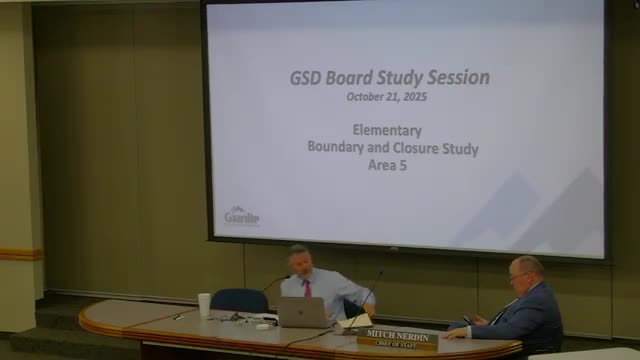
Summary
Steve Hogan, director of planning and boundaries, told the board the Population Analysis Committee recommends closing Eastwood Elementary as a boundaried traditional school and merging its traditional student body into Oak Ridge while continuing to host certain programs at a single campus.
The Granite School District Population Analysis Committee (PAC) presented a recommendation to the board’s study session to close Eastwood Elementary as a boundaried traditional school and merge its traditional student body into Oak Ridge Elementary while continuing to host programmatic offerings.
Steve Hogan, the district’s director of planning and boundaries, summarized PAC’s rationale: merging the two campuses would preserve program culture and cohorts while increasing the number of full‑time equivalent (FTE) positions available at the combined site and improving flexibility for class assignments. Hogan said PAC’s current recommendation is a single‑school merger — rather than parceling students among multiple campuses — so an entire cohort would move together.
Operational findings and program impacts
Hogan said observational traffic checks at both campuses suggested 80–90% of students at Eastwood and Oak Ridge are dropped off by vehicle; that pattern informed PAC’s view that limited walking‑route impacts could be mitigated by providing transportation. Hogan and district staff reported an informal two‑day observational study showing Eastwood had roughly 230 students and that pick‑up/drop‑off patterns at Eastwood create a tighter intersection impact as enrollment grows. Staff said buses can navigate Oak Ridge drive‑throughs more readily and that the Oak Ridge site provides more on‑site circulation for buses and cars.
Hogan reported the Eastwood campus holds a gold STEM designation and that the state STEM Action Center will honor that designation through the current cycle (to 2028). PAC recommended preserving the STEM programming by bringing Eastwood programming and staff into the combined campus.
PAC’s recommendation also addresses district programs: the plan would host two program models — the French dual‑language immersion (DLI) and the alternative learning center (ALC) — on one campus while reassigning boundaried traditional students to neighboring schools (Driggs or Rosecrest depending on the area). Hogan said PAC’s current position is to keep the ALC at Morningside for now and to study the ALC program over a 12–18 month period before any further relocation decisions. The recommendation would prioritize siblings for placement at nearby Driggs Elementary where appropriate.
Budget, staffing and instructional implications
Staff presented projected class‑size and FTE examples showing a combined school could support roughly 19 available FTE (district calculation) and give principals more flexibility than the nine or 10 FTE typically available in the smaller individual schools. PAC staff said combined soft funding (TSSA and land‑trust allocations) for a merged campus could provide roughly $163,000 in flexible funds to support class‑size reduction or targeted interventions. Presenters argued that three to four classes per grade fosters stronger professional learning communities (PLCs), better teacher collaboration, and more options for student‑teacher placement.
Concerns and next steps
Board members and staff discussed walking‑route safety, bus routing and short‑term logistics. Director of transportation (Dr. Gaddy) was cited in the discussion; staff said initial routing changes could be made within current resources and that the current plan produces a net zero change in routes for the district. Hogan emphasized that traffic and safety adjustments would be monitored and coordinated with Mill Creek city officials, Unified Police and school community councils during transition.
PAC also presented alternatives it considered (for example, moving programs into other small schools) and explained why those alternatives did not sufficiently address the problem of few classes per grade level at some sites. The committee recommended a deliberate transition and additional study of the ALC program in 12–18 months.
Board action at the end of the meeting
Later in the meeting the board moved into an executive session by formal motion for the purpose of litigation. Clark Nelson moved the motion and Karen Winder seconded; the motion passed on a roll‑call vote recorded as “yes” from Kim Chandler, Julie Jackson, Clark Nelson, Karen Winder, Chris Winn, Connie Burgess and Nicole McDermott. The vote was procedural and related to litigation; it did not enact the PAC recommendation.
What PAC asked of the board: PAC asked the board to accept the recommendation to merge Eastwood with Oak Ridge, keep programmatic offerings (DLI and ALC) hosted at a single campus in the near term, and direct district staff to study ALC program placement and transportation details over the next 12–18 months and to return with transition plans and more detailed community engagement steps.
The board session concluded with the executive‑session motion; any final action on PAC recommendations remains scheduled for a future regular board meeting.