
Granite board study session reviews curriculum-adoption rules, timeline and supplemental materials guidance
Get AI-powered insights, summaries, and transcripts
Subscribe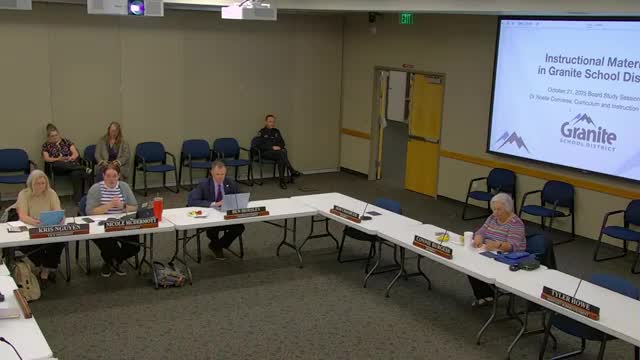
Summary
District staff outlined what Utah law and state board rule require for instructional materials, the district’s formal adoption process, the role of supplemental materials and a multi-year adoption timeline. Board members asked about vetting, parental review and neutrality in classrooms.
Dr. Noelle Converse, director of curriculum and instruction for Granite School District, told the board at a study session that state law and Utah State Board of Education (USBE) rule treat instructional materials as curriculum and set the standards for how districts must select and procure materials.
Converse said instructional materials are “resources to support student learning, including textbooks, digital materials, videos and online applications,” and emphasized they are “there to support the course standards, not to teach to the book.” She described the district’s two-tier approach: districtwide formal adoptions that require a two‑meeting public review process, and supplemental materials teachers may select locally but must still vet for age-appropriateness and compliance with law.
The presentation summarized key legal and administrative anchors: Utah code and USBE rule require local board policy for selection and procurement of instructional materials; Administrative Memorandum 140 lays out the district’s internal adoption procedures; and the RIMS searchable database is the district’s recommended starting point because materials on RIMS must align with Utah course standards. Converse also noted the district increasingly relies on open educational resources (OER) and cited specific examples used in Granite, including Bridges Math Intervention and I‑Ready math (the latter not listed on RIMS).
Why it matters: the board is responsible for policies that ensure adopted and supplemental materials allow students to reach state standards, and the district’s schedule of adoptions affects schools’ workloads and budgets. Converse displayed a five‑year adoption plan that staggers major adoptions so teachers are not required to implement multiple large adoptions in the same school year (examples shown: K–5 science in 2026–27, K–5 math in 2028–29 and 6–12 ELA in 2030–31).
Board members pressed staff on several practical points. Board member Clark Nelson asked why the board had once had to approve materials outside the scheduled adoption cycle; Converse said purchases can trigger formal board approval if they meet a procurement-price threshold. Karen Winder raised concerns she hears from constituents about teachers injecting personal ideology into instruction; Converse said the district instructs teachers and principals annually on neutrality, and the curriculum topics guide outlines expectations and disclosure practices. Kim Chandler asked how parents should proceed if they believe a standard or material itself is not neutral; Converse pointed to the state standards public-comment process and noted AP course content is governed by the College Board but still subject to Utah code and USBE rule.
Converse described the district’s process for materials flagged as sensitive (redacted as “*** ed” in the transcript). Those materials and novels are reviewed under a separate vetting procedure and are repeatedly audited and weeded. She reiterated that even supplemental materials must be vetted for age and developmental appropriateness, and teachers are expected to disclose use of such materials to families.
Converse: “If you create something under public funds, then it belongs to the public,” and that public‑funded resources are one reason OER is attractive both pedagogically and fiscally. She closed by inviting questions and said the curriculum and instruction department is increasing outreach to teachers and families to gather input ahead of future adoptions.
Board members and staff said they will follow up on several items raised during the conversation, including providing clearer documentation about supplemental materials vetting, clarifying how sensitive‑materials reviews are handled, and sharing the district’s curriculum topics guide with the board and public.
The study session then moved on to other agenda items.