Get Full Government Meeting Transcripts, Videos, & Alerts Forever!
Get email alerts on the Board Governance Self Evaluation topic
No spam. Unsubscribe anytime.
OKCPS board conducts quarterly self-evaluation workshop, moves evaluation to next consent agenda and holds executive session on superintendent evaluation
Summary
The Oklahoma City Public Schools board met Oct. 20 for a Council of Great City Schools–led quarterly self-evaluation. The board agreed to place the completed evaluation on the next meeting’s consent agenda, received coach analysis of meeting time use, and voted 7-0 to enter an executive session on the superintendent's evaluation and employment.
Oklahoma City Public Schools board members met Oct. 20 for a training-focused quarterly self-evaluation led by coaches from the Council of Great City Schools and agreed to place the completed self-evaluation on the next meeting’s consent agenda.
The session included a coaches’ review of the board’s governance rubric, a presentation of time-use analysis showing the board spent about 5% of its recent meeting time on monitoring and roughly 47% on training, and a unanimous 7-0 vote to enter executive session to discuss the superintendent’s evaluation and employment. The board returned to open session at 8:40 p.m.; the executive-session compliance statement said no action was taken during the closed session.
The coaches — identified in the meeting as Carol and AJ of the Council of Great City Schools — framed the self-evaluation as a quarterly, continuous-improvement tool designed to shift board focus toward student outcomes and to align board time use with strategic goals. AJ told members, “you spent 5% of your time monitoring,” and said training hours can be excluded from monitoring-time calculations if the trainings qualify under the rubric’s glossary. Coach Carol urged the board to set a near-term target for improving its scores and recommended documenting annual targets for interim goals and guardrails.
Board members and staff discussed several practical follow-ups. Coaches and staff will provide a detailed time-use evaluation package for members; the district’s board clerk will assist members with state-required financial disclosure filings to the Oklahoma Ethics Commission; and the coaching team and district staff will explore tools, including automated or AI-assisted approaches, to track board meeting time usage. Dr. Polk, identified in the meeting as Superintendent Polk, said the work is “the right work for kids,” underscoring the stated goal of aligning governance with student outcomes.
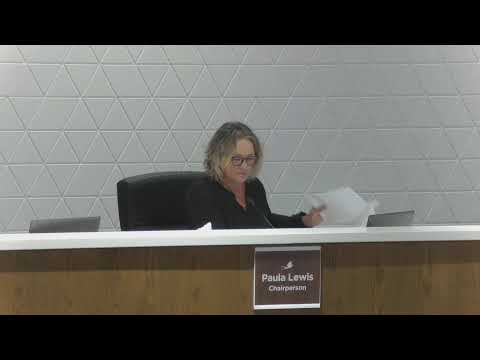
On procedure, Chair Paula Lewis asked whether to place the self-evaluation on a future meeting’s consent agenda or to bring it back as a separate action item. The board agreed verbally to move the evaluation to the consent agenda at the next meeting. Coaches advised that boards typically vote to approve a quarterly self-evaluation at some point for the record; some districts place the completed evaluation on a subsequent consent agenda instead of voting immediately after the exercise.
Formal actions recorded in the meeting included a motion to enter executive session to discuss the superintendent’s evaluation and employment. The board moved into closed session after a voice vote listing seven aye votes and no nays (Paula Lewis, Carol Thompson, Jessica Cifuentes, Dana Meister, Lori Bowman, Mike Shelton and Meg McElhaney). The compliance statement read after the session said the board entered executive session at 7:39 p.m. and returned to open session at 8:40 p.m. on Oct. 20, 2025, and that no actions were taken in executive session. The board then made and seconded a motion to adjourn; a voice vote carried and the meeting ended.
Discussion during the workshop highlighted a few recurring issues the board flagged for follow-up: clarifying whether interim guardrails and goals have annual target points visible on the district website, deciding whether the board wants to adopt or require a written theory of action (a managerial alignment tool coaches described as optional but helpful for larger districts), developing a plan to increase community ownership of board goals, and creating a sustainable calendar or committee approach to reviewing board operating policies. The board heard that roughly 90 policies are required by state law and that a practical approach is to identify which policies the board must actively own and which can be delegated to management for implementation and monitoring.
Board members and staff named several next steps during the meeting: staff will provide the full time-use evaluation backing the coaches’ summary; the board clerk will follow up with members on required ethics/financial disclosures to the Oklahoma Ethics Commission; the coaching team will supply templates and training support to help the board set quarterly targets and prepare community-facing materials; and staff and coaches will work on options for tracking time use, including possible AI tools. The board agreed to consider community outreach in two phases—planning in the next quarter and implementation in a less busy quarter—so outreach would be feasible around holidays and existing commitments.
The meeting combined board training, an initial self-scoring using the Council’s rubric, and clear assignment of follow-up tasks. The board’s immediate administrative decisions were to place the completed self-evaluation on the next meeting’s consent agenda, to accept the coaches’ offer of follow-up materials and time-use details, and to hold an executive session to discuss the superintendent’s evaluation and employment (7-0 vote). The board returned to open session and adjourned without reporting actions taken in executive session.