
Schools, townships and social-service providers urge commissioners to reject county "piggyback" homestead expansion
Get AI-powered insights, summaries, and transcripts
Subscribe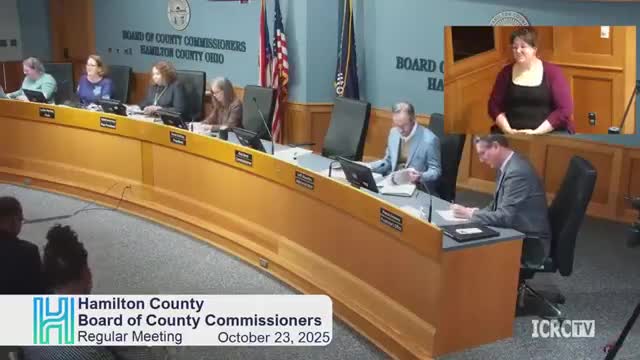
Summary
Hamilton County commissioners heard more than a dozen public‑comment speakers on Oct. 23 urging them not to adopt a proposed county “piggyback” expansion of the homestead exemption and owner‑occupied credit unless the state reimburses lost local revenue.
Hamilton County commissioners heard more than a dozen public-comment speakers on Oct. 23 urging them not to adopt a proposed county “piggyback” expansion of the state homestead exemption and owner-occupied property tax credit unless the state reimburses lost local revenue.
Speakers — including treasurers and superintendents from Cincinnati Public Schools, Forest Hills, Oak Hills, Sycamore, Loveland and other districts; township administrators and trustees; the county auditor; and the head of the county’s mental-health board — said the proposal would shift millions of dollars from school classrooms, emergency services and behavioral‑health programs to provide modest tax relief for homeowners.
The board did not take formal action on the measure during the meeting; commissioners said they were listening to the concerns and would continue to track related state legislation.
Why it matters: The expansion being discussed would allow the county to “piggyback” an additional homestead/owner‑occupied credit onto a state change. Several speakers said the county has no mechanism to be reimbursed for those lost tax dollars, and they warned that local governments and school districts would have to cut services or return to voters for new levies.
Many of the districts presented estimated annual revenue losses to the board. John Espy, chief financial officer of Loveland City School District, told commissioners the change would be “a financial loss of over $527,000 annually,” and said: “The conversation cannot be seniors versus students.” Amy Wells, chief financial officer and treasurer of Northwest Local School District, said the district would lose about $2,200,000. Skyler Miller, Delhi township administrator, said his township would lose roughly $622,000 and warned it could mean “no paving of township roads in 2026” or fewer firefighter/EMTs on duty.
Cincinnati Public Schools officials said the district would lose the largest amount in the county if the proposal goes forward. Michael Guston, treasurer and chief financial officer of Cincinnati Public Schools, said county calculations showed the district would lose about $7,500,000 annually — “about the salary and benefits of around 66 full‑time teachers,” he said. Shauna Murphy, Cincinnati Public Schools superintendent, told the board a sudden loss of that scale would make ongoing recovery and programming “much more difficult.” Daniel Hoeing, general counsel for Cincinnati Public Schools, urged the commissioners to reject the proposal, saying the district “would lose more than any other taxing entity in the county if this proposal went forward.”
Hamilton County Auditor Jessica Miranda framed the issue as a state‑level responsibility. Miranda said Ohio has shifted costs to local governments over decades and said the only durable relief would come if the state paid for it: “True property tax relief must be paid by the state of Ohio,” she said.
Leonora Godfrey, president and CEO of the Hamilton County Mental Health and Recovery Services Board, told the commissioners the board’s levies underwrite behavioral‑health contracts with more than 37 providers and that the board expects to lose “over $2,000,000” if the measure is enacted. She warned reduced funding would shift vulnerable people to other county departments.
Sen. Bill Blessing, who arrived later in the meeting, told the commissioners he opposed the local piggyback approach on policy grounds and called the change “regressive,” saying wealthier suburban homeowners tend to receive larger dollar benefits under the structure being discussed.
What commissioners said: Commissioners thanked the speakers and repeatedly said they were still weighing the matter. Board members noted pending state bills — including references to House Bill 96, House Bill 186 and a pending measure discussed as House Bill 335 — that could change school‑funding rules or limit local revenue growth and said those state actions affect the county’s options.
Public-comment tallies and examples: Speakers who quantified district or local impacts in the public‑comment period included:
- Loveland City School District (John Espy): $527,000 annual loss (estimate provided to commissioners). - Northwest Local School District (Daryl Yater, superintendent; Amy Wells, CFO/treasurer): $2,200,000 annual loss. - Delhi Township (Skyler Miller, township administrator): ~$622,000 annual loss; combined 12 townships could lose an estimated $4.9 million. - Sycamore Community Schools (Jenny Logan, treasurer/CFO): ~$1,200,000 annual loss; district receives about 85% of revenue from local tax base. - Cincinnati Public Schools (Shauna Murphy, superintendent; Michael Guston, treasurer/CFO; Daniel Hoeing, general counsel; Dr. Kareem Moffitt, board president): ~$7,500,000 annual loss. - Forest Hills (Alana/Elena Cropper, treasurer/CFO): ~$1,700,000 annual loss (equivalent stated as roughly 70 teachers). - Oak Hills Local School District (Steve Bain, treasurer/CFO): ~$1,800,000 annual loss (estimate stated by speaker; district noted it spends less per student than almost all county districts). - Hamilton County Mental Health and Recovery Services Board (Leonora Godfrey): loss of more than $2,000,000 to behavioral‑health levies.
Nut graf: The testimony highlighted a recurring theme: without a pledged state reimbursement, an expansion of the homestead/owner‑occupied exemptions at the county level would reduce locally controlled revenue streams that pay for schools, emergency services and mental‑health providers. Speakers urged commissioners to delay any county adoption until the state’s final actions are clear or until the state funds the shift.
Background and next steps: Commissioners referenced multiple pending state bills that could limit revenue growth or change the “20‑mill floor” that affects urban districts; speakers also cited the state’s 2.5% rollback and how — unlike that rollback — a county piggyback would not be reimbursed. Commissioners did not vote on the piggyback proposal during the Oct. 23 meeting. Multiple school and local officials said they would press for legislative solutions and for continued county‑level engagement with affected jurisdictions.
Ending: Commissioners thanked the speakers for a measured public‑comment period and said staff would continue to monitor state legislation and the county’s fiscal exposure before advancing any local action.