Get Full Government Meeting Transcripts, Videos, & Alerts Forever!
Get email alerts on the Assessment And Accountability topic
No spam. Unsubscribe anytime.
District learning director reviews assessment results: CAASPP, CAST, DIBELS and STAR updates
Summary
Dr. Macon Battle presented Coronado Unified’s annual assessment report, covering state and local assessments, the district’s screening and progress‑monitoring tools, and steps to identify students earlier for supports.
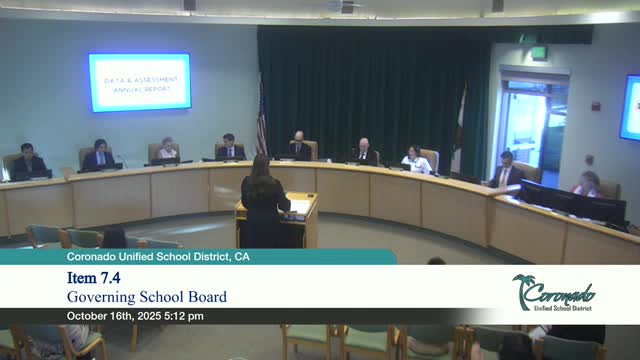
Dr. Macon Battle, the district’s senior director of learning, presented Coronado Unified’s annual assessment report at the Oct. 9 governing‑board meeting, reviewing statewide and local assessment results and the district’s progress‑monitoring tools.
Battle told trustees the district uses multiple measures to assess student learning: CAASPP and CAST for state testing, and local screeners and benchmarks including DIBELS (used for early reading screening), STAR (expanded this year to include kindergarten and first grade as STAR Early Literacy), and MDTP as a math diagnostic and readiness measure. “The most important question our teachers ask themselves, on a daily basis is how do we know students are learning what we’re teaching?” Battle said, and she framed the district’s assessment work as providing teachers actionable data to inform next‑day instruction.
State testing: Battle reviewed CAASPP and CAST trends, noting district outcomes have been relatively stable and that Coronado Unified ranks near the top of San Diego County for ELA and math among comparable unified districts. She flagged the state’s recent revision of achievement‑level descriptors; though standards have not changed, the descriptors families will see on score reports were updated after a two‑year state work group.
Local tools and interventions: Battle described how DIBELS is used as an early‑reading difficulty screener and how local progress monitoring and MTSS allow staff to group students and schedule targeted instruction. STAR’s extension to K–8 gives the district longitudinal data earlier in students’ careers; Battle said STAR can help predict CAST outcomes when students make typical growth.
SSTs, EduCLIMBER and early identification: The district described use of EduCLIMBER to make watch lists, track interventions and support a more proactive SST process so students are identified and supported earlier. Battle and trustees discussed how universal screeners trigger progress monitoring and when a school might escalate to a formal SST or psychoeducational assessment for suspected dyslexia or processing disorders. Battle said the district has a local flowchart tied to the early‑reading screener that guides the next steps when a student is flagged as at risk.
AP and science: Battle highlighted increases in AP exam takers and pass rates and credited DoDEA grant support and STEM leadership for gains in CAST science at elementary levels.
Board questions: Trustees asked for clarification about what local progress looks like, how early identification can be accelerated, and for more information to share with families about parent‑initiated referrals. Battle and Superintendent Mueller said staff will continue to improve communications and clarify parent options for initiating assessments and interventions.