Get Full Government Meeting Transcripts, Videos, & Alerts Forever!
Get email alerts on the Elementary Education topic
No spam. Unsubscribe anytime.
Silver Strand Elementary highlights phonics, inclusion and community supports in annual report
Summary
Principal Moore reported on Silver Strand Elementary’s programs and partnerships — including a Purple Star designation for military-connected families, expanded phonics training, MTSS interventions, DoDEA and CSF grants for enrichment and ongoing social‑emotional learning and counseling supports.
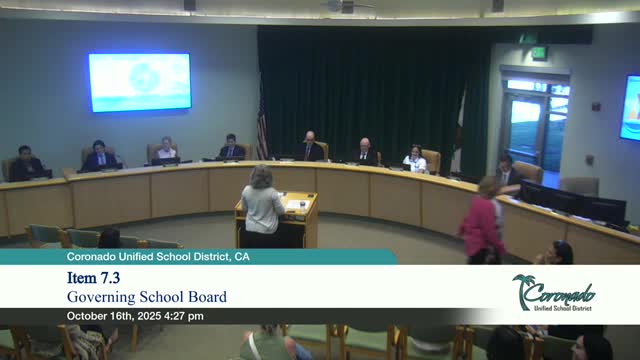
Silver Strand Elementary Principal Moore delivered the school’s annual report to the Coronado Unified governing board on Oct. 9, outlining academic priorities, student supports and community partnerships.
Moore emphasized the school’s military‑connected population and its Purple Star designation, noting that the site’s small size and military family demographics shape programming and supports. The school uses a campus MTSS (multi‑tiered system of supports) committee to align academic and behavior interventions and adopted a school‑wide writing focus tied to district goals. Moore said the school’s reading plan includes a district‑wide push for consistent phonics instruction; the district is providing a five‑day phonics training for TK–2 teachers and Silver Strand uses the Foundations program for early grades and interventions.
Programs and partners: Moore and trustees highlighted multiple grants and partnerships that support Silver Strand programs: DoDEA grants (which helped fund a math intervention teacher and a STEM TOSA), the Coronado Schools Foundation (CSF) for iLab, robotics and arts, and the National Conflict Resolution Center which led a community circle that informed the school plan. Moore described robust counseling supports — a full‑time counselor plus a dedicated MFLAC — and said social‑emotional learning curriculum and counseling groups are active at the site.
Inclusion and enrichment: Moore described an inclusion model in which special‑education students participate in general education activities, paired with peer models and access to tailored supports. The school runs stacked reading blocks so intervention specialists can serve every grade level during the same reading period. Moore said the school is expanding leadership opportunities to fourth grade and offers buddy classes, choir, band and robotics as enrichment.
Operational issues and priorities: The principal asked for better communication about maintenance and project scheduling, noting teachers sometimes find classrooms altered without prior notice. Moore also described a desire for a sensory/motor room and more occupational‑therapy‑style supports for students she said are increasingly presenting sensory needs.
Data and achievement: Moore credited a DoDEA‑funded science teacher (TOSA) and district supports for recent gains in CAST science scores. Trustees noted demographic features: Moore said some transfers between sites were related to capped TK enrollment and capacity decisions. Superintendent Mueller said restoring a program‑specialist position is a priority as the district transitions closer to basic aid and could help support special‑education coordination at sites like Silver Strand.
Board reaction: Trustees praised the school’s community culture and programming; several asked follow‑up questions about NCUST indicators (the National Center for Urban School Transformation) and dyslexia screening, to which Moore and Dr. Battle (learning department) responded with process details about universal screeners, progress monitoring and SSTs (student success teams).