Providence committee considers widening Safe School Act to cover student commutes, cites Oakland "VIP" school model
Loading...
Summary
Members of the Providence City Pathways and Gun Violence Advisory Council discussed proposals to amend the Rhode Island Safe School Act to explicitly cover studentscommuting to and from school, and to secure sustained funding for school-based community violence intervention after officials described a three-tiered model used in Oakland.
The Providence City Pathways and Gun Violence Advisory Council on Thursday discussed proposals to amend the Rhode Island Safe School Act so its protections and interventions explicitly cover students commuting to and from school during the day, and explored funding options for school-based community violence intervention programs.
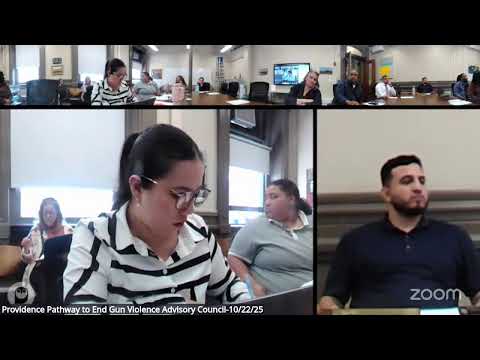
Councilor Miguel Canta Sanchez and Director Corey Jones convened the meeting, which included Providence Public School District Chief Operating Officer Dr. Dexter Moore Jr., Lisa Pina Warren of the Nonviolence Institute and council member Robert Bailey. Moore described a three-tiered school program his Oakland district used that combined violence interrupters, life coaches and gender-based-violence coaches and partnered with community-based organizations.
"We stood up what we call the school VIP team program," Dr. Dexter Moore Jr., chief operating officer, PPSD, said. "The VIP team was a kind of three-tier model ... focusing on our high schools who had the greatest need around incidents of violence." Moore said his Oakland model assigned teams to six high schools and relied partly on federal grant funding; he said each three-person model cost about $250,000.
The council returned repeatedly to parentsand community organizationsreporting that getting children home safely is a recurring concern. "We have been helping a few families get from school by assisting with Uber gift cards or Lyft gift cards. But that's just a Band Aid," Lisa Pina Warren, executive director of the Nonviolence Institute, said. Warren said her organization had provided about a $100 gift card in at least one case to temporarily cover rides home and warned that rideshare transport can place drivers at risk when the underlying safety problem remains.
Members and guests noted the Safe School Act is a state statute; one participant read language from the stateschool policy that cites 16-21-34 of the Rhode Island general laws as the authority for a statewide bullying policy. The councilwhich has police, school and community representativesdiscussed whether amendments could add explicit coverage "to and from school" and to locations such as Kennedy Plaza during school hours.
Council members said they want any changes and new funding to be clearly administered so dollars support community violence intervention (CVI) providers rather than being absorbed into the general fund. "We don't want this to just turn into a revenue tax for the state general fund," Councilor Sanchez said.
The council identified several implementation questions: how to secure multi-year funding for community-based organizations, whether schools or a city-level office should hold program contracts, and how to coordinate information-sharing between community-based organizations and law enforcement without undermining trust. Detective David Perez of the Providence Police Department said the department and CBOs already communicate primarily after incidents to provide victim support and gather information, but that preventive information-sharing has legal and operational limits.
No formal motion or vote was taken. Council members said they expected follow-up meetings and further work to flesh out statutory language, funding sources and administrative models.
The council asked Moore and other guests to return with additional details, including specific grant sources, costs and administrative models that could be adapted to Providence. "I can go back through my records or reach out to a colleague to get the specific source of funding," Moore said when asked about the federal grants his Oakland program used.
The committee also discussed city funding already allocated in mayoral budgets for violence-prevention work and the need to avoid diverting effective local grants. Participants suggested an initial next step: gather a more detailed inventory of current programs, funding amounts and gaps so the council can weigh statute amendments against program and administrative options.