Get Full Government Meeting Transcripts, Videos, & Alerts Forever!
Get email alerts on the Building Permits topic
No spam. Unsubscribe anytime.
Lake City adopts new permitting fees, clarifies inspection authority for private sewer and water lines
Summary
City officials outlined a new ordinance that raises permit and inspection fees, adds fire plan-review charges, and affirms the building department's authority to inspect private sewer laterals and private potable water distribution lines that state regulators do not permit.
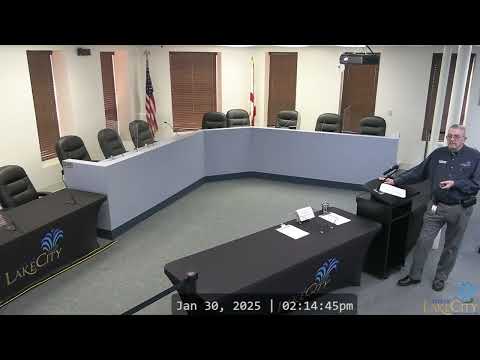
Lake City's Growth Management officials on Thursday summarized a newly adopted ordinance that raises permitting and inspection fees and expands the local building department's inspection responsibilities for privately owned sewer and potable water distribution lines.
My name is Dave Young. I'm the director of growth management for the City of Lake City, and I've got Scott Thomason in here. He's our building official and assistant director for the City of Lake City, Young said as he opened the presentation.
The council held two hearings on the fee changes and approved the ordinance on Jan. 6 and Jan. 21, Young said; the measure is filed as ordinance number 20252301. The ordinance text says the changes are effective immediately, but Young told attendees, "By what this ordinance says, it says effective immediately. We are not doing that immediately," and said the city expects to have the new fee schedule operational within about a month while the department completes administrative setup.
Why it matters: Growth Management officials said the changes bring the department closer to being self-sufficient and align local charges with regional practice. Officials also said state regulators limit what the Florida Department of Environmental Protection (FDEP) permits (mains only), which leaves responsibility for laterals, building tie-ins and private distribution laterals to local authorities.
Key provisions and examples: The ordinance sets commercial permits at $1.95 per square foot, a rate the presentation said covers building, electrical, plumbing, mechanical and roof work; plan review costs are charged separately. A technology fee of 3% and a state permit surcharge of 2.5% were included. Other fee examples provided in the presentation: - Residential permit extensions: 90 days maximum; $60 or 10% of the original permit fee, whichever is greater. Commercial extensions: 90 days; 10% of the original fee or $125, whichever is greater. - After-hours inspections (weekends/holidays): $100 per hour. - Reinspections: $50 payable before scheduling the inspection. - Contractor registration is voluntary and renewable annually; Young noted contractor licenses are issued by the state and expire in September, though the presentation referenced a January 30 renewal date for the local registration file. - Veteran discount: 50% reduction in permitting fees when the veteran is the owner of the home with a homestead exemption and has an honorable discharge.
The ordinance added fire-related plan-review and inspection fees. Examples listed: - Commercial fire plan review: 3 cents per square foot, $75 minimum. - Fire alarm plan review (when not included): 1 cent per square foot, minimums apply. - Hood suppression and other fire system inspections: listed flat fees (for example, $181 for certain hood and suppression inspections). Young said false-alarm inspections are limited: two false alarms per month are free; the third and subsequent false alarms in a month are $250 each.
Private sewer and water distribution: Officials spent part of the presentation clarifying definitions and enforcement scope for building sewers, building drains, private sewers, and private potable water distribution systems. Young and Thomason cited guidance from the Florida Department of Environmental Protection that FDEP permits public and privately owned force mains, gravity sewer mains, manholes and lift stations, but generally does not permit laterals, branch services or private distribution laterals. Because of that limitation, Young said the city will exercise inspection authority over private laterals and on-site distribution segments that FDEP does not permit.
Implementation and next steps: Young said the ordinance will be posted on the Growth Management web page (he gave the ordinance number as 20252301) and that staff will publish fee schedules and related charts online before the fees go live. The department plans to move to a new electronic permitting platform; Young estimated the new permitting system rollout could take three to six months and said training will be provided prior to going live. He asked contractors to check spam folders for departmental emails and said the office will attempt to transfer existing contractor registrations into the new system where possible.
Questions raised by participants included whether contractor registration must be renewed to use the new permitting system and which renewal date (September vs. January 30) applies to local registration; Young said he would confirm registration requirements and circulate guidance. Officials also noted discounts when third-party private providers perform inspections (presentation listed about a 25% reduction for inspections and 30% for plan review when a private provider performs that work).
Officials provided a growth management contact and phone number for follow-up questions. "If anybody's got questions, please contact either Scott or myself at Growth Management," Young said.
The presentation and fee schedule were posted as ordinance number 20252301; staff said they expect the web posting by the middle of next week and will notify contractors before the fees and new permitting workflows go live.