Get Full Government Meeting Transcripts, Videos, & Alerts Forever!
Get email alerts on the Animal Waste Ordinance topic
No spam. Unsubscribe anytime.
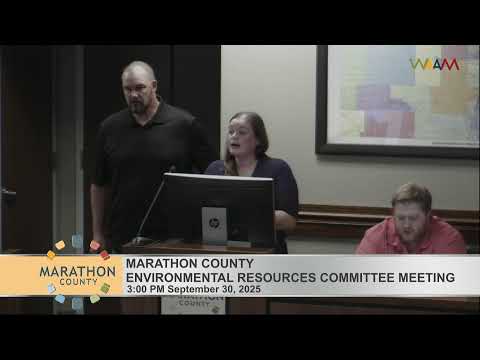
Marathon County committee reviews draft animal-waste ordinance; staff outlines phased timeline and supports for farmers
Summary
The Marathon County Environmental Resources Committee on Sept. 30 reviewed draft changes to the county animal-waste ordinance that would add a $200 winter-spreading permit option, carve out 60-day seasonal spreading limits for medium-sized livestock operations, and require 35-foot vegetative buffers along perennial and intermittent streams.
The Marathon County Environmental Resources Committee on Sept. 30 reviewed draft changes to the county nimal-waste ordinance that would add a $200 winter-spreading permit option, carve out 60-day seasonal spreading limits for medium-sized livestock operations, and require 35-foot vegetative buffers along perennial and intermittent streams. County staff said the proposal is intended to reduce phosphorus runoff while providing education, cost-sharing and a phased implementation timeline.
County conservation staffer Kirsty Heidenreich, the county conservationist, told the committee the proposed ordinance has been developed with input from a farmer work group and outside counsel and that staff plan a series of public meetings and outreach events before any formal vote. "We really have been talking about some of these changes for well over a year now," Heidenreich said. She said the county contracted attorney Jane Lindretti, formerly lead counsel for DATCP, to review the draft because the corporation counsel position is in transition.
The draft's primary changes, as presented by staff, are: a winter-spreading permit (suggested fee $200 covering four years) as an alternative to a full nutrient-management plan; seasonal spreading limits during a roughly 60-day high-risk period applied only to medium farms (defined by staff as 300 to 999 animal units, using the EPA definition for medium farms); and a 35-foot perennial/intermittent-stream buffer that must be at least 50% perennial grass where nutrients cannot be applied.
Heidenreich said the county will continue to offer low- or no-cost nutrient-management planning through cooperative courses with North Central Technical College and Mid-State Technical College and will work to connect affected farms to cost-sharing resources. "If people don't want to get [the winter permit], they can get a nutrient-management plan. Marathon County will always have a free way to get a nutrient management plan," she said.
County staff estimated roughly 40 to 60 farms would fall into the medium-size band; of those, they told the committee the number that currently daily-haul liquid manure was likely on the low end, about 6 to 10 farms. Staff said they do not expect to hire additional permanent staff for implementation and will instead reassign existing duties and use technical assistance during the rollout.
Public comment at the start of the meeting reflected the range of local reaction. Dean Beck, identified in the record as Towne Easton chairman, said he has been attending committee meetings and meeting with local farmers and expressed concern the proposal is premature and could burden smaller dairy operations. "I can tell you right now that dairy farmers are not—reaking even; they're hanging on by a thread," Beck said, warning that required short-term manure storage and the hauling that follows could force small producers out and damage town roads in spring hauling season.
By contrast, Kevin Jean Schmiedke of River Run Dairy said his earlier opposition had shifted after participation in the work group. "I was against it at first. I understand it. I don't like regulations, but it's coming either way. So I'm in support of it," Schmiedke said.
Staff emphasized the draft is intended to be phased and not immediately enforceable. The committee was asked to review the draft and bring questions to a special ERC meeting on Oct. 14. Staff described a tentative schedule that includes a farmer work-group meeting Oct. 27, public open houses in November, additional committee discussion and possible committee vote on Dec. 4, and then state review by DATCP/DNR if the committee and county board approve. Heidenreich said that state review can take up to 90 days and could place a county-board vote in March 2026.
Committee members asked about maps and how streams would be identified. Staff said the county used DNR data to map intermittent and perennial streams and will make the map available via county mapping services and potentially on the state's SnapPlus site for nutrient-management planning. Staff also said the draft includes a process for landowners to request a staff review if they believe a mapped buffer should not apply to a specific location.
The committee took no formal action on the ordinance at the Sept. 30 meeting. Staff said they will continue outreach and technical assistance and that the final ordinance and any changes would be refined with new corporation counsel and outside counsel review before any formal county-board consideration.
Ending: The ERC set a special meeting for Oct. 14 to begin detailed review; staff will host farmer work-group meetings, open houses and educational sessions in the coming weeks before further committee deliberations and any formal vote.