Get Full Government Meeting Transcripts, Videos, & Alerts Forever!
Get email alerts on the Copay Assistance Specialty Drugs topic
No spam. Unsubscribe anytime.
Patient With Rare Cancer Urges Lawmakers to Restore Copay Assistance Exceptions for Specialty Drugs
Summary
A Massachusetts patient testified that a state rule blocking private copay assistance for expensive specialty drugs left her facing $1,200 monthly co‑pays when a generic was listed as available but not actually distributed, and she urged the committee to consider exceptions.
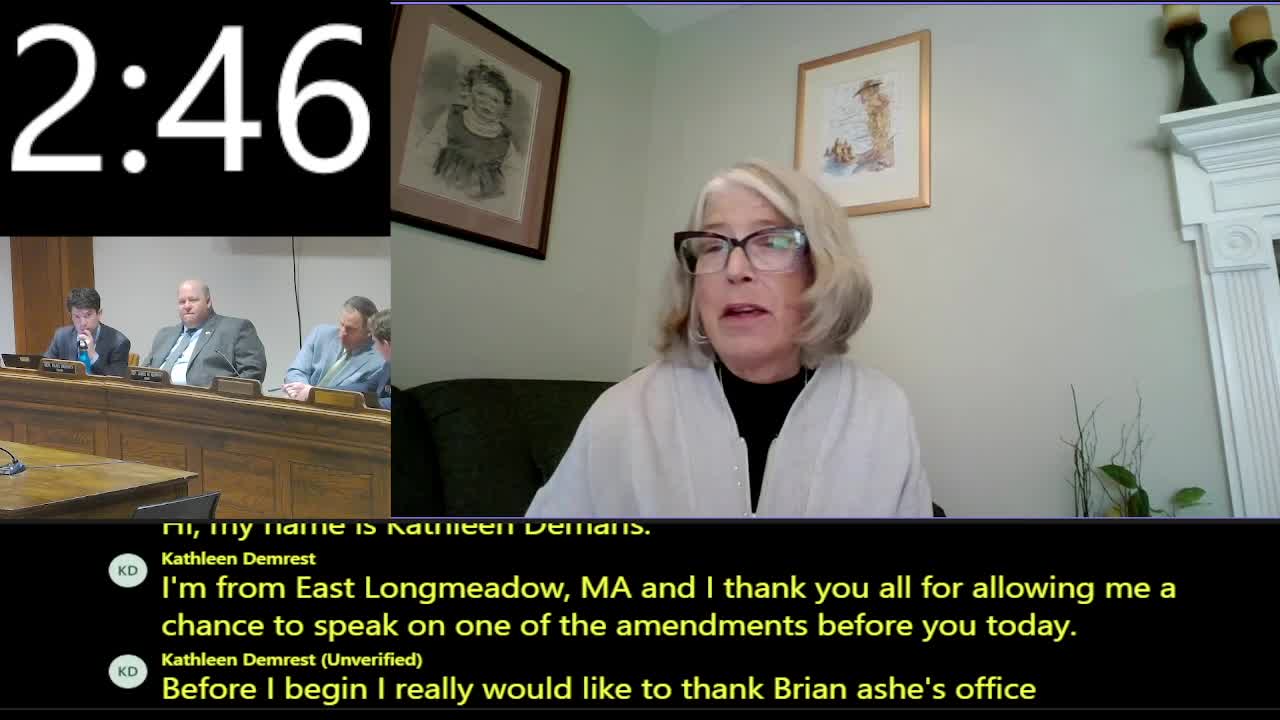
Kathleen Demarest of East Long Meadow told the Joint Committee on Financial Services she was diagnosed with a rare, incurable pancreatic cancer and that a state rule recently removed her access to copay assistance for a specialty drug (Lanreotide). She said the removal occurred because a generic was recorded as available in state records even though distribution issues meant the generic would not be available for months.
Demarest described being notified that the state would no longer allow her co‑pay assistance and said she faced a sudden increase in out‑of‑pocket cost to about $1,200 a month. She asked committee members to consider exceptions for patients currently on therapies and to review the state’s process for determining generic availability and the timing of enforcement.
“I was baffled and angry. How could the state of Massachusetts just decide to not let a private company pay for my copay?” Demarest said. She thanked Representative Brian Ashe’s office for helping her navigate the process and asked the committee for an opportunity to provide more detailed case information.
Committee members did not offer a formal response during the hearing. Demarest said the law that led to the change was adopted in 2012 and noted that Massachusetts’ approach differs from other states with similar statutes.
Why it matters: the testimony highlights how administrative determinations about drug availability and enforcement of copay assistance rules can produce immediate, significant financial burdens for patients on specialty therapies.
No committee action was taken on the matter at the hearing.