Wyoming school health-insurance trusts defend local choice as committee weighs state plan implications
Loading...
Summary
Trust representatives told the Select Committee on School Finance that school districts favor locally governed, self-funded trusts offering multiple plan choices and transparency. Lawmakers pressed staff about unknown state costs and eligibility rules if districts moved to a single state plan; no decisions were made.
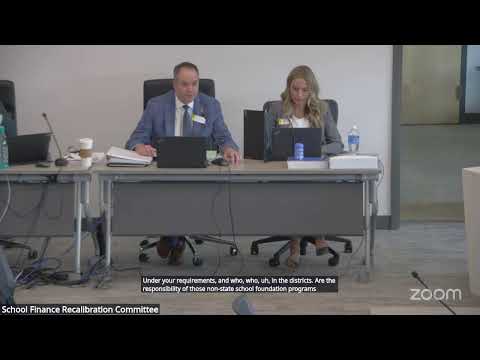
At a meeting of the Select Committee on School Finance, trustees and consultants for two major Wyoming public-sector health insurance trusts described how districts choose benefit plans and defended local control as lawmakers pressed staff about the cost and eligibility implications if the state were to move employees onto a single state plan.
The presentations and public comment matter to lawmakers because health benefits factor into school budgets, teacher recruitment and retention, and the recalibration of state funding formulas now under consideration by the committee.
Terry Sterling, plan administrator and chair of the Wyoming School Boards Association Insurance Trust board, told the committee the trust was created by districts and is governed by participating districts’ trustees. “We don't want it just a single plan,” Sterling said, describing a system built around choice, local control and board-level transparency. Sterling said the trust began as a statutory trust in 1995, is regulated by the Wyoming Department of Insurance as a multi-employer welfare arrangement, and operates as a partially self-funded program governed by the districts that participate.
Brian Farmer, executive director of the Wyoming School Boards Association, introduced Sterling and said districts sought a program that lets them “define the plan itself” to help attract and retain employees. Sterling highlighted options the trust now offers, including a reduced menu of plans (he said the trust once offered as many as 13 different plans and is now down to two), transparent claims and renewal processes, and new benefits such as virtual primary care, virtual physical therapy and coverage for hearing aids.
Cheryl Hagerman, a director at Willis Towers Watson who consults for the Wyoming Educators Benefit Trust (WEBT), described WEBT’s history and structure. She said WEBT began in 1971, converted to self-funding in 1985, opened to other public entities in 2005 and today serves about 95 public-sector employers, including 24 school districts. “We do currently offer a selection, of up to 9 medical plans,” Hagerman said, adding that WEBT offers five traditional plans and four high-deductible plans, telehealth and a free employee assistance program. WEBT uses Blue Cross Blue Shield of Wyoming’s network as well as Delta Dental and Vision Service Plan and provides local customer service, she said.
During the committee’s public comment period, Sublette County resident Bill Winnie described a personal case he said illustrated risks when administrators have access to individual claims information. “The administrators should not have visibility into the specific claims any particular person makes,” Winnie said, recounting that his wife later lost employment after an alleged age-related remark by a superintendent. Representative Yen noted age discrimination is illegal under federal law and asked whether the case was litigated; Winnie said it was taken to the federal level and that a judge characterized the comment as isolated.
Lawmakers and school staff repeatedly raised how districts decide plan design. Representative Kelly asked whether employees are involved in those decisions and whether plans reflect teachers’ preferences. Jeremy Smith, a business manager who said he has served multiple Wyoming districts, described plan design as “bottom up in our district,” saying teachers and staff participate in conversations and committees about what benefits meet local needs. A vice chair of the Wyoming School Boards Association Insurance Trust board (identified in the transcript as Miss Lewis) and other district officials described processes in which districts set a contribution level and let employees choose among available plans; one speaker said districts sometimes used savings from lower-premium plans to increase salaries.
Speakers from several districts said they compared the state plan, WEBT and the school boards association trust and found costs broadly similar. Chase Christiansen, speaking for his district, said his district conducted a request-for-qualification process and concluded that costs across the three major options were comparable; he cited concerns about year-to-year cost volatility with private insurers and said trusts provide guardrails that help districts budget for compensation.
Legislative staff and committee counsel told members the fiscal impact of moving all district employees to the state plan is unknown and depends on policy choices. Staff noted key variables include the eligibility threshold (many districts require 30 hours per week for benefits while the state plan uses 20 hours in its descriptions), whether the state would be required to cover employees funded partly by federal grants or other nonstate sources (for example, food-service staff funded by food-service operations), and how to apportion costs for positions that are partially federally funded. Those factors, staff said, would affect both who becomes eligible and the state’s ultimate cost if the committee moved toward a state-sponsored option.
The committee did not take formal action on benefits. Members were told the committee’s next meeting will be in October in Casper, when members are expected to provide drafting instructions, and that a final report from Dr. Pikes and his team will be available. The committee’s follow-up meeting is scheduled for January 2026.
The discussion highlighted trade-offs lawmakers face in the committee’s funding recalibration work: local choice and trustee-governed trusts that offer multiple plan options and local customer service versus potential state-level standardization that could change eligibility counts and the state’s fiscal obligation.
The committee adjourned after scheduling the October meeting and confirming remaining agenda items for future sessions.