Get Full Government Meeting Transcripts, Videos, & Alerts Forever!
Get email alerts on the Zoning And Land Use topic
No spam. Unsubscribe anytime.
Raymore council advances broad sign-code rewrite after hours of public comment
Summary
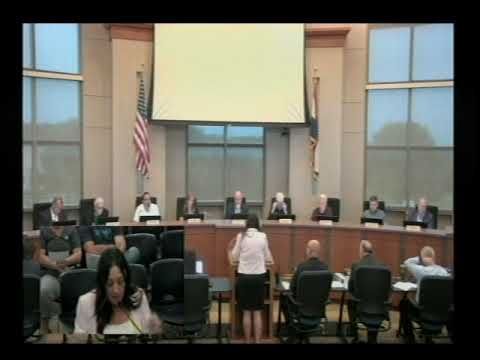
The Raymore City Council approved first reading of a comprehensive rewrite of the city's sign regulations (Bill 39-81) on Aug. 5, 2025, after a lengthy public hearing and council debate that produced one targeted amendment to allow home-occupation signs.
On Aug. 5, 2025, the Raymore City Council held a public hearing and approved the first reading of Bill 39-81, a proposed 30th amendment to the Unified Development Code that rewrites the city27s sign regulations. The ordinance passed first reading by a 7-1 vote after council members voted unanimously to amend the draft by striking a provision that would have prohibited home-occupation signs.
City staff told the council the rewrite is driven by legal and practical needs, including to remove content-based rules ruled problematic by the U.S. Supreme Court in Reed v. Town of Gilbert (2015) and to replace those content distinctions with rules focused on sign characteristics such as size, height, materials, location and spacing. "The new sign code refines signage regulations to remove any content-based regulations and instead regulates characteristics of the signs themselves," Development Services staff David Gress told the council during the public hearing.
Why it matters: Council and staff said the update aims to bring Raymore into compliance with constitutional standards while giving clearer, more modern rules for businesses and residents. The rewrite reorganizes temporary versus permanent signs, adds clearer permit and review procedures, expands incidental- and temporary-sign allowances (for example for grand openings), and adds definitions for sign types such as quill signs, banners and monument signs. Planning and Zoning Commission reviewed and unanimously recommended the draft in July.
What happened at the hearing: About a half-dozen residents and small-business owners spoke at the public hearing. Homeowners and small-business operators raised concerns about permitting, enforcement, and whether commonly used items (vehicle magnets, yard flags, small garden signs, inflatable seasonal decorations and quill banners) would be prohibited. Small-business owner Harry Woods said he was concerned vehicle magnets or small yard signs might be banned; staff responded the draft targets vehicles parked primarily to function as signs and that ordinary magnets/stickers for work vehicles were not the intent. Resident Adam Campbell and others said the draft was overly long and left some terms open to interpretation; staff and the city attorney said the length reflects detailed, non-content rules for many sign types.
Major amendments and council debate: Council member Mills moved, and the council later agreed, to strike a provision (listed as item E12 in the draft) that would have explicitly prohibited home-occupation signage. After that amendment passed unanimously, staff clarified that, under the revised draft, yard-sign categories would allow residential property owners with permitted home occupations to display up to four yard signs on their property under the same dimensional rules that apply to other yard signs, rather than being singled out by message. City legal counsel, Mr. Zurer, cautioned against language that would reintroduce content distinctions (for example by allowing only certain messages) and advised limiting regulation to time, place and manner or structural characteristics.
Council member Brian Baker repeatedly urged additional legal review and raised multiple questions about time limits, election signage, flag and flagpole rules, and the risk of content-based distinctions that could trigger constitutional challenges. Baker made a motion to refer the ordinance back to the Planning and Zoning Commission for further legal review; that referral motion was defeated 5-3. After debate, the council voted 7-1 to approve the ordinance27s first reading with the amendment removing the prohibited-home-occupation language.
Enforcement, flags and other FAQs: Staff said the code is structured so enforcement focuses on placement (right of way/sight triangles), size and mounting rather than message. Flags that are flown from a pole or mounted as flags are treated differently than banner-like signs; staff said those differences were intended to separate business-style quill banners from traditional flag displays. The council discussed temporary displays (for example Boy Scout or veterans27 observances) and staff said such displays are generally permissible if placed on private property and they meet the dimensional/location rules; City Attorney Zurer warned against drafting provisions that single out a particular organization or flag type by name.
Next steps: The council approved the first reading. The ordinance will return for a second reading and final vote at a future meeting. Council members and staff said they will provide clarifications or possible drafting tweaks between readings to address typos and tighten uncertain language identified during the hearing.
Ending: Council members thanked residents and business owners for attending and noted staff will continue to refine the document before the second reading to reduce ambiguity and ensure the regulations fit with constitutional standards and practical enforcement needs.