
Residents and mayor spar over moratorium, land-development codes and impact fees
Get AI-powered insights, summaries, and transcripts
Subscribe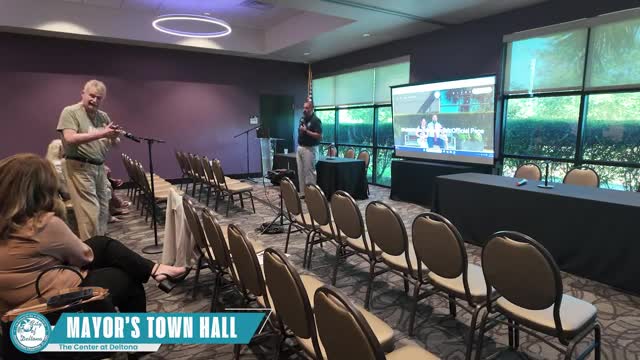
Summary
At a Deltona town-hall meeting residents and the mayor debated a development moratorium, land-development-code updates, annexation effects and timing for an impact-fee study. The mayor said code updates and a $2 million grant for road elevation are in progress; residents urged changes to reduce flooding and protect trees.
Multiple residents used a mayoral town-hall meeting to push for clearer city rules on development, to question the scope of a moratorium on new development and to press for land-development-code updates that they say would reduce flooding and preserve trees.
One long public comment criticized the moratorium as “setting our city up for so much failure,” saying that the city should use existing votes to deny developments it opposes rather than pursue a broad moratorium that could risk state funding. That speaker also said the city has $3,000,000 pending to come to Deltona and said a moratorium could endanger relationships built with state legislators.
The mayor said the city has received a roughly $2,000,000 grant "for designing" an elevated road connected to flooding mitigation and told residents the city is updating land-development codes that had not been revised for decades. He said those code updates include moving from counting total acres to counting buildable acres, which he said can reduce development in wetland areas.
Speakers raised several specific concerns:
- Impact fees and timing: Residents warned that rushing an impact-fee study before new permits are processed could raise costs for a small number of homeowners as projects move forward.
- Annexation and infill rules: A resident said a property buyer was annexed into the city and can no longer build because of new infill minimums (cited as one acre in public comments); the resident asked the commission to consider exceptions for individual homeowners living on small lots.
- Tree preservation and design: Commenters urged the city to value existing trees in project design and to adopt newer site-planning techniques to reduce habitat loss and flooding.
The mayor said concessions had been made to remove infill and mixed-use from a proposed measure to make it more acceptable and that the city is trying to balance attracting commercial development while preserving open space. He also said the city is tracking a state bill (identified in public remarks as SB 180) that could affect local moratoria.
No formal vote on the moratorium was recorded at the meeting; participants emphasized the need for a written benefits-vs.-risks analysis and an implementation plan if the commission proceeds. The mayor and several commenters urged that any moratorium be accompanied by a clear plan for administration and a timeline, with attention to whether state law would preempt local restrictions.