Get Full Government Meeting Transcripts, Videos, & Alerts Forever!
Get email alerts on the Municipal Budget topic
No spam. Unsubscribe anytime.
Marshfield council weighs reserves, utility contributions and partner contracts to fund community development role
Summary
Council members discussed using general fund reserves, economic development funds, utility dividends or partnerships with Visit Marshfield and Main Street to fund a community development director, and debated pausing refill of a parks events coordinator while reviewing communications and motor-pool charges.
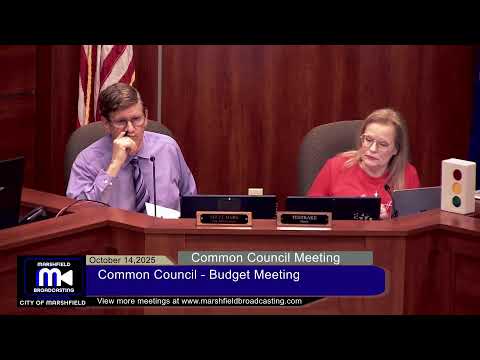
The Marshfield Common Council on Oct. 14 reviewed the recommended 2026 budget and debated possible funding sources for a proposed community development director, including using portions of the city’s general fund balance, transfers from the economic development fund, utility dividends and vendor-style contracts with local partners.
Rebecca Spiroz, chairperson of the Finance, Budget and Personnel Committee, opened the discussion and asked staff to respond to follow-up requests from the Oct. 6 budget meeting. City staff member Steve reported that staff are compiling requested information and that the city is pursuing grants as an additional revenue source. “We are becoming very active as much as we can be at seeking grants,” Steve said.
Jennifer (finance staff member) gave a detailed review of the city’s fund balances and cautioned against using one-time reserves for ongoing expenses. “Fund balance represents the equity in the governmental fund, and it’s a measure of our financial health,” Jennifer said, explaining that the general fund’s 2024 audited fund balance was just under $8.7 million, with roughly $8.0 million unassigned (about 31% of budgeted general-fund expenses and 34% of actual expenses). She said the city plans to use about $336,000 of fund balance in 2026 and estimated a year-end unassigned general-fund balance near $7.5 million under current assumptions, leaving the city near the middle of its 25–30% reserve policy range.
That accounting framed a council discussion on whether to use reserves for an ongoing $160,000‑range community development director salary. Jennifer and Steve repeatedly cautioned that using the general fund’s unassigned balance for recurring payroll would be “not recommended” because fund balance is intended primarily for one-time projects or emergency needs.
Council members discussed alternatives: reallocating existing economic development expenditures, repurposing the economic development fund (which had an estimated unassigned balance near $1.6 million at the end of 2025 and a planned 2026 draw of about $657,000, including a $200,000 transfer to the general fund), pursuing a stormwater fee or other enterprise fund, implementing a transportation utility, negotiating a contribution or contract with Marshfield Utilities, or arranging a vendor-style contract with local partners such as Main Street or Visit Marshfield to cover event- and business‑development services.
Alderman Wurman and others suggested exploring whether duties could be absorbed by existing staff — for example, by a planned full-time zoning administrator — or folded into a reshaped planning-and-events coordinator position. Council consensus was to pause refilling Nikki Anderson’s vacated events-and-programs coordinator role while staff, council and partner organizations evaluate options. Staff said 40% of that position’s salary had been covered by Visit Marshfield, with 40% from the economic development fund and 20% from parks and recreation.
Members also asked staff to examine possible contributions from Marshfield Utilities. Several speakers noted the Public Service Commission’s regulation of water and electric utilities and that communications utility revenues are handled differently. Alderman Tompkins said the communications utility is not PSC‑regulated and requested a report comparing charges and reserve levels for the communications utility, noting concerns that internal city customers (the city and school district) may be paying above-market rates.
The council discussed a potential “wastewater dividend” (a contribution from utility revenues or interest earnings) but heard caution that the wastewater utility currently pays for shared services — for example, portions of the plumbing inspector, GIS and street-division costs — and that municipal code (chapter cited by staff as chapter 14, article 61 on wastewater disposition of funds) would likely need amendment to change fund uses.
Other budget topics raised included: the motor-pool chargeback rates (several council members requested a staff review of whether current rates and replacement schedules accurately reflect usage and costs), the upcoming expiration and likely cost increases of the city’s 10‑year garbage contract (noting neighboring cities had seen contract increases near 30%), and consideration of an operating referendum or levy reset in 2027 if expenditure restraints continue.
Council members asked staff to continue analysis and return findings at the next budget meetings (Oct. 20 and Oct. 27) rather than make immediate motions. Steve said staff will pursue follow-up on grants, utility reports, the motor-pool analysis and alternative service-delivery models with partner organizations.
Public comment included a brief remark from Pete Lotzer, who represented the city communications committee and urged the council to consider moving the communications director position to the city payroll rather than contract funding; Lotzer said the committee has helped the city save significant contracting costs and is already trimming expenses internally.
Votes at a glance: The council moved to approve minutes from the Oct. 6, 2025 budget meeting (motion by Alderman Varshao, second by Alderman Delas); the transcript records the motion and second but does not specify the recorded tally. The council approved a motion to adjourn (motion by Alderman Varshao, second by Alderman Delas); several members voted yes as recorded in the transcript and the meeting was adjourned.
The council set two additional budget deliberations (Oct. 20 and Oct. 27) and directed staff to bring requested analyses back to those meetings for further action.