Teton County, small‑district leaders tell recalibration committee teacher pay, ELL support and housing must be addressed
Loading...
Summary
Superintendents and school officials from Teton County and several rural districts told the Select Committee on School Finance that recalibration should prioritize higher base pay, minimum fractional positions for small schools, and funding that reflects local housing and regional cost pressures.
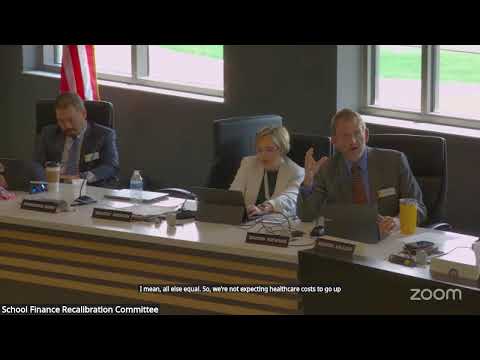
Leaders from Teton County schools and several rural Wyoming districts told the Select Committee on School Finance on Aug. 25 that recalibration must do more to address teacher pay, English‑language learner services and local cost pressures that make it difficult to recruit and retain staff.
Kristen Mayo, speaking for Teton County, told the committee the district’s funding model generates 5.4 FTE for ELL teachers and another 10.5 FTE for tutors for the coming year, but the district still faces challenges when many newcomers arrive at the secondary level. “Many times we get them in high school and that becomes a much more difficult challenge to even have the ability to graduate them from high school,” Mayo said.
Teton’s interim superintendent, Scott Chris, described the district’s approach: dual‑immersion programming in K‑5, newcomer programs in secondary schools and a multi‑tiered system of supports that pools local block‑grant funds with federal Title funding to meet students’ needs. Chris said the district estimates ELL classification among its second‑language population at roughly 10–20% of Latino students, and that outcomes vary widely by age at enrollment.
Why it matters: committee members are using public testimony to weigh how the recalibrated model should treat base teacher pay, fractional staffing at small districts, English‑language learner funding and regional cost adjustments that affect housing and salaries.
Housing, RCA and recruitment
Teton County officials pressed the committee on the regional cost adjustment (RCA) and the housing component of the Wyoming Cost of Living Index (WCLI). Kristen Mayo said the most recent WCLI analysis put Teton’s RCA at 174%, and that the district is funded at 170% in the current model; she said the housing component alone is 253% in the WCLI analysis. “When you look at what does it cost for someone in Teton County to actually live in Teton County? We can't pay enough right now,” Mayo told the committee.
Mayo described district efforts to create housing, including an upcoming 24‑unit apartment complex funded through a local special‑excise tax and a state SWIB loan, but said expensive land and construction limit options. The district also operates eight duplex units and repurposed modular classrooms as staff housing.
Teacher pay and compensation design
Several district leaders urged the committee to raise the model’s base teacher pay. Chase Christensen, legislative coordinator for the Wyoming Association of Secondary School Principals and superintendent in Sheridan County School District No. 3, said fractional positions in small districts are hard to fill and argued the recalibration should set minimums (he cited a recommendation to increase minimum fractional positions to 0.5 where feasible).
Jeff Jones, superintendent in Sheridan County School District No. 1, said rural districts face strong competition from other professions and nearby districts; his district’s base pay moved from about $48,000 to roughly $52,700 this year. Jones said a higher base salary — he cited a regional goal of roughly $65,000 as reasonable — would attract more candidates and elevate the overall pool of applicants.
Tate Mullen of the Wyoming Education Association cautioned the committee against removing teacher pay from the block‑grant model, saying it would likely lead districts to increase class sizes because they cannot practically hire 0.12 or 0.28 FTE positions. “If you pull teacher salaries out of the model what you will unintentionally do is increase classroom sizes,” Mullen said.
Small‑district staffing and fractional FTEs
Several small‑district speakers said the model’s fractional FTEs create personnel challenges. Chase Christensen urged the committee to consider raising minimum fractional hires (for example, to 0.5) so districts can recruit candidates for half‑time roles that are practical to staff. Sheridan County and Johnson County leaders described paying more out of pocket to meet training and certification requirements for ELL and special programs when the formula allocation is too small to fund a dedicated hire.
Transportation and buses
Multiple speakers raised transportation costs. Johnson County said bus replacement costs have risen substantially; speakers cited state bid prices that have doubled over several years (examples given were $125,000 several years ago vs. $220,000–$235,000 on recent state bids). Districts warned higher bus costs and driver shortages complicate operations and add budget pressure.
Ending
Committee members did not adopt new funding figures at the Aug. 25 hearing but heard repeated calls to raise the model’s teacher base pay, ensure minimum fractional staffing levels for small districts, and account for local housing and RCA effects — with Teton County presented as a prominent example of how regional cost pressures affect recruitment and retention.