Get Full Government Meeting Transcripts, Videos, & Alerts Forever!
Get email alerts on the State Budget topic
No spam. Unsubscribe anytime.
Finance subcommittee advances $59.7 billion FY26 appropriations bill to full finance
Summary
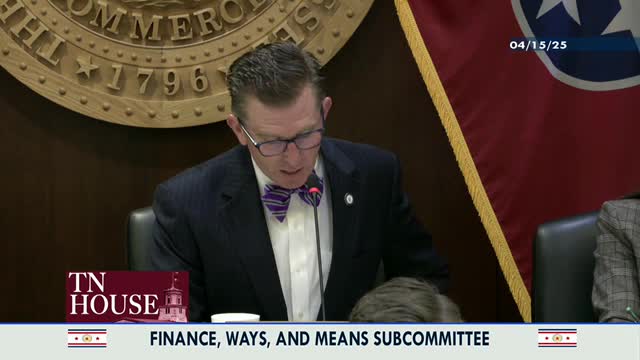
The Finance Ways and Means Subcommittee voted 13-0 to send House Bill 1409, the FY26 appropriations act as amended, to full finance after adopting three amendments and hearing an overview of revenues and major spending priorities including disaster relief, education, health and transportation.
The Finance Ways and Means Subcommittee voted unanimously to advance House Bill 1409, the fiscal year 2026 appropriations act as amended, to the full Finance Committee. The committee adopted three amendments and recorded a 13-0 vote to move the bill forward.
Chairman Hicks opened the committee’s consideration and described the budget totals and revenue sources that underlie the appropriation. "What we are presenting to you is House Bill 14‑09, which is the appropriations bill as amended," Chairman Hicks said.
The bill sets total appropriations for FY26 at $59,700,000,000. Chairman Hicks said the revenue mix programmed in the budget is roughly 50% state appropriations ($29,700,000,000), 35% federal funds ($20,800,000,000) and 15% other sources ($9,200,000,000). The presentation noted no growth in general fund tax revenues for the current fiscal year (FY25) and an assumed 2% recurring tax‑revenue growth in FY26 — described in the presentation as $376,700,000 in additional recurring state revenue programmed into the FY26 budget.
The committee heard itemized spending highlights from the bill. Disaster relief funding in the package totals $597,000,000 and includes funds for disaster cost‑share obligations, an emergency assistance loan fund, and targeted reconstruction and grant programs for counties and property owners affected by Hurricane Helene. Education allocations total more than $640,000,000 in new state funding for K‑12 programs, including one‑time teacher bonuses ($198,000,000), TISA growth funding ($148,000,000), fast growth stipends ($25,000,000), a charter school facilities fund ($20,000,000), a school safety grant fund ($20,000,000) and $27,300,000 for summer learning camps and transportation. Higher education received $264,000,000 for raises, insurance increases and capital improvements.
Health and social services were listed as receiving over $1,500,000,000 in new spending, with one explicit wage change cited for direct support professionals providing home and community‑based waiver services — an increase from $15.37 to $15.68 per hour. Behavioral health infrastructure, workforce supports, and year 4 of a dental pilot program (listed at $24,000,000) were also noted.
Public safety and law enforcement initiatives were described at roughly $378,000,000, including funding for additional positions at the Tennessee Bureau of Investigation and the State Highway Patrol, public safety grants and violent crime intervention grants. Economic and community development funding was reported at $213,000,000 from state and FastTrack reserves, with separate line items for rural development, R&D and jobs training. Transportation spending in the package included a $1,000,000,000 general fund subsidy for TDOT projects and operations, plus smaller appropriations for commercial and general aviation through a transportation equity fund.
Chairman Hicks said the bill also includes expanded grant pools and local government grants: $20,000,000 for volunteer fire departments, $5,000,000 for EMS, $5,000,000 for rescue squads, $5,000,000 for senior centers, $5,000,000 for museums and $2,000,000 to assist local governments with courthouse capital maintenance and improvements. In response to a member question, Hicks said courthouse grants will be available to municipalities and local governments statewide except where the locality is receiving a tax increment financing (TIF) allocation.
The committee adopted three amendments (drafting codes 7420, 3600 and 4400) before voting. After the vote, the clerk announced 13 ayes and 0 nos; the chair announced that House Bill 14‑09 "moves to full finance."
The committee did not take final action beyond sending the bill to the full Finance Committee; the measure will next be considered in that committee for further debate or final passage.