Get Full Government Meeting Transcripts, Videos, & Alerts Forever!
Get email alerts on the Parental Liability Juvenile Justice topic
No spam. Unsubscribe anytime.
Panel examines bill to criminalize gross parental neglect tied to juvenile offenses; agencies urge safeguards
Summary
Bill 107-38 would create criminal liability for parents or guardians who fail to exercise reasonable care and thereby permit or encourage minors to commit crimes. Department witnesses warned the measure could have unintended harms without clarified language, affirmative defenses and diversion options.
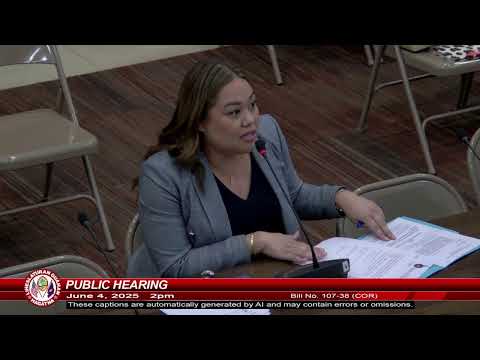
The committee heard testimony June 4 on Bill 107-38, which would add a new article to chapter 4, title 19 of the Guam Code Annotated to establish criminal liability for parents or guardians who fail to exercise reasonable care, supervision, protection and control when that omission permits or encourages a minor to commit a felony or misdemeanor.
Senator Parkinson, the bill’s author, said the measure targets “egregious cases” in which parental neglect directly facilitates juvenile crime and stressed it is not intended to criminalize ordinary parenting or poverty. Parkinson cited U.S. examples and said at least 42 states have parental‑responsibility laws with similar aims.
Agency witnesses urged caution and asked for clearer statutory language and protective provisions. Lonnie Brennan, director of the Department of Youth Affairs (DYA), told the committee the DYA juvenile correctional population currently stands at 25 residents and that “more than half” are dually involved with child welfare. Brennan warned the measure could exacerbate disparities and impose financial burdens that further destabilize families. She described the department’s preference for front‑end diversion and family preservation work rather than back‑end criminal penalties.
Theresa Areola, director of the Department of Public Health and Social Services, submitted written testimony read at the hearing and supported holding parents accountable for “gross negligence,” but also recommended safeguards: an affirmative defense where parents can show reasonable, good‑faith supervision; explicit criteria for documenting preventative measures; prosecutorial discretion and judicial oversight; diversion or support programs in lieu of criminal penalties; and clear statutory definitions of “reasonable care.”
Committee members asked for data on past civil restitution and on the frequency with which parents have been held civilly or criminally accountable for minors’ acts. Witnesses and senators noted restitution is often unrecoverable when parents lack means, and several witnesses suggested restorative remedies—supervised repair of damage, counseling, parenting classes or subsidized diversion—rather than prison or fines where parents cannot pay.
The BBMR fiscal note acknowledged potential DOC costs for incarceration and said the bureau lacked sufficient information to estimate revenue from fines; legal counsel reported no recommended changes at the hearing. The chair said the record would remain open for 10 days and the committee would seek additional input from the attorney general, the AG’s office on constitutionality, and other stakeholders to clarify definitions, possible affirmative defenses and diversionary options.
Outcome: No vote taken. Committee left the record open for 10 days for further testimony and asked for AG and stakeholder input to refine statutory language and safeguards.