Get Full Government Meeting Transcripts, Videos, & Alerts Forever!
Get email alerts on the Victims Rights Plea Notification topic
No spam. Unsubscribe anytime.
Committee considers bill requiring proof victims were notified before plea deals
Summary
Bill 106-38 would bar courts from accepting plea agreements without reasonable proof that victims were notified. Supporters and social-work advocates framed the measure as protecting victim dignity; committee requested clarification on what qualifies as proof and how agencies maintain victim contact information.
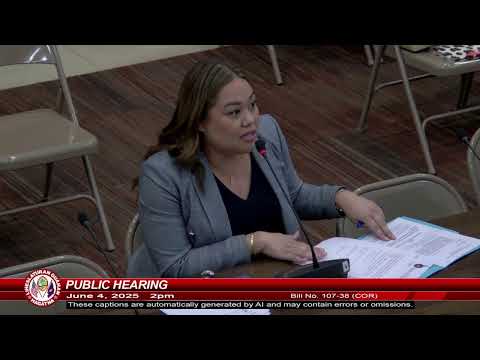
A Senate committee on June 4 considered Bill 106-38, introduced by Senator Parkinson, which would amend Guam law to require prosecutors to provide reasonable proof that victims were notified before a court accepts a plea agreement.
Senator Parkinson told the committee the bill is “about fundamental fairness and dignity,” and said prosecutors must be able to “affirmatively show proof that the victim was reached and informed.” He and supporting witnesses cited federal victims’‑rights laws and state practices as models and urged documentation—examples given included written acknowledgements or documented phone calls.
Supporters noted research on trauma‑informed notification and cited work by social‑work groups. The National Association of Social Workers (NASW) submitted testimony in support and recommended definition of “reasonable proof,” culturally competent outreach, use of victim advocates and interpreters, and annual reporting on compliance.
Committee members queried how the bill interacts with existing Guam law. Senator Sean Gumatautow observed that Guam statute (8 GCA chapter 160, the Victims’ Bill of Rights) already provides victims certain notice and participation rights, and asked the committee to specify what evidence a prosecutor must present to show notification occurred. Senators also asked whether law‑enforcement and prosecutor case files contain reliable contact information and how often that information is updated.
A BBMR fiscal note submitted in April 2025 determined the bill was administrative in nature and posed no fiscal impact to the government of Guam. Legal counsel reported no recommended amendments at the hearing; invitations were sent to the Office of the Attorney General, the Public Defender Service Corporation, Judiciary of Guam, Guam Parole Board, DOC, Department of Youth Affairs, Department of Education and victim‑service organizations for input.
The committee left the record open for additional written testimony and asked staff to gather clarifications on acceptable forms of proof, agency practices for maintaining victim contact data, and whether prosecutors currently document consideration of victims’ views in plea negotiations.
Outcome: No final vote; committee will accept written testimony for 10 days and expects follow-up information from judiciary and prosecutors.