Get Full Government Meeting Transcripts, Videos, & Alerts Forever!
Get email alerts on the Criminal Justice Parole topic
No spam. Unsubscribe anytime.
Guam committee hears bill to bar discretionary parole for violent and sexual offenders
Summary
Senators debated Bill 105-38 on June 4, which would restrict parole for people convicted of violent and sexual offenses by raising parole-eligibility thresholds; proponents cited truth-in-sentencing goals and recidivism data, while others warned of fiscal and constitutional risks.
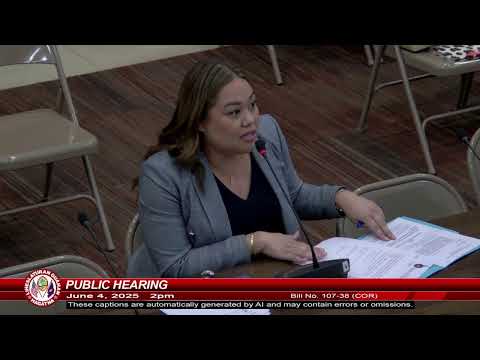
Senators heard testimony June 4 on Bill 105-38, a measure introduced by Senator Parkinson that would prohibit parole for persons convicted of violent and sexual offenses and require that those sentenced serve substantially more of their term before any release consideration.
The bill’s author, Senator Parkinson, told the committee the change is meant to ensure “violent and sexual offenders must serve their full prison terms,” saying “if the sentence is 20 or 30 years, then 20 or 30 years must be served.” He described the proposal as an alignment with “truth in sentencing” policies adopted in other jurisdictions.
Parkinson cited national recidivism data and high-profile cases to argue for the change. He said many states have limited discretionary parole for violent crimes and noted examples such as New York’s 85% requirement and Nevada’s effective elimination of early release consideration. Parkinson also referenced local parole-board procedural lapses in 2011 and Guam Police Department data he summarized from the 2023 report.
Committee members pressed for fiscal and legal details. Senator Sean Gumatautow asked the Department of Corrections (DOC) data questions included in the bill’s fiscal note, noting DOC cited roughly 305 detainees with charges listed in the bill and that maintaining a larger prison population raises facility and staffing costs. He also asked for DOC’s average length of confinement and records of in‑custody violations. Gumatautow noted prior media reporting and DOC estimates regarding daily incarceration costs (transcript references an historical $97.71/day figure and a more recent estimate near $120/day) and cited national research on per‑inmate annual costs.
Other senators raised constitutional concerns and questions about incentives for rehabilitation. A senator on the panel said that eliminating parole for categories of offenders “would likely result in most appeals and may be conceived as unconstitutional” and urged working with the attorney general to ensure the bill’s language passes constitutional muster. Committee staff and legal counsel reported no recommended amendments at the hearing but noted the judiciary would provide further input if submitted.
The chair closed discussion and left the record open for written testimony. The committee indicated it will accept written submissions for an additional 10 days and seek follow-up information from DOC, the parole board and the attorney general about implementation, fiscal impacts, and whether parole procedures and psychiatric-evaluation practices are being applied consistently.
Outcome: No final vote was taken; the committee left the hearing record open for 10 days and requested additional fiscal and legal information.