Get email alerts on the Nextgen 911 Gis topic
No spam. Unsubscribe anytime.
Morgan County discusses NextGen 911 rollout, data corrections and vendor work
Summary
County staff reported progress on text-to-911 and other NextGen 911 components, described extensive GIS data cleanup needed to create an MSAG, and discussed using Geocom for mapping work amid budget and procurement questions.
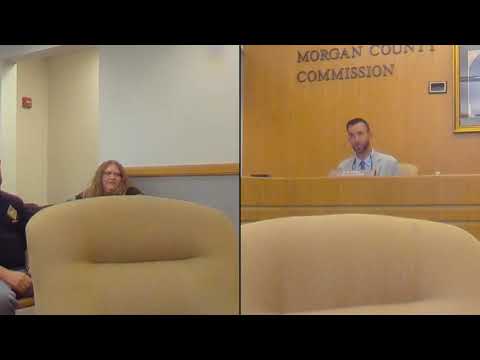
Marshall Yonker, identified in the meeting as a county staff member, told the Morgan County Commission on Oct. 15 that several NextGen 911 projects have moved into operation and that the county faces a substantial data-cleanup task before the system can be fully deployed.
"That transition has been tested out and done. It's now operational," Marshall Yonker said, referring to a text-to-911 capability the county piloted earlier this year. He said the county will keep a language line available for voice calls but will handle most calls by text going forward.
County staff reported additional components in testing or recently completed: a pager project, camera integrations with businesses and the school system, and training work. Yonker told the commission a trainer nominated by the county, Julie Farrell, won a statewide award for 911 training.
Why it matters: The county must supply accurate addressing and mapping data to meet NextGen 911 standards. Yonker said the county needs an MSAG (Master Street Address Guide) built to the state standard and that many county data elements—address points, road centerlines, municipal boundaries—require correction before vendors will certify systems for live use.
Commissioners and staff discussed vendor selection and budgeting. Yonker said the county has used Geocom for parts of the project and that other vendors’ bids were sometimes much higher. He also said the county previously committed roughly $45,000 "as part of the NextGen project," which could help offset further work. Yonker cautioned that creating an MSAG and cleaning the county's GIS data is "years of work" and will involve changing attribute tables and correcting addresses.
On procurement, commissioners asked whether the county should seek additional bids rather than sole-source work to Geocom. A commissioner said they would "like to at least have 1 other bid" to ensure competitive pricing; Yonker said other vendors quoted roughly double the cost for the same parts of the project.
Staff described operational dependencies and vendors. Yonker said the county currently uses Frontier data and that some vendor certification depends on reaching data-accuracy thresholds. He also said the county has an existing contract piece that was part of the NextGen project; the $45,000 figure was cited by staff as money already committed. Other dollar figures mentioned in the meeting—for example, a reference to "27,000"—were not fully explained in the discussion.
The commission did not take a formal vote on a contract or appropriation during the discussion. Commissioners directed staff to continue work on the MSAG and to pursue procurement options, including getting an additional bid if feasible.
The exchange included technical clarifications about what the county controls and what vendors provide. Yonker described the work as largely data correction—splitting or consolidating address fields, fixing road centerlines and boundary data—rather than new equipment installation. He said ongoing upkeep will be needed so that when a new address is added the master data is updated.
The discussion closed with staff acknowledging the scale of the project and saying they would return with further procurement and budget details for commission consideration.
AI generated
The text on this page is AI generated. Summaries, highlights, analysis, and video transcripts are all produced from the original source material.
AI can make mistakes, so if you spot one, and we will fix it for everyone.
Note: the source content is unaltered by us. Any content source we link to, be it a video, an audio recording, or a document, is presented exactly as its publisher released it. That publisher is usually a government body, sometimes an individual official or another organisation.