Get Full Government Meeting Transcripts, Videos, & Alerts Forever!
Get email alerts on the State Employee Health Insurance topic
No spam. Unsubscribe anytime.
Joint committee approves higher state health-insurance allocation per full-time position
Summary
The Joint Finance-Appropriations Committee approved a 2026 increase in the per‑employee health insurance allocation to $14,130 per eligible full‑time equivalent; the measure passed by joint majority and will carry a due‑pass recommendation.
The Joint Finance‑Appropriations Committee voted Friday to raise the state’s funding allocation for employee health insurance to $14,130 per eligible full‑time equivalent (FTE) for fiscal year 2026.
The motion to adopt the $14,130 per‑FTE figure was made during the committee’s Jan. 31 meeting by Senator Woodward and seconded by Representative Tanner. The committee recorded a joint total of 17 ayes, 0 nays and 3 absent/excused; the Senate recorded 8 ayes, 0 nays and 2 absent/excused and the House recorded 9 ayes, 0 nays and 1 absent/excused. The committee said the motion will carry a “due pass” recommendation.
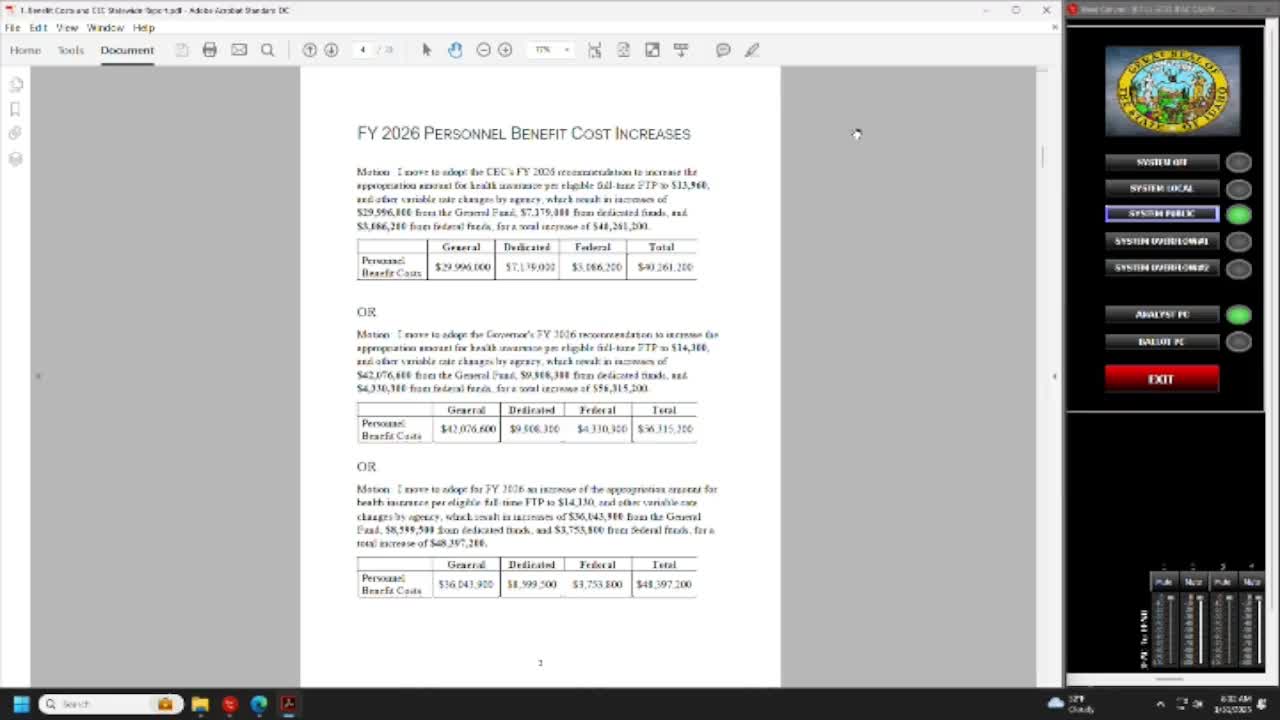
The change was offered after analysts presented three dollar‑amount options: the CEC committee recommendation of $13,960 per FTE, the governor’s recommendation of $14,300 per FTE, and a midpoint compromise at $14,130 per FTE. Mr. Bybee, the committee analyst, told members the most significant component of the personnel benefit cost changes is health insurance and that smaller employer‑paid adjustments for workers’ compensation and Social Security were included by agency.
Members debating the amounts described different approaches to managing the insurance reserve and the appearance of year‑to‑year premium changes. Senator Ward Engelking urged the committee to “reflect the actual cost of insurance” rather than using reserves to temporarily buy down premiums, saying buying down premiums in one year can make future increases look larger. Representative Furness cited actuarial projections from Milliman and urged the committee to use a more conservative number, arguing some actuarial projections have overestimated costs in past years.
Mr. Bybee provided projected reserve balances tied to the three dollar options: a projected ending reserve balance of about $51.6 million for the $13,960 option, $61.4 million for the $14,300 option, and an intermediate balance for the $14,130 option (the analyst noted he did not have that midpoint calculation immediately available but earlier described the midpoint approach).
Committee clerking staff completed the roll calls and the chair announced the motion passed; the committee instructed staff that the recommendation will carry forward as a due‑pass recommendation.
The committee discussed voting procedures for joint votes and confirmed a procedural determination to require a majority of the quorum present from each chamber’s committee delegation to carry joint motions in this session. The committee also noted it will revisit the personnel‑benefit and compensation decisions at a later date if necessary.
The committee moved on to separate discussions about change‑in‑employee‑compensation (CEC) options after the vote on the health‑insurance allocation.