Get Full Government Meeting Transcripts, Videos, & Alerts Forever!
Get email alerts on the Federal Grants Budget Risk topic
No spam. Unsubscribe anytime.
King County warns federal funding changes could squeeze public health, transit and human services
Summary
County budget staff briefed the Council on a fast-evolving federal funding landscape, saying new grant conditions, litigation and possible federal budget cuts risk millions in county services; the county has instituted legal review before accepting federal awards.
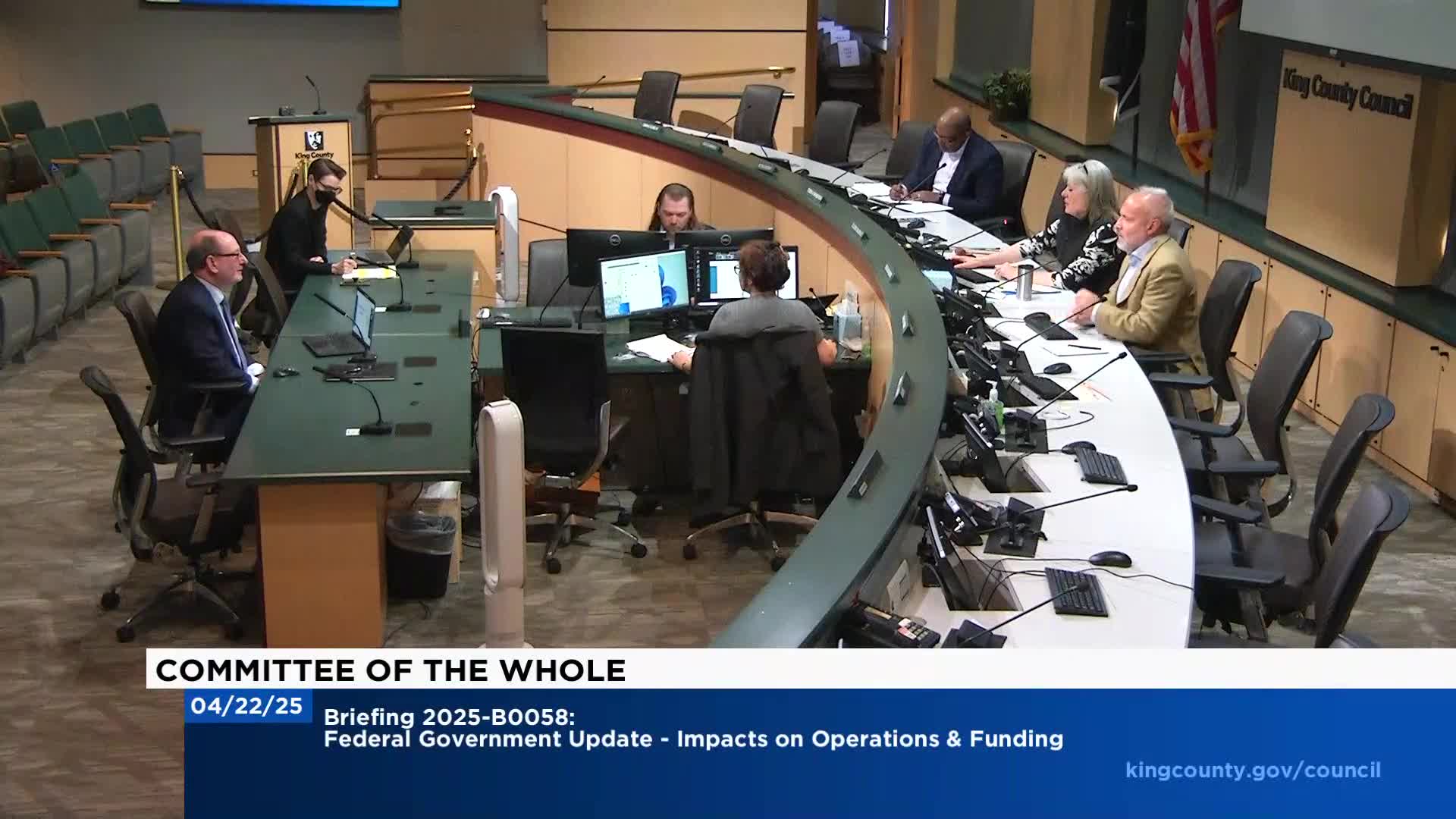
Dwight Dively, director of the Office of Performance, Strategy and Budget, told the King County Council Committee of the Whole on April 22 that the county is seeing rapid, unpredictable changes in federal grant conditions and that the executive has put a new sign‑off process in place.
"We are directing departments to not make any applications or sign any acceptances without the explicit legal approval of legal counsel in the executive's office," Dively said, describing a single review point intended to prevent one agency from inadvertently binding the entire county to conditions the county cannot accept.
Dively said the county is tracking three types of federal risk: new conditions attached to grants, changes to renewals or new awards, and larger cuts if Congress and the White House approve reduced domestic discretionary funding next fiscal year. He described mixed federal behavior on compliance with court orders, and cited a recent nationwide injunction from the U.S. District Court for Rhode Island that restored access to some public health awards.
The briefing referenced immediate examples: the Federal Emergency Management Agency denied Washington State’s request for disaster public assistance for last fall’s bomb cyclone — a denial county emergency management staff said would have been approved historically — and the U.S. Department of Health and Human Services has asked how certain programs will comply with newly announced executive orders.
Dively said the county has not yet found grants that would force it to sign unacceptable conditions, but that legal review and coordination with the King County Prosecuting Attorney’s Office are now mandatory steps before any department signs federal awards. "We really face 3 types of risk," he said.
Council members pressed for specifics. Councilmember Burrowan asked whether the county would simply absorb a $2 million denial for county roads and parks; Dively replied that the county would front costs and that departments had sufficient appropriation in that instance, but cautioned that FEMA historically reimburses slowly. Councilmember Zahilai and others asked about coordination with other governments and the state; Dively said that interjurisdictional coordination is happening mainly on an issue‑by‑issue basis (public health with county and state health departments; transit with other transit agencies) and that state leaders have limited ability to backfill federal reductions.
Dively offered a rough exposure estimate: of the federal dollars in the adopted 2025 county budget, he judged that $10–20 million might realistically be at risk from actions the administration has taken, "and very little of it goes into the general fund," he said, noting that the bulk of at‑risk federal funds flow to public health, Community and Human Services, and Metro Transit.
He identified several timing risks: (1) immediate contractual risk if a federal agency refuses to honor existing awards and refuses to comply with court orders; (2) a July 1 state‑budget risk if expected state backfill (for example, for the document recording fee) is not provided; and (3) the risk after October 1 if a new federal fiscal year budget reduces domestic discretionary and entitlement spending.
Dively recommended private briefings or executive‑session discussion where litigation or contract specifics arise. Councilmembers said they would share the briefing with the county’s congressional delegation and asked that the county distribute the briefing slides to the full committee.
Ending: Dively concluded that the county will continue monitoring daily developments, coordinating with legal counsel, working with departments, and updating the Council as federal and state situations evolve.