Get Full Government Meeting Transcripts, Videos, & Alerts Forever!
Get email alerts on the Public Defender Budget topic
No spam. Unsubscribe anytime.
JFAC approves multi‑part public‑defender supplementals and larger FY26 enhancement package
Summary
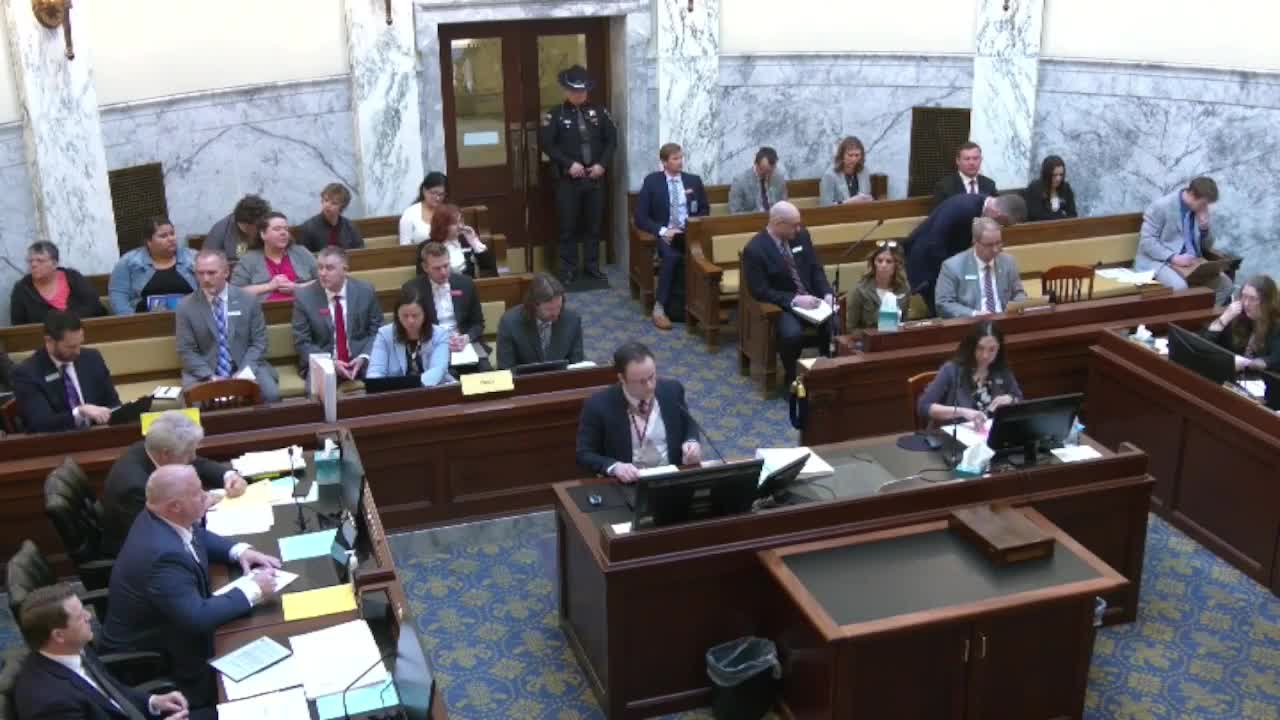
The Joint Finance‑Appropriations Committee on March 24 approved three FY2025 supplementals and a larger FY2026 enhancement package for the newly created Office of the State Public Defender, funding transcript costs, higher contractor rates, staff positions and operational increases.
The Joint Finance‑Appropriations Committee on March 24 approved a series of supplemental and enhancement budget actions for the Office of the State Public Defender, the new state agency created by Idaho Code (Title 19, Chapter 60). Committee members approved three FY2025 supplementals and later approved a larger FY2026 enhancement package that increases ongoing personnel and contract funding while adding nearly 18 full‑time equivalent positions for new institutional offices.
Supplementals approved in current fiscal year
- Child Protective Act appropriation alignment: Representative Manwaring moved and Senator Cook seconded a one‑time appropriation of $2,500,000 from the Public Defense Fund to align authorized appropriation with the cash transfer specified in statute (referenced in the transcript as section 57 8 11, Idaho Code). The motion passed with a combined committee tally of 15 ayes and 5 nays and will carry a due‑pass recommendation.
- Transcript costs: The committee adopted the governor’s recommendation of $390,200 one‑time from the general fund to cover court‑ordered transcript costs following the Idaho Supreme Court’s ruling in State v. Blasek that the state is responsible for transcript costs effective in the current fiscal year. Representative Tanner moved the supplemental; the motion carried unanimously 20‑0.
- Additional personnel and contracting costs (current fiscal year): The committee approved $3,799,900 one‑time from the general fund to increase state employee salaries and to raise the contracted‑attorney rate to $125 per hour (up from the previously discussed $100/hour). Representative Manwaring moved the supplemental; the motion passed with a combined tally of 13 ayes and 7 nays. The transcript records the governor reduced the original request and that the supplemental lowers the governor’s ask by about $1.6 million.
FY2026 enhancement package
Later in the session the committee considered and approved a FY2026 enhancement motion that totaled $32,382,100 in additional budget enhancements (including dedicated funds), adding 17.96 full‑time equivalent positions. The enhancement package included: a permanent alignment for Child Protective Act appropriations, a substantial operating budget addition to cover contracted attorneys, investigators, experts, capital litigation costs and IT purchases, 17.96 FTPs and $226,700 for new institutional offices (Benewah, Elmore, Jerome and Shoshone counties), ongoing transcript cost funding, ongoing personnel costs, and an ongoing increase in contracting that implements a $125/hour standard for contracted attorneys. Representative Manwaring moved the enhancement package; Senator Cook seconded. The motion passed on roll call with a combined committee tally of 12 ayes and 8 nays and will carry a due‑pass recommendation.
Committee discussion and context
Members and staff described multiple drivers for the requests: a recent court decision (State v. Blasek) requiring the state to cover transcripts; a transition of public defense duties from county to state that led some contract attorneys to stop taking cases; shortages of attorneys in rural counties; and a need to recruit contract and experienced attorneys back into the system. Representative Manwaring and others described parallel policy work (Senate Bill 1191 referenced in the transcript) intended to analyze the efficiency and cost effectiveness of contracting vs. employing defenders and to require consultation with district public defenders and county commissioners on transition plans.
Several legislators expressed concern about implementation, county coordination, facility arrangements and communications during the transition. Representative Miller and others cited facilities and memorandum‑of‑understanding issues in counties such as Ada, Twin Falls and Gooding. Supporters argued the enhancements are intended to stabilize operations and get attorneys assigned to cases promptly; opponents argued more structural fixes are necessary beyond immediate funding increases.
The transcript records specific roll‑call tallies for each motion described above; the committee recorded that the motions will carry due‑pass recommendations to the full legislature.