Get Full Government Meeting Transcripts, Videos, & Alerts Forever!
Get email alerts on the Medical Education topic
No spam. Unsubscribe anytime.
House committee advances bill to add medical school seats, directs state board to plan expansion
Summary
The House Committee on Education voted to send House Bill 368 to the floor with a due-pass recommendation after debate over shifting WWAMI seats and adding in‑state medical education capacity. The bill would add 30 non‑WWAMI seats (net +20) and direct the State Board of Education to produce a medical education growth plan.
BOISE — The House Committee on Education voted Wednesday to send House Bill 368 to the floor with a due‑pass recommendation after hearing testimony from the bill sponsor, medical educators and Idaho clinicians.
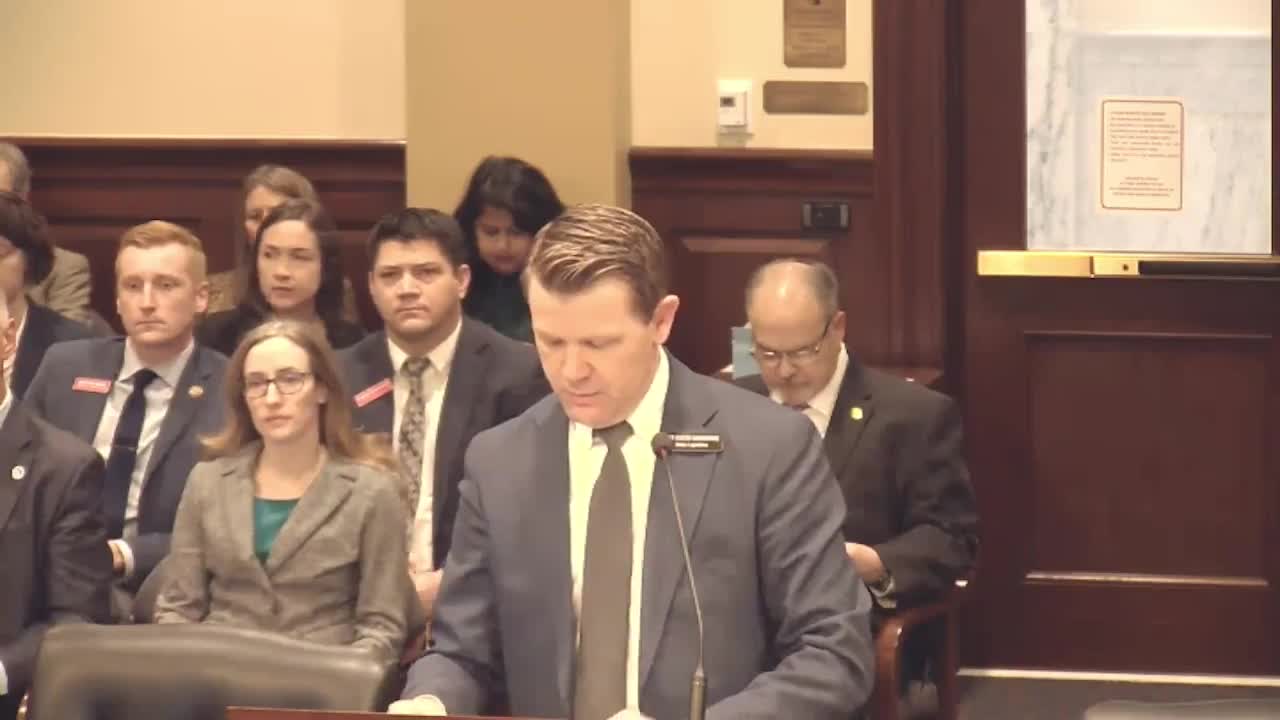
Representative Dustin Manwaring, state representative for District 29 of Pocatello and the bill’s sponsor, told the committee Idaho ranks “fiftieth out of 50 states for physicians per capita” and described the legislation as a way to expand medical education options in Idaho. “With this pending legislation, Idaho will add 30 new non‑WWAMI seats leading to a net increase of 20 medical school seats bringing the total to 70,” Manwaring said. The bill also directs the State Board of Education to develop a medical education plan to guide future expansion.
The measure would phase in new seats over multiple years, with Representative Manwaring explaining the schedule as adding ten non‑WWAMI seats in year one, ten in year two offset by a 10‑seat reduction in WWAMI, and a final ten in year three, for a net gain of 20 seats. Manwaring reported current state support of nearly $8 million annually for the WWAMI program, saying “about two thirds of it or over $5,000,000 a year goes to the University of Washington.” He characterized the bill as a means to diversify where that money is invested and to give Idaho more influence over admissions, clerkships and training locations.
University of Utah School of Medicine officials told the committee they are prepared to partner on expanded Idaho training. “We feel very confident,” said Benjamin Chan, associate dean of admissions and Idaho affairs at the University of Utah School of Medicine, describing plans to keep most training in Idaho and bring students to Salt Lake City only for specialty rotations or research that cannot be completed in‑state.
WWAMI (the regional partnership that places many Idaho students at the University of Washington) also testified. Mary Baranaga, a family physician and WWAMI graduate who works on clinical site development in Idaho, urged maintaining WWAMI while creating a statewide plan. “WWAMI is committed to figuring out how we expand medical education in Idaho,” she said, and noted an economic impact study by the University of Idaho showing that “for every dollar that's invested into Idaho WWAMI, our state gets back $5.10.” Baranaga said the biggest practical obstacle to expanding seats is securing clinician preceptors and clinical rotation sites, a shortage worsened after the COVID‑19 pandemic.
Josh Whitworth, executive director of the State Board of Education, told the committee the board supports a methodical plan that brings partners — including WWAMI, the University of Utah and Idaho institutions — together to grow the physician workforce. Senator Dave Veil, a bill cosponsor, described the proposal as planning for long‑term growth: “This really isn't about right or wrong or who's at fault, this is about how do we diversify our education process, how do we create more educational opportunities for our doctors in the state and retain those.”
Committee members debated the bill’s Section 2, which specifies how many seats will be added and reduced and includes the phrase “at least 10” in one line. Representative Mathias and others pressed for clarity about whether “at least 10” could mean the legislature or the State Board could direct more or fewer seats; Manwaring said the statute establishes a 10‑seat baseline and the medical education plan could recommend more.
After discussion and two failed alternative motions — one to hold the bill in committee and another substitute to send it to general orders — the committee approved the motion to send HB 368 to the full House with a due‑pass recommendation. The roll call recorded the final vote as 8 yes, 5 no, 1 absent.
Votes at a glance
- House Bill 368 (medical education expansion): Motion to send to floor with due pass. Mover: Representative Hawkins. Committee outcome: sent to the floor with due‑pass (8 yes, 5 no, 1 absent). The committee also considered and rejected a motion to hold the bill in committee and a substitute to send to general orders.
- Senate Bill 1091 (technical transfer to State Board of Education): Motion to send to the floor with due pass. Committee outcome: approved (voice vote; no roll call recorded). The bill makes a technical one‑word change reflecting a prior budget transfer.
What the bill does and what remains unresolved
HB 368 would add 30 non‑WWAMI seats, producing a stated net increase of 20 seats (from 50 to 70 total) over a multi‑year phase‑in; it also directs the State Board of Education to prepare a medical education plan that considers admissions, training locations, clerkship capacity and partnerships. The committee heard competing perspectives on whether seats should be taken from WWAMI now or whether expansion should focus first on securing clinical sites and residency pipelines in Idaho. Several members sought firmer limits or more explicit language about how and when WWAMI seats might be reduced.
The bill’s sponsor and multiple testifiers emphasized that clinical‑site capacity, preceptor recruitment and graduate medical education (residency) expansion are critical to actual increases in practicing physicians. Witnesses asked the legislature to ensure the State Board’s plan addresses clerkship capacity, retention strategies and the role of existing partners.
Next steps
HB 368 will go to the full House with a due‑pass recommendation. The committee directed the State Board of Education to produce the medical education plan described in the bill language, and several members signaled they expect follow‑up legislation or amendments as the plan and implementation details are developed.