Get Full Government Meeting Transcripts, Videos, & Alerts Forever!
Get email alerts on the County Fairs Governance topic
No spam. Unsubscribe anytime.
House panel advances bill to repeal population cap on county fair governance
Summary
The House Agriculture Affairs Committee voted to send House Bill 106 to the House floor with a due-pass recommendation. The bill would repeal a statutory population threshold that allows counties above the cap to convert county fair boards to advisory-only status and would grandfather currently affected counties while providing a path to revert.
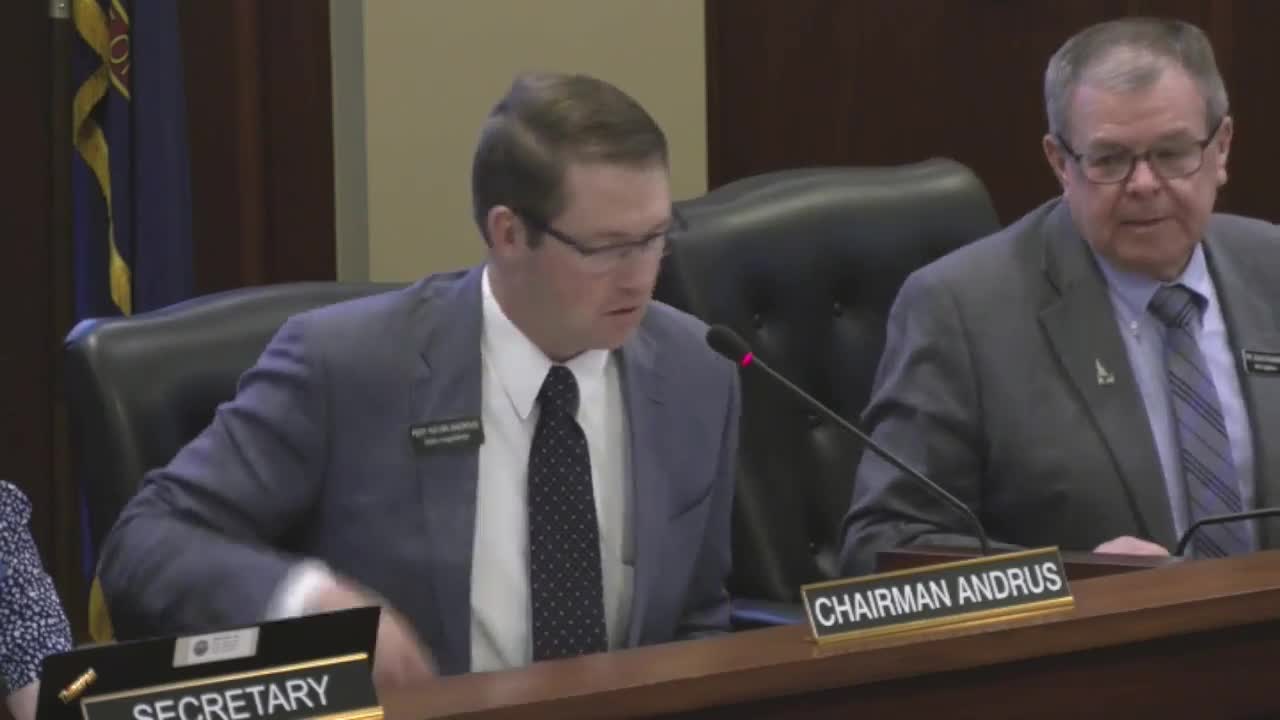
Boise — The Idaho House Agriculture Affairs Committee voted to send House Bill 106 to the House floor with a “do pass” recommendation after roughly an hour of testimony and questions Thursday.
Sponsor Representative Gerald Raymond, who introduced the measure, said the bill would repeal a population-based rule that allows some counties to convert their county fair boards to advisory-only status. “The purpose of the county Fair is to promote agriculture in that county,” Raymond said, summarizing the bill’s intent and historical context.
The bill would repeal the statute commonly cited as section 202A, which Raymond said set a population threshold originally at 100,000 in 1989 and later was raised to 200,000 in 1993. Under current draft language, the statute would be repealed and the legislation would grandfather the two counties operating under the advisory-only model while providing an explicit procedural path for those counties to return to the prior governance model if they choose.
Why it matters: County fair boards manage fairgrounds, year-round events and youth agriculture programs that many speakers said form a core public connection to production agriculture. Supporters argued keeping local, volunteer-led governance preserves community partnerships, fundraising and timely operational decisions.
Supporters and testimony Linda Bridal, a rancher from near Coeur d'Alene who said she serves on her county fair board, told the committee that her fair is a year-round operation with 81 acres, 26 buildings and more than 700 event days last year. “House Bill 106 is of particular interest to our Fair Board because we are no doubt the next county to reach that 200,000 population threshold,” Bridal said, explaining why her board fears losing operational control if the county commissioners assume direct management.
Braden Jensen of the Idaho Farm Bureau Federation said the federation supports the bill. “The vast majority of our society these days, their only interaction with production agriculture happens at the county fair,” Jensen told the committee, arguing the fairs provide important public education about agriculture.
Opposition and concerns Sarah Westbrook of the Idaho Association of Counties testified she and the association oppose the bill as written. “We are opposed to this, bill as it's written currently,” Westbrook said, and urged tightening some language. Westbrook flagged section 4’s mechanics and argued the draft could allow changes to the two counties currently operating in the advisory-only model; she recommended clearer punctuation and process language to avoid ambiguity.
Committee members pressed for clarifications. Representative Levitt asked how fair board members are chosen; Raymond replied that county commissioners appoint members and that, in practice, community volunteers who are active in 4-H and FFA generally step forward. Representative McCann asked whether counties that have crossed the 200,000 threshold would remain unchanged; Raymond said, “Should this house bill pass, then they would remain operating as status quo.”
Procedure and next steps Representative Dygert moved to send House Bill 106 to the floor with a due-pass recommendation. The committee approved the motion by voice vote; the official roll-call tally was not recorded in the hearing transcript. The bill will now go to the House calendar for consideration by the full chamber.
Clarifying details from the hearing - Historical statute: Witnesses and the sponsor referenced statutory language commonly identified as section 202A (Idaho Code Title 22 provisions on county fairs), originally tied to a 100,000-population trigger and later amended to 200,000. - Repeal and grandfathering: The bill’s text (as read by the sponsor) would repeal the 202A threshold, grandfather the two counties currently operating under an advisory-only model, and provide a mechanism for counties to return to the pre-1989 governance model. - Reversion process described in testimony: a fair board must petition county commissioners, there would be a public hearing, and then a higher-level approval by the fair board (testimony described a three‑quarters threshold) before any governance change; county commissioners remain a gatekeeper.
Community impact and context Testimony emphasized the role fairs play in youth livestock programs, education (including farm-to-school or farm-to-table field trips for fifth graders), local volunteerism and local economic activity. Several committee members said they will review the bill’s language further before the House floor debate.
Outcome The committee approved sending House Bill 106 to the House floor with a due-pass recommendation. No amendments were adopted in committee; the bill will proceed to the House calendar for further action.