Get Full Government Meeting Transcripts, Videos, & Alerts Forever!
Get email alerts on the Aquatic Invasive Species topic
No spam. Unsubscribe anytime.
Idaho reports limited quagga detection, completes expanded Snake River treatment and statewide testing increase
Summary
The Idaho State Department of Agriculture told the House Agriculture Affairs Committee it intensified boat inspections and water sampling in 2024, undertook a large chelated-copper treatment on the Snake River after 2023 detections and continues multilab confirmation and monitoring efforts to delimit and address quagga mussel presence.
The Idaho State Department of Agriculture (ISDA) briefed the House Agriculture Affairs Committee on Feb. 18 about expanded quagga and zebra mussel surveillance and a large-scale treatment on the Snake River following detections in 2023 and 2024.
ISDA Director Chanel Tewalt and bureau chief Nick Zerflue described a rapid, multi‑partner response that increased inspections, doubled statewide water sampling and added laboratory redundancies and external subject-matter review in 2024. "We have increased by every single measure what we do in this program," Tewalt said, noting more stations, more hours, more communication and more partners.
ISDA fieldwork and lab confirmation: Tewalt and Zerflue said the department uses a multi-layered confirmation process: initial plankton-net sampling for veligers, visual assessments, double-blind review with outside taxonomic experts, molecular confirmation and cautious use of environmental DNA (eDNA). Tewalt cautioned that eDNA can be imprecise and stressed the department’s effort to avoid false alarms by combining methods. Zerflue emphasized redundancies in lab review and cross‑state consultations to speed and validate sample identification.
Delimitation and treatment decision: The agency said it delayed public alarm until genetic confirmation was obtained and then began a targeted delimitation sampling strategy along the mid‑Snake River to determine the infestation’s leading edge. ISDA reported fewer veligers in 2024 than in 2023, which the agency described as evidence the 2023 treatment reduced populations but also noted that finding any veligers in the Snake River is unacceptable.
ISDA described the 2024 treatment as larger and more complex than the prior year’s effort. The department said it worked under federal and state permitting to deploy a chelated‑copper product (manufacturer SePRO) in Twin Falls Reservoir and the Twin Falls reach, treating approximately 8.6 river miles and deploying just over 60,000 gallons of product between Oct. 8 and Oct. 19, 2024. Zerflue said the treatment strategy targeted an in‑river concentration of 1 part per million and extended contact time to a 200‑hour duration once that concentration was maintained; the 200‑hour clock, he said, did not start until monitoring showed the 1 ppm concentration had been achieved. ISDA personnel said they coordinated flow augmentation and measurement with Idaho Department of Water Resources and Idaho Power to ensure stable flows for accurate dosing.
Partners and logistics: ISDA said it coordinated closely with contracted applicator Clean Lakes, the product manufacturer SePRO, distributor Simplot for logistics and Idaho Power for access and flow management within hydroelectric facilities. The department also worked with university laboratories, the University of Idaho’s Hagerman facility and Pisces Laboratory, and obtained outside verification from taxonomists in other states and Canada. ISDA called the collective response a "three‑pillar model" that combined ISDA staff, the contracted applicator and product manufacturer scientists.
Monitoring and impacts: Zerflue said field teams conducted scuba assessments and multiple surveys and that no adult mussels were observed in 2024, only low numbers of veligers at a few sites. The department said it ran daily monitoring and had contingency plans to remove copper downstream if needed, but that the contingency (activated charcoal and other mitigation) was not required. Tewalt acknowledged treatment impacts and told committee members ISDA has committed to transparency and to providing clear expectations to affected communities.
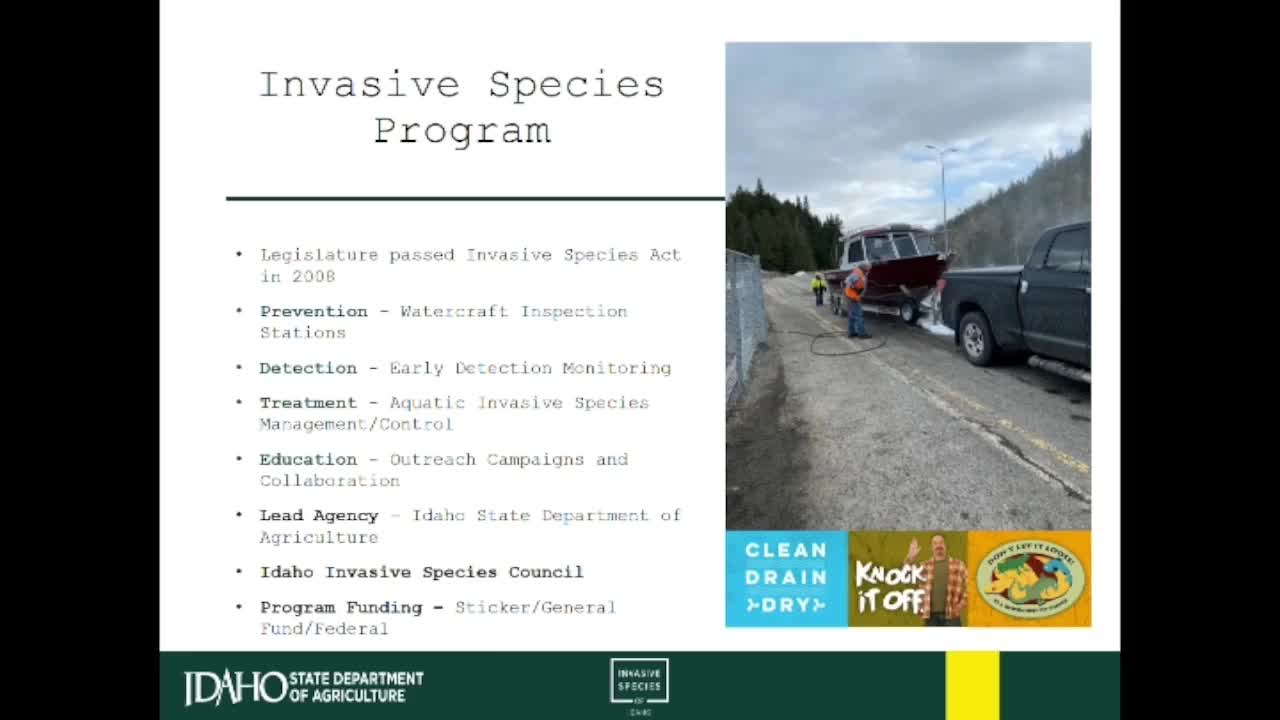
Prevention, inspections and law enforcement: Tewalt and Zerflue said ISDA increased boat inspections roughly 50% from 2023 to 2024 and urged stronger public cooperation, especially from out‑of‑state boaters. Tewalt said Idaho law prohibits hauling boats with ballast water and requires out‑of‑state boaters to have inspections before launching; she noted ISDA lacks independent enforcement authority and depends on law‑enforcement partnerships to check compliance at launch points.
Why it matters: Quagga and zebra mussels attach to hard surfaces and can damage irrigation systems, hydropower infrastructure and municipal intakes; their spread poses economic and ecological risk. ISDA officials told the committee they are attempting an aggressive technical and operational response to limit establishment in the Snake River while expanding statewide monitoring to detect new introductions early. The agency said its program is well resourced by recent legislative actions but urged continued partnership from local governments, law enforcement and the boating public.
ISDA said it would continue expanded sampling in 2025, maintain the multi‑laboratory confirmation process and run outreach campaigns to increase awareness at high‑risk launch sites.