Get Full Government Meeting Transcripts, Videos, & Alerts Forever!
Get email alerts on the Public Safety topic
No spam. Unsubscribe anytime.
Idaho State Police seeks funds for fentanyl response, lab expansion and to shore up trooper ranks; director warns of staffing shortfalls
Summary
During a budget review, Idaho State Police requested staff and funding for fentanyl interdiction, forensic capacity, a housing unit for remote troopers and a transfer to replace shrinking highway distribution revenues; Director Bill Gardner warned of trooper vacancies and urged action to retain officers.
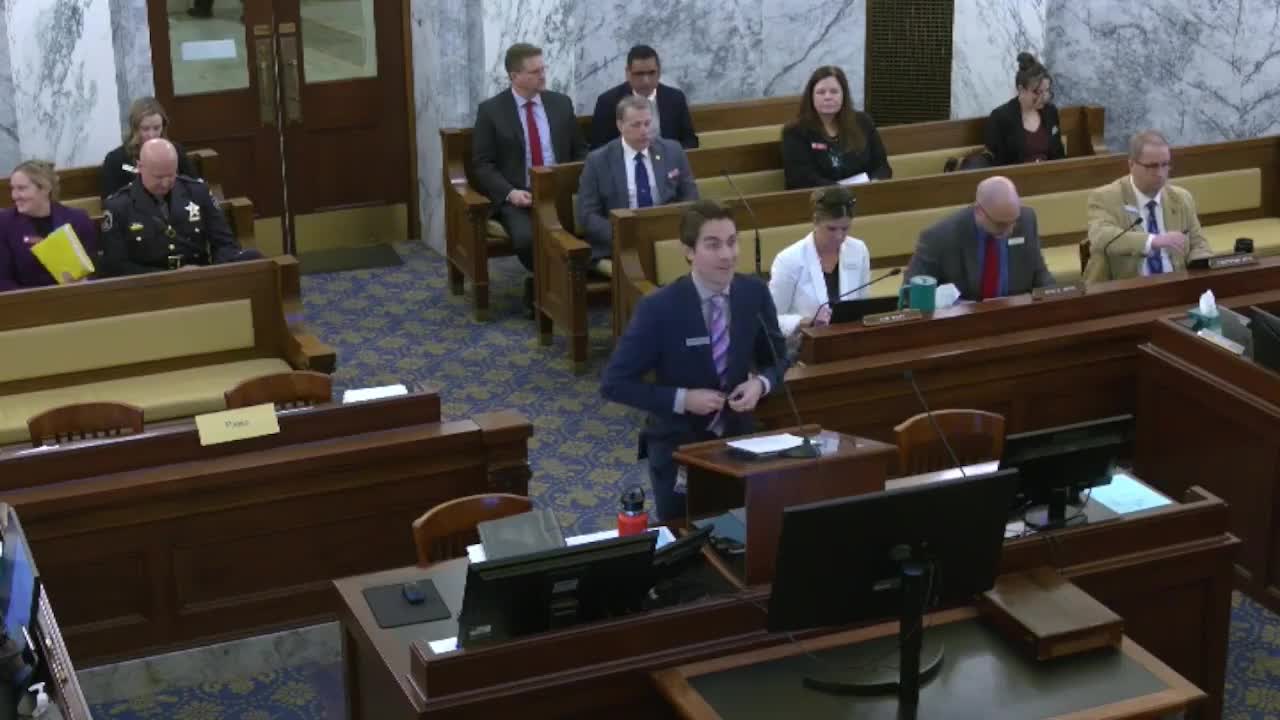
Idaho State Police officials outlined multiple budget requests and operational pressures during a Feb. 12 Joint Finance and Appropriations Committee hearing, seeking staffing and funding to maintain patrol operations, expand forensic capacity and bolster responses to fentanyl trafficking.
Budget analyst Noah Peterson reviewed the agency's fiscal requests, including a proposed transfer of $4,995,500 and 37.48 full‑time positions in fiscal year 2026 to replace diminishing Highway Distribution Account (HDA) support for the Law Enforcement Fund. Peterson said the change responds to a statutory phase‑down from Senate Bill 1201 (2019) that reduced HDA transfers to law enforcement and will be necessary "if this shift is to be approved, this would allow the patrol program to maintain current operations."
The agency requested multiple enhancements for fiscal 2026: two fleet service positions to convert contractor work to state employees (2.00 FTP; net $63,300), a four‑person special investigations unit to handle criminal investigations at Department of Correction facilities (4.00 FTP; $757,300 total, $443,300 ongoing, $314,000 one‑time), a forensic deputy lab manager (1.00 FTP; $118,200), an estimated $168,100 fiscal impact to implement DNA‑collection legislation (described as 1,681 samples at $100 each), a request to convert investigators for the sexual assault kit initiative to permanent employees (net 0 transfer to personnel; $402,100), a $233,000 ongoing ILETS disaster recovery site appropriation, and multiple transfers and IT consolidations.
Colonel Bill Gardner, director of Idaho State Police, told the committee the agency is facing severe staffing pressures in parts of the state and described recent enforcement results. "I can tell you that over the last year, we've seized over 65,000 fentanyl pills, over a full pound of fentanyl powder, [and] 150 pounds of methamphetamine," Gardner said, adding that in a recent operation the agency seized 50 pounds of methamphetamine in a single operation.
Gardner said vacancies are concentrated in northern Idaho and that competitive pay elsewhere is drawing officers away. "I've got an opening right now through DHR to hire troopers and I can't get anyone to apply from Northern Idaho," he said. The director said the department is exploring short‑term steps such as reassigning detectives to uniformed patrols and seeking longer‑term pay and retention solutions with the committee, DHR and DFM.
The agency also requested $268,100 as a supplemental to acquire a remote housing unit to station personnel in Fairfield (originally planned for Mackay). Colonel Gardner said Fairfield was chosen because Idaho Transportation Department property there already has excavation and utilities in place and would be less costly to finish.
On a proposed public‑awareness effort, the governor recommended a $500,000 one‑time Millennium Fund payment for a "Fentanyl Takes All" communications campaign; DFM confirmed the recommendation is for one‑time funding and said the Millennium Fund committee will consider the request.
Agency staff and committee members also discussed the planned Meridian forensic laboratory project and smaller lab space improvements in Twin Falls that are intended to increase forensic capacity. Peterson and Gardner said a new Meridian lab will consolidate equipment and staff and offer room for future growth; the Twin Falls work is renovation to add a drug‑identification lab focusing on southern Idaho cases.
The committee did not vote on agency requests during the hearing; staff said several items are subject to later decisions, including Millennium Fund approval and the committee's deliberations on OITS consolidation and appropriations.