Get Full Government Meeting Transcripts, Videos, & Alerts Forever!
Get email alerts on the Sb34 Historical Displays topic
No spam. Unsubscribe anytime.
Proponents urge posting founding-era documents, including Ten Commandments, in classrooms; critics question legal and pluralism implications
Summary
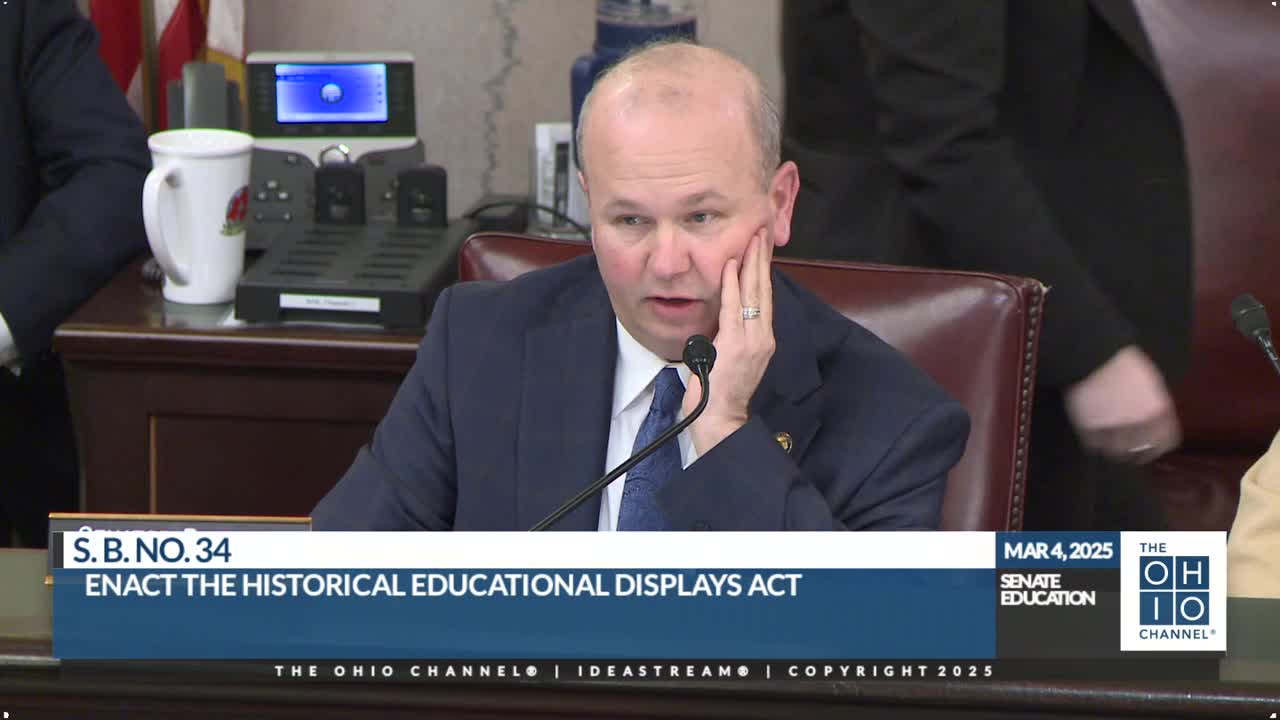
Supporters of Senate Bill 34 argued it would strengthen civic knowledge by requiring school districts to display historical documents — including, as an option, the Ten Commandments — as part of classroom displays; committee members raised questions about the selection of documents and potential First Amendment implications.
Supporters of Senate Bill 34, the Historical Education Displays Act, told the Senate Education Committee that requiring school districts to post one of a list of founding or historically influential documents in classrooms would strengthen civic knowledge. Two proponents — Tim Throckmorton of the Family Research Council and Monty Lobb of the Christian Business Partnership (Center for Christian Virtue) — urged committee members to support the bill and framed the Ten Commandments as a historical influence on Anglo-American legal and moral thought.
Tim Throckmorton characterized the Ten Commandments and similar documents as part of the nation’s civic heritage and said they have long appeared in American educational materials and public halls; he closed by saying, “I therefore urge your support of Senate Bill 34.” Monty Lobb, who teaches political science and has taught citizenship exam material to college students, said many students cannot identify the founding documents and asked, “What’s so scary about the Ten Commandments? Is it possibly because people may actually follow these tenets?” He argued that the Ten Commandments helped shape moral norms that underpin civic order and law.
Committee members questioned the scope and selection of the documents on the bill’s list. Senator Smith asked whether more modern or different milestone documents — such as the Emancipation Proclamation (1863), the 19th Amendment (1920) or even recent Supreme Court decisions — should be included; proponents said the bill intentionally focuses on founding-era documents that directly influenced the political philosophy of the founders and that other relevant documents also form part of broader civic education. Senator Smith additionally noted the National Archives’ 1965 list of 100 milestone documents did not include the Ten Commandments and asked whether that omission undercut the bill’s selection criteria.
Senators also raised legal questions. A committee member referenced Stone v. Graham (1980), a U.S. Supreme Court case that struck down a Kentucky law requiring Ten Commandments postings, and asked whether the Ten Commandments could be displayed in a nonsectarian, historical context to avoid Establishment Clause problems. Proponents said the bill frames the Ten Commandments as a historical document and argued the display would be educational and contextual.
Ranking Member Ingram repeatedly emphasized concerns about religious diversity in public schools and the proper roles of families, religious institutions and schools in teaching morality. Proponents replied that the documents would be displayed as part of historical instruction and that local districts retain discretion about which document to display.
No vote occurred during the second hearing. The committee took testimony from proponents and asked clarifying questions; members signaled concerns about legal risk and asked whether additional documents or contextual language might be appropriate.