Get Full Government Meeting Transcripts, Videos, & Alerts Forever!
Get email alerts on the Student Transportation topic
No spam. Unsubscribe anytime.
Department reviews transportation law, impracticality rules and penalties after rising noncompliance fines
Summary
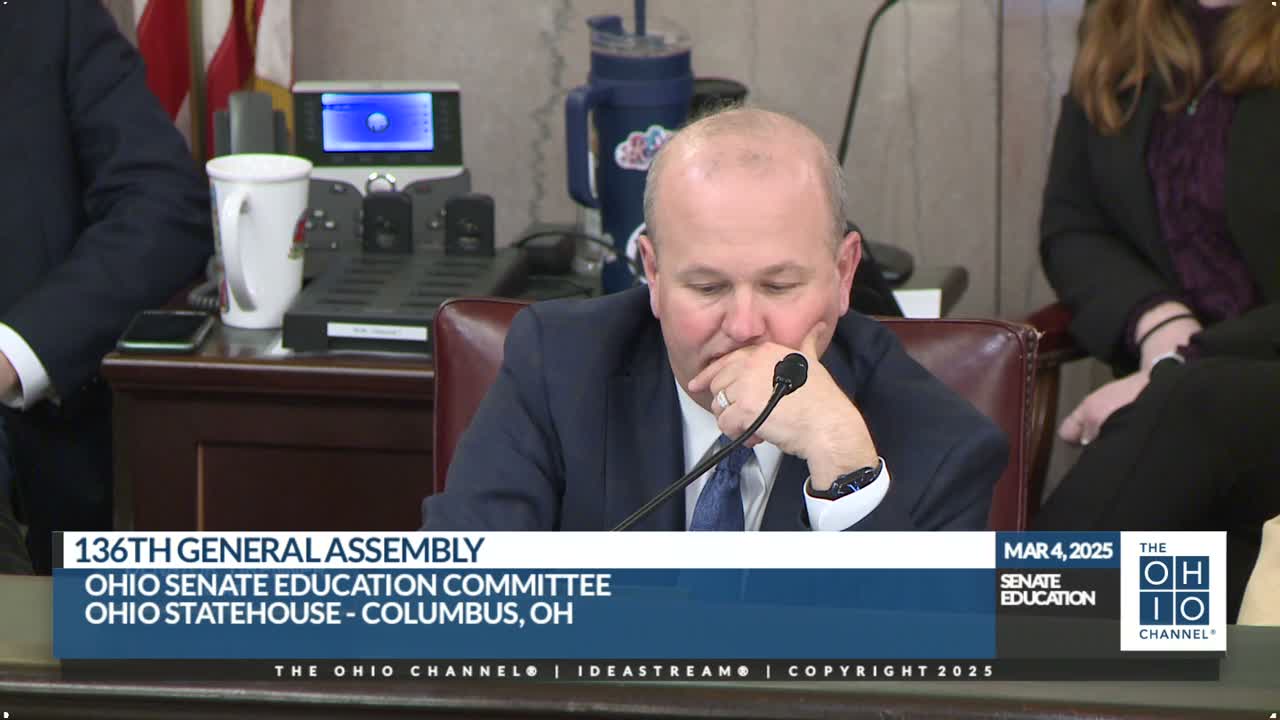
The Ohio Department of Education and Workforce provided senators a detailed overview of state student transportation law, explaining who is eligible for transportation, how “impractical to transport” determinations are made, payment‑in‑lieu rules, allowable transportation modes and statutory penalties for noncompliance.
The Ohio Department of Education and Workforce provided senators a detailed overview of state student transportation law, explaining who is eligible for transportation, how “impractical to transport” determinations are made, payment‑in‑lieu rules, allowable transportation modes and statutory penalties for noncompliance.
“State law lays out several groups who are eligible to be transported to and from school by their resident school district,” Jenny Stump, chief of policy and legislative affairs, told the committee. Stump listed the standard K–8 2‑mile rule, provisions for students with physical disabilities and students whose IEPs require transportation, and open‑enrollment rules when requested by parents.
Nut graf: The presentation specified administrative processes that districts must follow when declaring a student “impractical to transport,” the six statutory factors the board must consider, timelines for the determination and appeal paths that include mediation and Chapter 119 hearings. Committee members pressed the department for additional data after staff cited several large fines in recent years.
Key rules and procedures
Stump described two important statutory exceptions: a district is not required to transport a student if the drive time between the assigned public school and the school the student attends is more than 30 minutes (the district times the route during the same time of day the bus would run), and districts may declare an otherwise eligible student “impractical to transport” after considering six factors laid out in statute.
“The law does not allow blanket declarations,” Stump said. “Declarations of impracticality must be on a student‑by‑student basis.” She listed the six factors that must be considered: time and distance, number of students transported, cost of equipment/maintenance/personnel/administration, whether similar service is provided to other students, whether additional service disrupts current schedules, and whether other reimbursable transportation options exist.
If a board declares a student impractical to transport, it must notify the parents, the school the student attends, and the department and provide detailed reasons and which statutory factors applied. The district must offer the parent payment in lieu of transportation; the minimum is 50% of the district’s average cost per student in the prior year and the maximum is the prior year average. The department displayed FY figures of about $584 (minimum) and $1,168 (maximum) as example reference amounts.
Appeals and enforcement
Stump explained that parents may accept payment in lieu or request department‑facilitated mediation; if mediation fails, the department proceeds to a Chapter 119 hearing and may order either payment in lieu or that the district provide transportation. If the department finds a district failed to provide required transportation, the district must pay parents 50% of the district‑determined transportation cost up to $2,500; if the district fails to pay, the department may withhold state aid and redistribute funds to affected schools.
Modes of transportation and transfers
School buses are always allowed; vans carrying nine or fewer passengers (excluding the driver) are permitted in limited situations; mass transit may be used under agreements. Stump said a district may combine modes in practice, including a district routing students to mass transit at a transfer point, and parents may file complaints if the district’s routing violates statutory requirements.
Noncompliance penalties and recent fines
Stump reviewed the statutory penalty framework: corrective action plans on initial instances; withholding 25% of daily transportation payments for additional instances within a school year; and, on repeated noncompliance, withholding 100% of daily transportation payment until compliance is restored. She told senators the department has enforced penalties: “For last school year, Columbus was fined $9,600,000; Youngstown was fined $1,900,000. In the current school year so far, Columbus has been fined $1,100,000; Dayton, $135,000; Cincinnati, $547,000; and Cleveland, about $100,600,” according to the department’s presentation to the committee.
Committee questions and next steps
Senators pressed the department on how it helps districts avoid fines. Stump said the department’s transportation team works with districts on corrective action plans and that only a small number of districts were found noncompliant in recent years. Several senators urged a broader, system‑level review — including pilot projects and technical assistance — to respond to challenges caused by expanding school choice, staggered bell schedules and districts that do not operate their own fleets.
The department agreed to provide requested data, including breakdowns on students with disabilities and additional details on noncompliance instances and fines, and said it would work with the committee on potential language and pilot approaches.
Ending
The committee accepted the department’s offer to follow up with data and invited the agency to work with legislators on technical fixes or pilots to reduce late buses and noncompliance.