Get Full Government Meeting Transcripts, Videos, & Alerts Forever!
Get email alerts on the School Transportation topic
No spam. Unsubscribe anytime.
Senate committee hears overview of Ohio school-transportation law; department details impracticality rules, payment-in-lieu and penalty structure
Summary
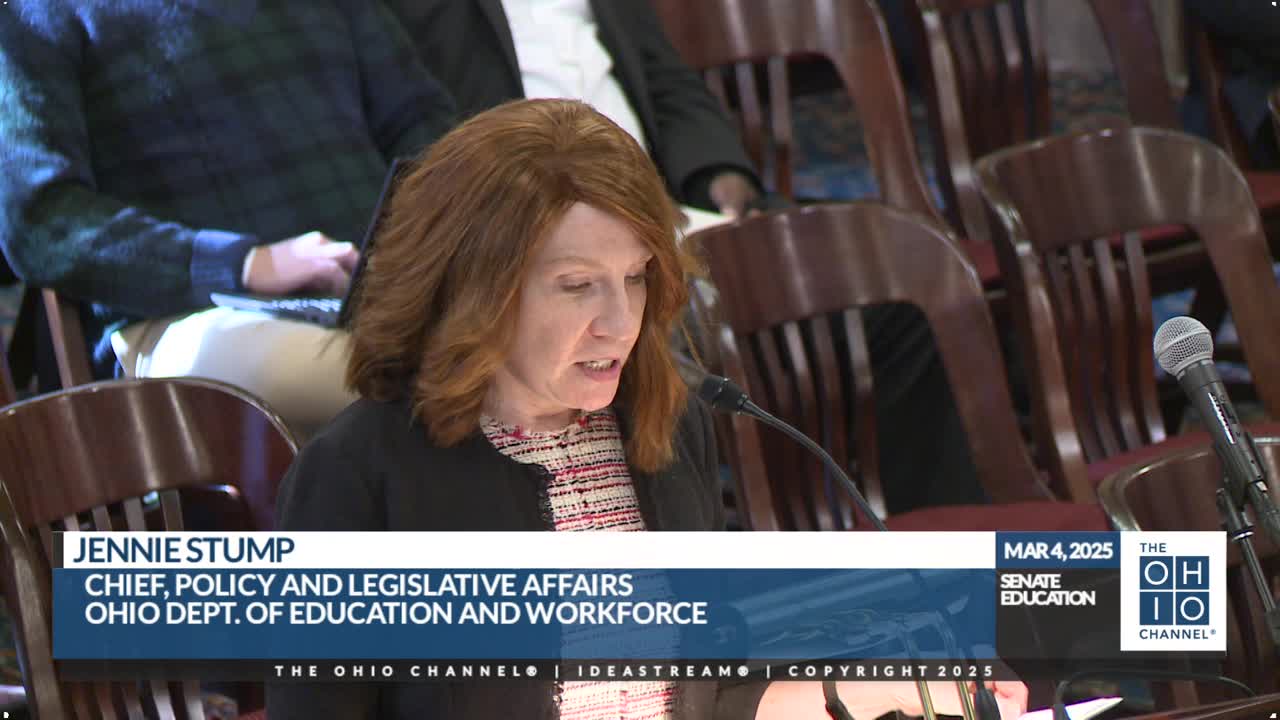
Chief of Policy and Legislative Affairs Jenny Stump briefed the Senate Education Committee on Ohio’s student-transportation law, explaining eligibility rules, the six-factor impracticality test, the payment-in-lieu process, allowable modes and the graduated penalties for noncompliance.
Jenny Stump, chief of policy and legislative affairs at the Ohio Department of Education and Workforce, gave the Senate Education Committee a detailed review of state student-transportation law, outlining who is eligible, how districts may declare transportation “impractical,” payment-in-lieu rules, allowable transportation modes and statutory penalties for noncompliance.
Stump reviewed eligibility criteria that state law sets for resident-district transportation: K–8 students who live more than two miles from school, students with physical disabilities who cannot walk to school, students whose IEPs require transportation, and open-enrollment students on parental request within resident-district boundaries. By default, responsibility rests with the resident district; community schools may assume responsibility but then must follow the same laws as districts.
Stump explained two common exceptions to required transportation. First, a district need not provide transportation if the bus-drive time between the student’s assigned public school and the actual school the student attends exceeds 30 minutes; the timing is performed during the bus’s actual route time and may be re-timed by the department at a parent or school’s request. Second, a district may declare a student “impractical to transport” after considering six statutory factors (time and distance, number of students, equipment/maintenance/personnel/administration costs, whether similar service is provided to others, unavoidable schedule disruption, and availability of other reimbursable transportation). Stump stressed that impracticality determinations must be made on an individual-student basis and ratified by the board; blanket declarations are not permitted.
If a board declares a student impractical to transport, the district must notify the parent, the student’s school of attendance and the department with detailed reasons tied to the six statutory factors, and the district must offer payment in lieu of transportation. Stump described the payment formula: the minimum for FY25 is about $584 and the maximum about $1,168; the maximum equals the district’s average cost of student transportation for the prior year and the minimum is 50% of that average. Parents may accept payment in lieu or reject it and request mediation; if mediation fails, the department conducts a Chapter 119 hearing and may order payment in lieu or require the district to provide transportation. If the department determines a district failed to provide required transportation, the district must reimburse parents up to 50% of the transportation cost as determined by the school board, capped at $2,500; the department may withhold state aid to enforce payments.
Stump also described allowable modes of transportation: standard school buses are “always permitted,” vans under nine passengers may be used in limited circumstances, and mass transit may be used where an agreement exists. She said districts must provide transportation while mediation is pending.
On penalties, Stump summarized the graduated statutory sanctions for noncompliance within a single school year: a first instance requires submission of a corrective action plan; the second, third and fourth instances require the department to withhold 25% of the district’s daily transportation payment for each day of noncompliance and disperse that money to affected students’ schools or parents; a fifth instance requires withholding 100% of the district’s daily transportation payment until the district is compliant. She noted the instance-count resets at the end of the school year; weather-related delays are excluded from noncompliance determinations.
During committee questions, senators raised operational and policy concerns. Ranking Member Ingram asked how the department assists districts with corrective action plans and the department provided recent counts of noncompliant districts: Stump said two districts were found noncompliant in the 2023–24 school year; four districts had been found noncompliant so far in the current school year. When asked for amounts withheld, Stump said that for the 2023–24 year Columbus had $9,600,000 withheld and Youngstown $1,900,000; for the current school year she reported Columbus $1,100,000, Dayton $135,000, Cincinnati $547,000, and Cleveland an amount she described verbally (committee asked for the written figures and the department agreed to provide them).
Committee members asked whether combinations of modes (for example, a yellow bus plus mass transit) are permitted; Stump confirmed combinations are allowed and that parents may file complaints with the department if a routing forces excessive transfers or otherwise appears inconsistent with statutory requirements. Several senators urged the department and the committee to consider regional pilots, scheduling coordination and other systemwide reviews to address recurring urban transportation challenges tied to school choice and bell-time mismatches.
Stump recommended continued technical assistance and a broader, regional review of the transportation system, given the diversity of Ohio’s regions and the expansion of school-choice options since the last formal statewide review.