Get Full Government Meeting Transcripts, Videos, & Alerts Forever!
Get email alerts on the Education Agency Update topic
No spam. Unsubscribe anytime.
Ohio Department of Education and Workforce outlines priorities: literacy, learning acceleration, workforce readiness and student wellness
Summary
Director Steve Dakin told the Senate Education Committee the Department of Education and Workforce is focusing on four policy priorities and implementing the science of reading statewide, expanding tutoring and career-technical grants, and supporting school-based health centers while pursuing operational efficiencies ahead of the budget season.
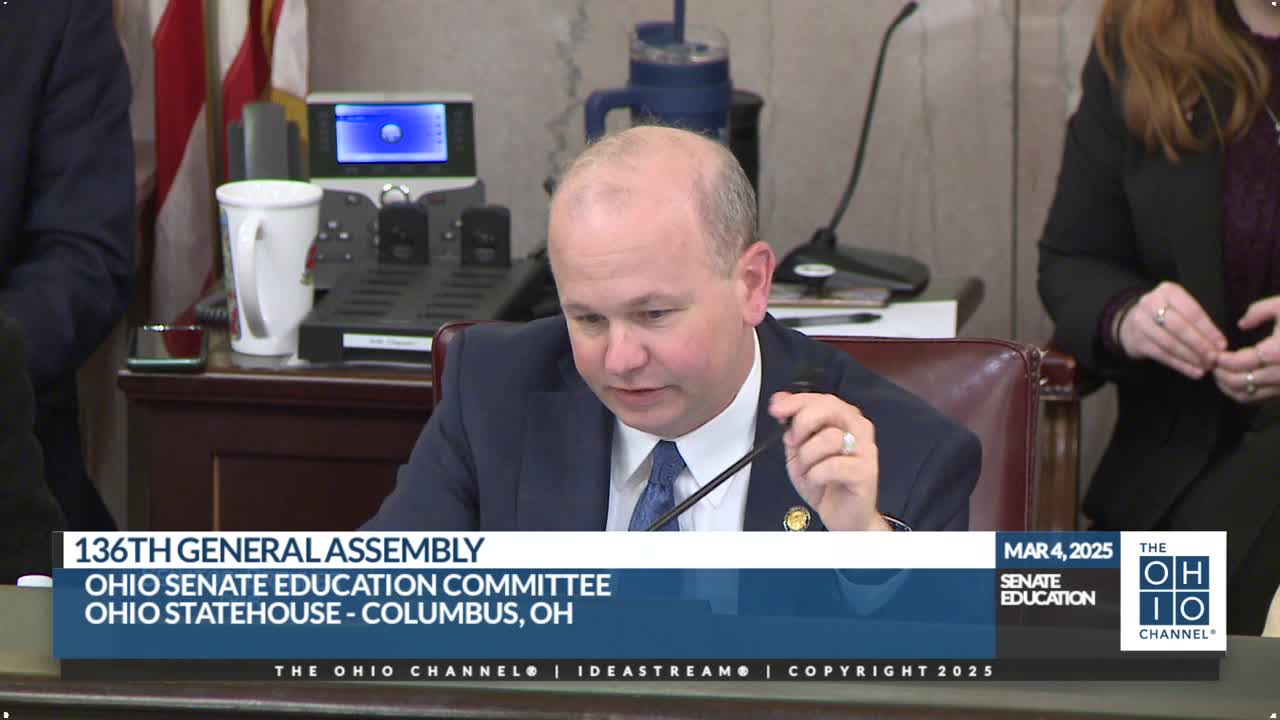
Director Steve Dakin of the Ohio Department of Education and Workforce told the Senate Education Committee on an agency update that the department is centering its work on four priorities: “literacy, learning acceleration, workforce readiness, and student wellness.”
Dakin said the 2025–26 school year marks the first year Ohio will fully implement the science of reading and that the department is reviewing core curricula and evidence-based intervention programs, with updated approved-materials lists to be published this spring. “It is imperative that the science of reading is implemented with fidelity,” he said, and noted that “over 71,000 teachers and administrators have completed the department's training in the science of reading.”
The department described Read Ohio literacy coaches as a key support; Dakin said the number of Read Ohio coaches “nearly tripled” from FY24 to FY25 and that twice as many schools and districts are using their training. The agency also said it has directed federal ESSER funds toward high-dosage tutoring, math supports and workforce connections. As of December 2024, the department reported that about 560,000 students in grades K–8 and roughly 25,000 educators across 1,585 schools have access to Zearn Math.
On career and technical education, Dakin said the state awarded $300,000,000 in construction and equipment grants to support career-technical programs; the department estimated that about 16,500 additional students will gain access to career-technical education as a result. Dakin said Deputy Director Jeremy Varner’s team has held career-pathway workshops to help districts and local partners develop region-specific pathways and expand college and workforce opportunities.
Student wellness was emphasized as a continued priority. Dakin noted the department’s school-based health center toolkit and said there are currently 135 school-based health centers in Ohio. He said the agency is working to implement recommendations from the Ohio School-Based Safety Working Group and the Ohio Attendance Task Force.
On operations, Dakin said the agency is using the state’s e-performance system to align staff evaluations with departmental priorities and that the department is undergoing an annual performance audit to identify efficiency opportunities. He added the department has seen a decrease in both part-time and full-time employees since his appointment and told the committee he plans to return in a few weeks to discuss the budget.
Committee members asked about the integration of the former Department of Education with workforce functions. Dakin praised the transition leadership and said the consolidation allows the agency to concentrate on a few “goals and do them better,” including the literacy initiative. He told the committee the agency will provide follow-up data when requested.
The presentation concluded with committee members expressing interest in further data and follow-up on several points, including the department’s workforce-readiness metrics and more-detailed staffing and program cost information ahead of budget hearings.