Get Full Government Meeting Transcripts, Videos, & Alerts Forever!
Get email alerts on the Hemp Policy And Processing topic
No spam. Unsubscribe anytime.
Lawmakers hear hemp industry briefing: standards, costs, remediation and processing needs
Summary
The House Agriculture Affairs Committee received an informational briefing on Idaho's industrial hemp program from Idaho Farm Bureau, ISDA, growers and processors. Speakers highlighted Idaho's stricter THC standards (0.3%), high program fees, remediation challenges for fiber growers, and the need to support processing infrastructure and research.
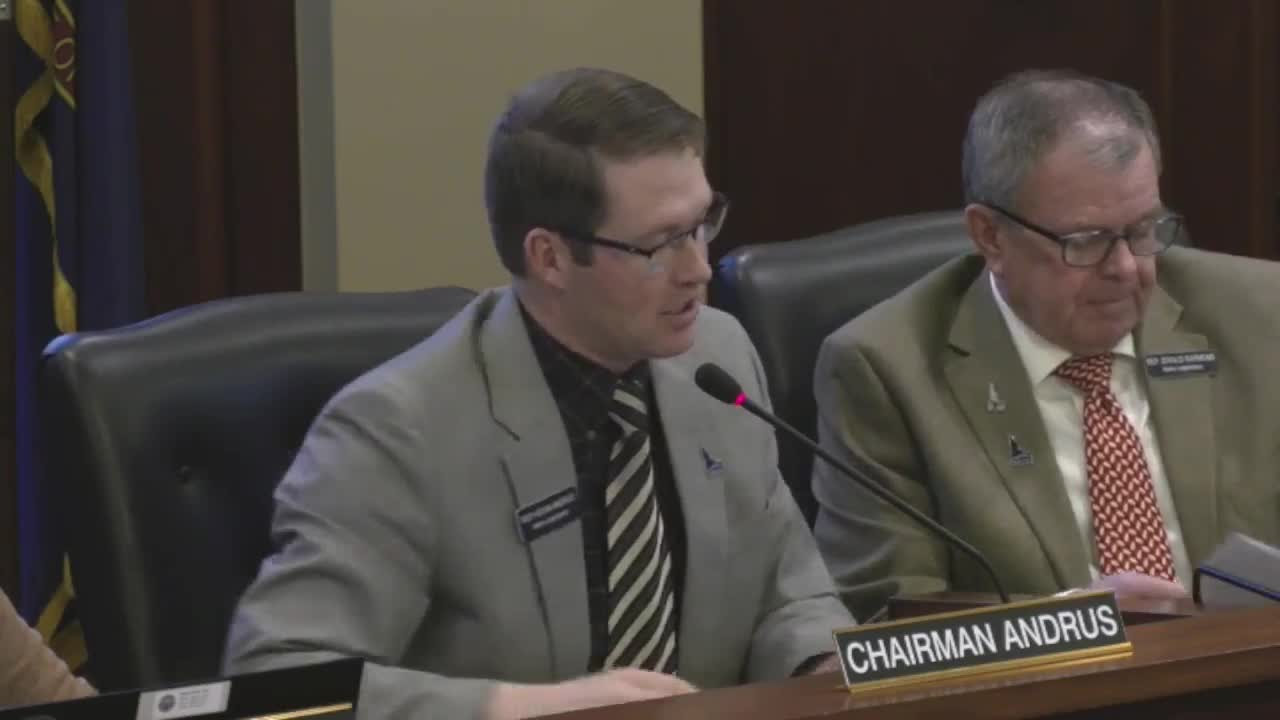
The House Agriculture Affairs Committee heard an informational update on industrial hemp from the Idaho Farm Bureau Federation, the Idaho State Department of Agriculture and industry participants, who outlined regulatory requirements, production experience and market prospects.
"House Bill 126 legalized the production, processing, research, and transportation of industrial hemp in the state of Idaho," said Rayne Jensen of the Idaho Farm Bureau Federation, explaining the program's origin and that the presentation was for information only. Chanel Tewalt, director of the Idaho State Department of Agriculture, said Idaho's program follows the 2018 federal farm bill but is stricter in key respects: "Idaho is much more stringent than the federal standard, even in the Farm Bill," she said, and noted Idaho's on-farm THC limit is 0.3 percent compared with the federal 1 percent threshold for enforcement.
Tewalt described the program's requirements and costs. Licensing requires background checks and fingerprinting consistent with USDA expectations; the state administers the licensing and testing. She said the program is expensive to run because of frequent on-farm inspections and a relatively small number of licensees, and that fees were set in rule during negotiated rulemaking. Under Idaho rules, hemp must test at or below 0.3 percent THC on the farm; after processing, products that leave a licensed handler must test at 0 percent THC or below the laboratory's level of quantification, the director said.
Producers and processors described on-the-ground challenges and opportunities. Tristan Sponseller of Idaho Hemp Processing said nearly 90 percent of the roughly 1,800 acres grown in Idaho in 2024 was for fiber and that his Rexburg-area facility processed most of that fiber. "We are really excited to be processing here in Idaho," Sponseller said. He and others asked for adjustments to rules and protocols that are calibrated toward CBD production, not fiber and grain, and urged steps to allow processors to remediate hot crops under tracked conditions. Sponseller described remediation by removing flowering tops or other separation techniques and said some remediation options (for example, shredding) currently must be done in the field rather than at a processing facility, which limits options for economic recovery of fiber.
Matthew Mead, founder of Hempitecture in Jerome, described market demand for hemp-based building products and provided production and employment figures: Hempitecture purchased nearly 1 million pounds of hemp fiber in 2024, about 42 percent sourced from Idaho, and operates a Jerome plant with 10 full-time manufacturing jobs, expanding to 15 in 2025. Mead said his company’s bat insulation has an R-value of about 3.69 per inch and that products are currently 10–20 percent more costly than mineral fiber and 30–40 percent more than fiberglass but that scale and processing capacity could reduce costs.
Farmers described practical experience with the crop. Travis McAfee, a producer in the Little Lost River area, described growing fiber hemp on small, remote farms where lower water demand and rotational benefits make hemp attractive. He explained harvest and retting (drying) practices, bale sizes and payment by weight. Tim Korney of Thousand Springs Mill noted hemp grain is a protein-dense food product and described dual-purpose grain/fiber varieties and early-stage local milling and processing efforts.
Speakers sought policy changes to support farming and processing infrastructure: aligning remediation and enforcement thresholds to reflect fiber/grain cultivars (some urged following USDA's 1 percent negligence threshold for enforcement), adjusting application timing to reflect contract schedules, and sustaining research funding (speakers said Idaho Global Entrepreneurial Mission support for research had been cut in late 2024). Director Tewalt noted remediation, sampling and laboratory protocols live in administrative rule and USDA-required protocols and must be performed on the property under current federal/state agreements.
The committee did not take formal action; presenters and legislators indicated interest in further work and potential legislation to fine-tune licensing, testing and remediation rules for fiber and grain hemp.