Get Full Government Meeting Transcripts, Videos, & Alerts Forever!
Get email alerts on the Personnel Health Insurance topic
No spam. Unsubscribe anytime.
Committee approves higher per‑employee health insurance funding at $14,130 per FTE
Summary
On Jan. 31 the Joint Finance‑Appropriations Committee adopted a $14,130 per‑full‑time‑equivalent funding level for state employee health insurance, after debating three funding options and reserve projections.
Boise — The Joint Finance‑Appropriations Committee voted Jan. 31 to increase the state appropriation for employee health insurance to $14,130 per eligible full‑time equivalent (FTE) for fiscal year 2026, adopting the committee compromise motion after debate over reserve balances and actuarial assumptions.
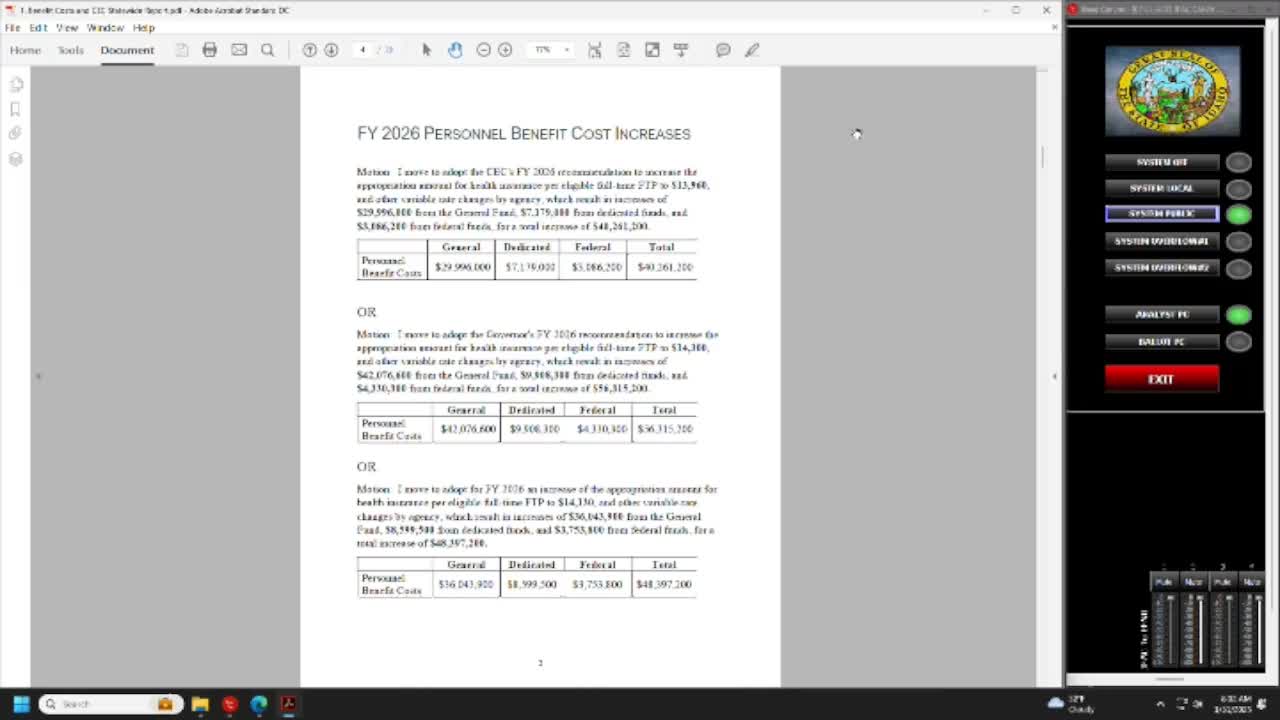
Committee members discussed three funding options presented by staff: the CEC committee recommendation at $13,960 per FTE, the governor’s recommendation at $14,300 per FTE and a midpoint compromise at $14,130 per FTE. Committee analyst Mr. Bybee described the motions, and Senator Woodward moved the $14,130 motion, which was seconded by Representative Tanner and carried by the joint committee.
The vote carried with a majority in both bodies: the committee reported 17 ayes, 0 nays and 3 absent/excused on the joint tally. Committee staff said the governor’s $14,300 option would leave a projected reserve balance of about $61.4 million at the end of fiscal 2026; the $13,960 option projects roughly $51.6 million. The midpoint figure’s ending reserve was not calculated in the oral record.
During debate, some members questioned the actuary projections and reserve sizing. Representative Furness repeatedly urged a lower funding figure, citing historical reserve balances and arguing that prior plan changes had reduced costs; he said Milliman’s projections have been conservative in the past. Senator Ward Engelking and others urged the committee to reflect actual insurance costs rather than using reserves to smooth premiums.
Mr. Bybee and members also noted the motion includes other employer‑paid personnel cost adjustments, such as workers’ compensation and Social Security changes that vary by agency. The committee approved the motion “with a due pass recommendation,” and staff said the committee will move on to other agenda items, including Change‑in‑Employee‑Compensation (CEC) proposals, later in the hearing schedule.
The committee’s action sets the statewide appropriation level for health insurance premiums used in agency budgets and in the calculation of employer costs for the 2026 fiscal year, and staff provided projected reserve levels tied to the three options on the table.