Get Full Government Meeting Transcripts, Videos, & Alerts Forever!
Get email alerts on the Corrections Security Transport topic
No spam. Unsubscribe anytime.
Idaho DOC seeks funds for contraband tech, transport expansion after staff shooting
Summary
Following a spring ambush that injured three Idaho Department of Correction staff, the agency asked the Joint Finance Preparations Committee for ongoing funds to install mail scanning, drone detection and phone-transcription technology, expand its transport bureau and pilot body-worn cameras.
The Idaho Department of Correction asked a legislative budget committee on Feb. 4 for funding to harden prisons and improve transport safety after an incident last spring in which three DOC staff were shot while escorting an inmate to and from a hospital.
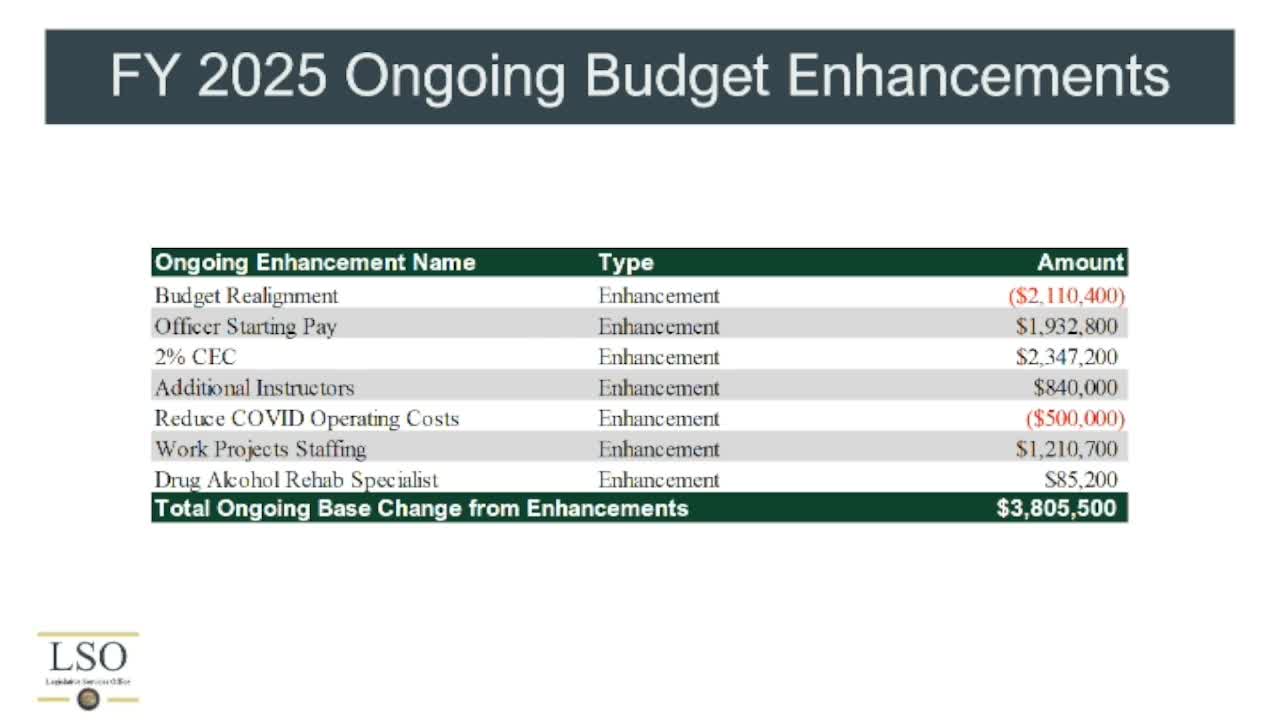
The requests include $2.4 million annually to operate a package of technologies — digital mail scanning, drone detection and phone-call transcription and analysis — and a supplemental $1.15 million to expand the agency’s transport bureau, adding 12 full-time positions and seven vehicles. The department also requested federal grant funding to pilot body-worn cameras at three sites and a smaller ongoing appropriation to cover future state matching costs.
Why it matters: Director Josh Tewalt and agency analysts told the Joint Finance Preparations Committee these steps respond to “vulnerabilities” revealed by the hospital transport shooting and to growing sophistication in how contraband arrives in facilities, including drones and chemically altered printed material. The committee’s budget analyst, Noah Peterson with the Legislative Services Office, said the items are intended “so as to not allow them to happen again.”
What the package covers: Peterson told the committee the combined ongoing price tag for the surveillance technologies would be about $2.397 million per year, broken out as roughly $1.01 million for digital mail scanning, $385,500 for drone detection and $1 million for the LEO phone-transcription/analysis tool. The DOC’s fiscal summary said the digital mail scanning would route incoming mail to an off-site facility for scanning and delivery in digital form to residents; the package also funds a stand-alone illicit-substance testing unit.
On transport: The supplemental to expand the transport bureau would fund 12 positions and specialized vehicles equipped for secure medical transports; the agency described the new bureau as trained and equipped to handle high-risk emergency transports that currently rely on facility staff detailed away from posts. Director Tewalt said the state’s previous strategy relied on drawing already-assigned facility staff into emergency transports, creating large overtime and post-coverage impacts. He told lawmakers the department recorded roughly 20,000 overtime hours at one maximum-security facility and 14,000 hours at another as a result of transport-related demands.
Body-worn cameras: The DOC asked for an initial federal grant to buy cameras, docking stations and evidence storage for a pilot at Idaho Maximum Security Institution, District 3 probation and parole, and the agency’s special investigations unit. The agency said federal funds would cover most startup costs, with a state match falling into the 2026-27 budget window; the committee packet showed the ongoing state license costs would be about $505,000 in the out years unless covered by further federal support.
Governor’s recommendation and an equipment alternative: The governor recommended most items as requested, but suggested contracting winter snow removal at St. Anthony’s work camp rather than buying a skid-steer loader (the governor recommended a $30,000 ongoing contract instead of the agency’s $83,200 one-time purchase). Department of Administration staff told the committee they preferred contracting to owning a seasonal machine that could sit idle much of the year.
Agency view: Tewalt told the committee contraband threats have “a level of sophistication ... unlike anything any of us in the field have ever seen,” including autonomous drones and exotic methods to embed substances in printed materials. He described mail scanning as a way to “plug” a porous entry point and said drone detection would allow the DOC to notify law enforcement and try to intercept contraband deliveries. He called the phone-transcription capability potentially “revolutionary,” arguing it could surface intelligence useful to state and federal law enforcement beyond facility safety.
Next steps: The committee did not take a formal vote during the hearing. The requests will be considered as parts of the department’s supplemental and budget-year requests in the Joint Finance process.