Get Full Government Meeting Transcripts, Videos, & Alerts Forever!
Get email alerts on the Program Maintenance Budgets topic
No spam. Unsubscribe anytime.
JFAC staff outlines program-maintenance bill structure; flags sales-tax distributions, Techum earmark and revenue volatility
Summary
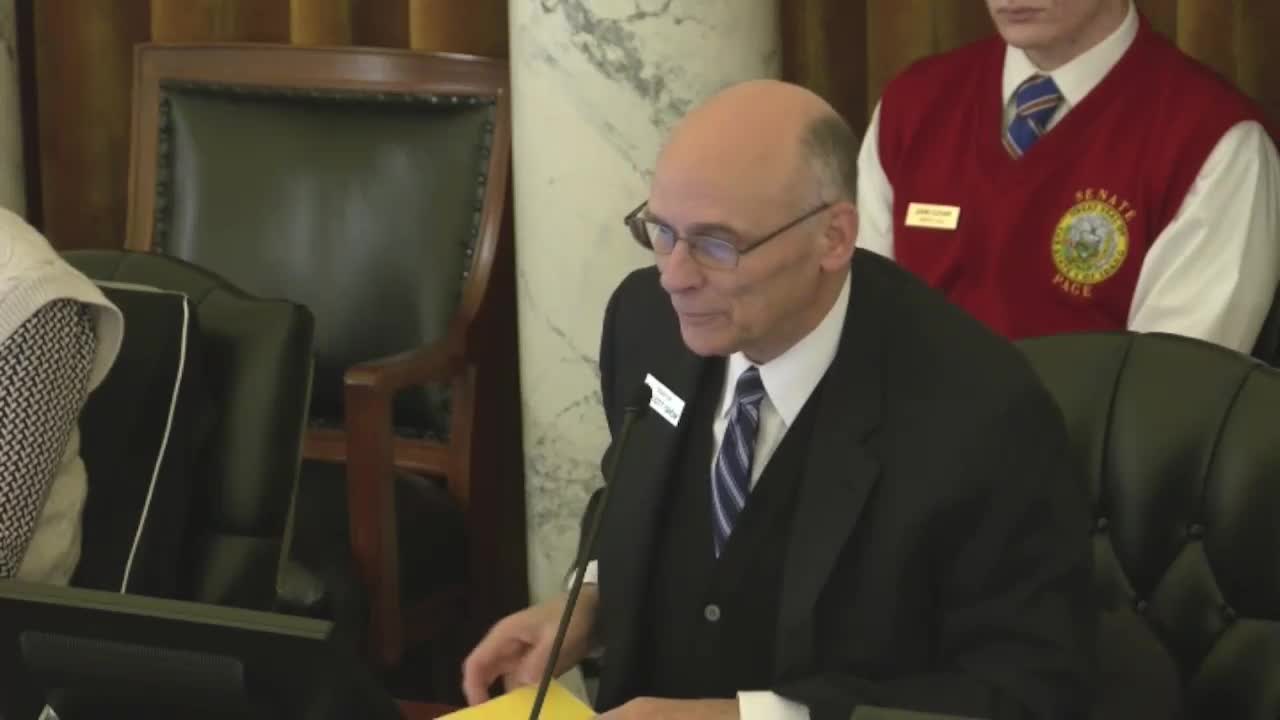
Keith Bybee, Division Manager of Budget Policy Analysis, briefed JFAC on the program maintenance bill structure, schedule and how statutory sales-tax distributions and earmarks reduce the portion of sales tax available to the general fund.
Keith Bybee, Division Manager of Budget Policy Analysis, briefed the Joint Finance-Appropriations Committee on the structure, contents and schedule for the program maintenance appropriations bills and explained how statutory sales-tax distributions affect the general fund.
Bybee said the program maintenance bills are organized into 10 functional areas of state government and include adjustments such as benefit-cost changes (including items from the CEC recommendation), contract inflation, statewide cost allocation and CEC items. He explained that enhancements (the separate bills) will contain replacement items, population-forecast adjustments (formerly labelled nondiscretionary), and new or expanded requests.
"The maintenance budgets will include beginning with the base budget's building blocks'so that's Benchmark Number 4, and everything in between Benchmark 4 and Benchmark 5," Bybee said, describing the mechanics of how the maintenance bills are built. He noted that replacement items are being presented separately for general replacements and for IT replacements so the committee can review IT replacement needs (including cybersecurity) with more visibility.
Bybee walked members through a sample calculation and said, as an illustrative figure, "you would see a total of 10 appropriations bills equaling 12,859,224,200" for a program-maintenance scenario that mirrors the governor's plan. He emphasized committee schedule items: an initial hearing on adjustments and statewide impact the following Wednesday and decision-making over program maintenance on Friday.
On sales tax distribution, Bybee reviewed statutory flows that remove a portion of gross sales-tax collections before they reach the general fund. He noted gross sales tax is projected to grow (roughly $3.1 billion in 2024 to about $3.37 billion in 2025 in the legislative book), but the share available to the general fund has fallen because of statutory distributions to revenue sharing (11.5% of net collections), the Techum program (described in statute as 4.5% of net collections with $80 million earmarked for bonding), the Tax Relief Fund, school modernization and other earmarks. The legislative budget book cites statute 63-36 for the current sales-tax distribution formula.
Bybee cautioned against assuming all sales-tax growth is available for general-fund appropriation: "sales tax is your most stable, least volatile revenue source," he said, "but the scary thing for me...is how committed we are on the sales tax and our inability to rely on that as a growing fund source." Several legislators noted that as more sales-tax revenue is earmarked by statute, less remains available for JFAC appropriation and that could amplify cuts during a downturn.
Committee members asked about the proposed Techum increase under discussion in other parts of the legislature. Bybee said the current statute earmarks $80 million of the Techum share for bonding and that proposals to add an additional $50 million would either be carved from the existing distribution or would reduce amounts otherwise available to the general fund.
Why it matters: How the legislature classifies maintenance versus enhancement items will shape the pace and focus of budget hearings; statutory earmarks and distributions reduce the share of sales tax that enters the general fund and therefore affect the pool of dollars JFAC may appropriate.
The presentation concluded with staff handing out the general fund daily update and scheduling reminders for upcoming hearings and decision sessions.