Get Full Government Meeting Transcripts, Videos, & Alerts Forever!
Get email alerts on the Indirect Support Services topic
No spam. Unsubscribe anytime.
Health and Welfare asks for fleet, IT and MMIS funding; director warns of high contractor costs for licensing work
Summary
The Department of Health and Welfare requested one-time replacement items including 60 vehicles and IT hardware during the indirect support services budget hearing; the director said hiring staff is cheaper than contract labor for regulatory work and outlined progress on MMIS IT positions.
During the Jan. 13 hearing the Department of Health and Welfare presented the division-level budget for Indirect Support Services, describing one-time replacement requests and information technology items and answering committee questions about the state vehicle fleet and information‑system staffing.
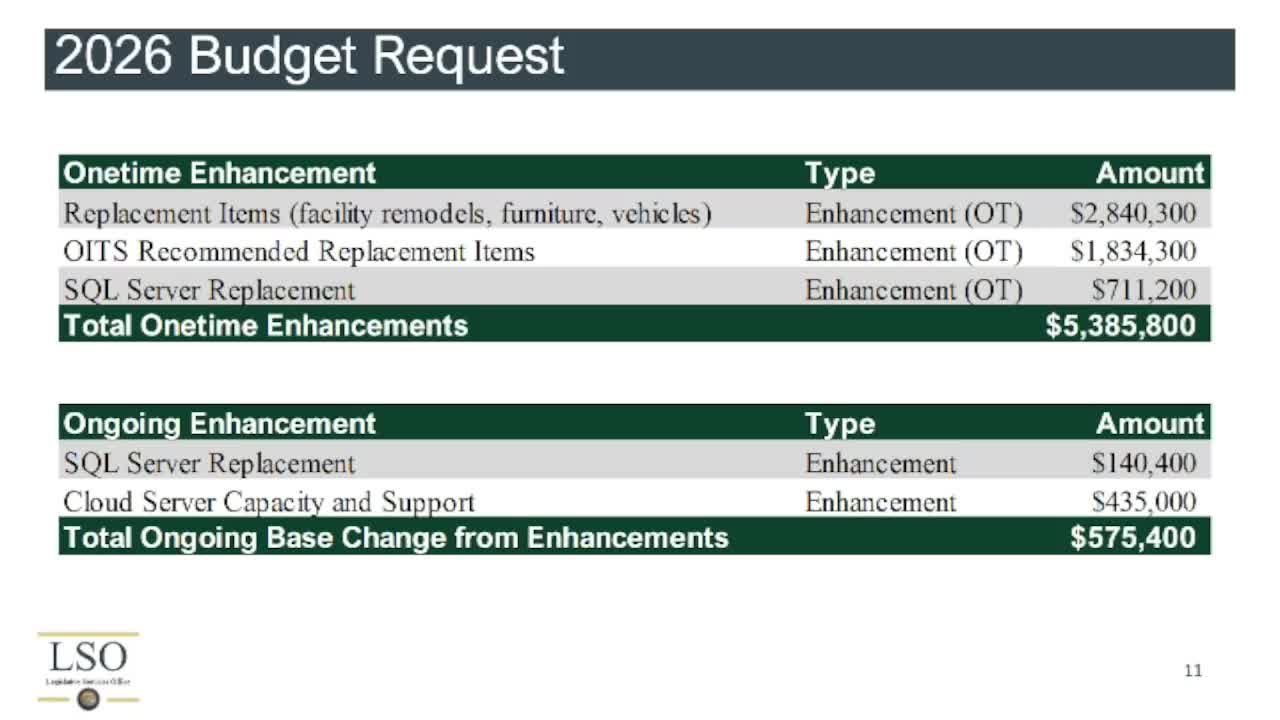
Legislative Services analyst Alex Williamson told the committee the division spent about $40.2 million in fiscal 2024 and that indirect support services is personnel- and operations‑heavy. For fiscal 2026 the department requested one-time replacement items totaling about $2.8 million: visitation‑room improvements ($384,000), office remodels and furniture (about $648,000) and $1.8 million to replace 60 vehicles. The Office of Information Technology Services separately requested about $1.8 million in hardware replacements, including funds to upgrade SQL Server; an ongoing $140,000 request was described as software-assurance services tied to that upgrade. The governor recommended the requests except for a line for cloud server capacity and support, which the department said it no longer needs.
Director Alex Adams told the committee the agency maintains roughly 435 state vehicles statewide, with about two-thirds used in child‑welfare work (transporting children to visitations, court, and appointments). Adams said the department intends to return the fleet to a seven‑year replacement schedule; the vehicles targeted for replacement have odometer readings of roughly 105,000 to 159,000 miles.
Adams emphasized the larger operating context for the IT requests: the Medicaid Management Information System (MMIS) modernization is a multi‑year, multi‑million‑dollar effort. The department has budgeted and posted IT positions to support MMIS and expects hires to be in place soon, with a February target for some roles. Adams also warned that contracting for licensing and inspection work is substantially more expensive than hiring staff: licensing contractors have cost roughly $90–$95 an hour, whereas a state employee doing the same work costs roughly $35 an hour. The division's turnover rate has improved, Adams said, dropping from about 21% in previous years to 7% most recently.
Committee members asked for more detail on the fleet (miles, replacement schedule and resale proceeds) and for a breakdown of specific vehicles in the request; staff said they would work with the agency to provide that information in follow-up materials and in division-level hearings scheduled later in the session.