Get Full Government Meeting Transcripts, Videos, & Alerts Forever!
Get email alerts on the Energy Policy topic
No spam. Unsubscribe anytime.
Office of Energy and Mineral Resources outlines federal grants, seeks $24.5 million to run home-efficiency rebates and proposes 'Speed Council'
Summary
Agency officials told JFAC about growth in federal grant activity, a $24.5 million federal appropriation request to administer home energy rebates, and a governor-backed Speed Council initiative to streamline permitting for large projects.
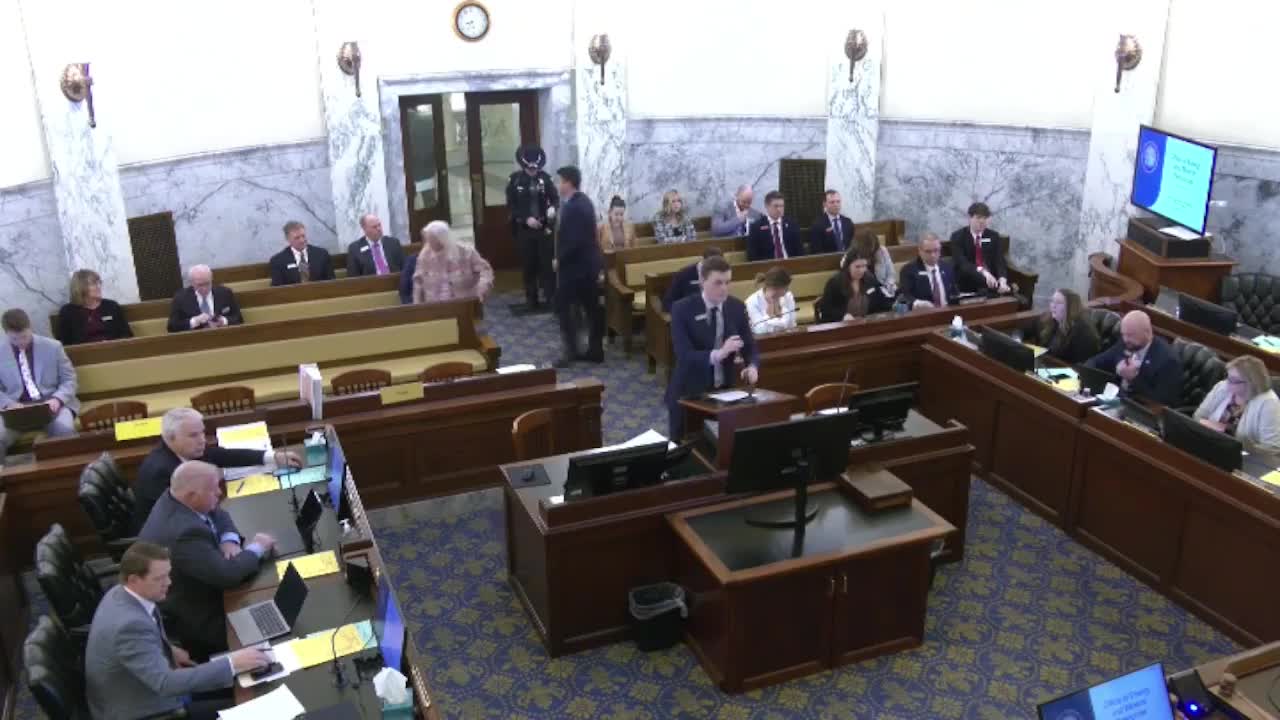
The Governor's Office of Energy and Mineral Resources (OEMR) presented a briefing to the Joint Finance-Appropriations Committee detailing recent federal grant activity, a multi-million-dollar federal request to administer home-efficiency rebates, and a governor-proposed interagency Speed Council to speed permitting for large projects.
Kellen McGurkin, budget and policy analyst with the Legislative Services Office, summarized the office's funding history and recent federal awards. He said OEMR's appropriations have grown as the office took on administration of federal energy grants, including a one-time $15 million transfer in FY2022 to match federal energy-resiliency grants and additional federal appropriations in FY2024 and FY2025 to administer rounds of competitive grants. McGurkin called attention to the Renewable Energy Resources Fund (state dedicated fund for revenues from federal geothermal, wind and solar leases and royalties) and said the agency plans to increase receipts if Senate Bill 1020 (as described) is enacted to deposit additional federal license revenues into that fund.
McGurkin described the agency's FY2026 request for an ongoing federal appropriation of $24,500,000 to administer a Home Energy Rebates program, broken down as $20,000,000 for rebates (trustee and benefit payments), $4,000,000 for operational costs (procurement and third‑party implementation, including software and eligibility verification), and $502,000 for personnel costs to add four limited-service FTPs to administer the program. He said the agency would use a competitive procurement for a third‑party implementer and that the federal rules allow up to 20% of the federal award to be used for administration.
McGurkin also described the governor's Speed Council initiative that would be housed partially in OEMR and funded in the governor's recommendation with $311,000 ongoing from the general fund and $170,000 one-time for initial development of a public project-tracking dashboard. The recommendation would fund a new management-assistant position and part of the administrator's salary to coordinate council activities across agencies, streamline permitting, and improve transparency for large-scale infrastructure and energy projects.
Administrator Richard Stover told the committee OEMR has increased engagement with proponents, federal agencies and local governments and that the Speed Council's objectives are transparency, accountability and recommending permitting reforms. Stover said Idaho should prepare for rapid energy demand growth and expanded development of critical minerals and energy projects, and he described current work on an advanced nuclear strategic framework in coordination with Idaho National Laboratory and other stakeholders.
Members questioned administrative-cost assumptions and program design. Senator Cook and others noted the home-efficiency request allocates 20% to administration (the agency said federal rules permit up to 20% and the amount would largely be used to procure and pay a third-party implementer). Senator Cook also asked whether the four limited-service FTPs would persist after grant funds end; McGurkin and Stover confirmed the positions are expected to be limited-service and removed when federal funding ends.
Stover described energy demand projections: he told the committee Idaho could need 30–50% more generation over 10–20 years, that the Northwest has roughly 11,000 megawatts of capacity and may need 8,000 more megawatts in the coming decade, and noted a single nuclear unit can be about 1,100 megawatts. He also discussed spent-fuel recycling research at Idaho National Laboratory and said the state is exploring advanced nuclear as part of a diverse energy portfolio.
No formal committee votes on OEMR budget items were recorded in the transcript.